
The Three Water Categories Under IICRC S500
The IICRC S500 standard, now in its 5th edition (2021), sorts water damage into three categories based on contamination, not appearance.
- Category 1 comes from a sanitary source and does not pose a substantial risk on contact: a broken supply line, a tub overflow with clean water, melting snow, falling rain.
- Category 2 carries significant contamination that could cause discomfort or sickness: washing machine or dishwasher discharge, a toilet overflow on the room side of the trap with urine but no feces, and seepage from hydrostatic pressure.
- Category 3 is "grossly contaminated and can contain pathogenic, toxigenic or other harmful agents." That includes sewage, backflow from beyond a toilet or drain trap, seawater flooding, and rising water from rivers or streams.
In February 2026 the IICRC issued a position statement clarifying that weather-related water, such as wind-driven rain, is not automatically Category 3. The word "can" in the definition describes a possibility; the category is set when an inspection finds a grossly contaminated condition.
Sewage vs Groundwater: The Utah County Question
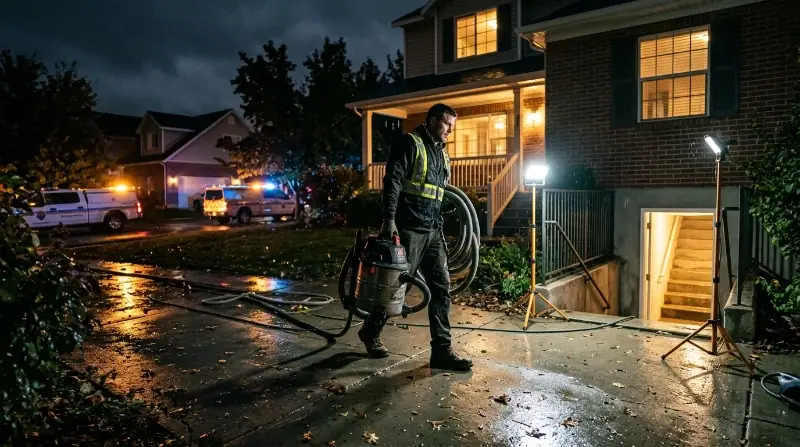
This is where Utah County basements get misjudged in both directions. A floor drain backing up with sewage from a failed lateral or a surcharged main is Category 3 every time. Water coming up through a slab or foundation crack because the water table rose is different. Under S500, seepage from hydrostatic pressure is listed as Category 2, and the 2015 revision dropped the old "ground surface water" wording from Category 3.
Utah County has both problems. Neighborhoods near Utah Lake and along the river corridors can see spring groundwater rise, while older laterals across the county fail and push sewage up the lowest drain. Sometimes both happen at once: high groundwater infiltrates cracked sewer pipe, the line surcharges, and what comes up the drain is a mix. Mixed water is treated as Category 3.
The practical answer is to identify the source before deciding the scope. Water rising evenly through a slab with no odor and dry floor drains points to seepage. Water coming out of a floor drain or toilet, especially with debris or odor, points to sewage. When in doubt, the safe assumption is Category 3 until the source is confirmed.
How Category 2 Water Becomes Category 3
Category is not fixed. S500 says time and temperature can change the quality of water, so a category set on day one can change during the job. Clean water that soaks into carpet, dust, and wall cavities picks up contamination from what it touches. The standard does not give a fixed hour count, but institutional guidelines based on it, such as Northern Arizona University's, treat untreated Category 2 water left more than 48 hours as potentially Category 3.
Utah's climate cuts both ways. Basements stay cool most of the year, which slows bacterial growth, but they also dry slowly, and the EPA advises drying water-damaged areas within 24–48 hours to prevent mold. A seepage event left alone for a long weekend in a warm, finished basement can need the same tear-out as a sewage event.
What Category 3 Water Damage Means for Your Materials
Once a space is Category 3, the rule for porous materials is removal, not drying. Northern Arizona University's S500-based guideline states that carpet wet with Category 3 water must be removed, with "drying is not an option at any point in time," and that wet insulation cannot be dried and reused. The CDC's flood guidance says to discard drywall and insulation contaminated with sewage.
| Material | Category 3 handling |
|---|---|
| Carpet and pad | Removed and disposed |
| Drywall and insulation that wicked water | Cut above the wet line and removed |
| Upholstered furniture, mattresses | Usually discarded |
| Particleboard cabinets and baseboard | Usually removed |
| Concrete, tile, metal | Cleaned, disinfected, and dried in place |
This is why the same 400 square feet can be a $2,000 job as Category 2 and a much larger one as Category 3. It is also why a contractor who offers to "dry the carpet" after a sewage backup is not following the standard. Our sewage decontamination page covers what happens after removal.
Classes 1–4: How Wet, Not How Dirty
Category answers "how contaminated." Class answers "how much water is in the structure," which sets drying equipment and time. Class 1 means a small area of wet porous material. Class 2 and Class 3 cover progressively more of the floor, walls, and ceiling. Class 4 means water bound deep in dense materials such as hardwood, plaster, brick, or concrete, which need specialty drying. A finished basement after a backup is often Category 3 and Class 2 or 3; a concrete block wall that soaked for days can push part of the job to Class 4.
Why the Category Decides Which Insurance Applies
Insurers care about the source as much as the restorer does. A sewer backup is excluded from a standard HO-3 policy and covered only by a water backup endorsement. Flood from a river or stream falls under flood insurance; the Utah Insurance Department notes that the NFIP covers a sewer backup only when an active surface flood directly caused it, and that flood policies usually have a 30-day waiting period. Seepage through a foundation without a general flood is typically covered by neither.
That is why our first-day report records the source, the category, and the evidence behind it, with photos. If an adjuster reads "groundwater" when it was a sewer backup, or the reverse, the claim can go to the wrong policy. In 2021 Fox13 reported a Utah homeowner whose sewer backup claim was denied because floodwater caused it, which shows how much the source matters.
Where Category 3 Water Comes From in a Utah Home
Most Category 3 water in Utah County homes comes from the sanitary sewer. Wastewater flows by gravity from the house through the lateral to a city main and on to a treatment plant. When the main surcharges or the lateral clogs, that sewage comes back up the lowest drain. On properties without city sewer, such as Goshen, the same contamination comes from a backed-up septic tank.
Storm drains are a separate system in Utah cities. Surface runoff through a window well usually starts as Category 2, though it can worsen as it sits and picks up contaminants. Utah County does not have combined sewers that mix storm water with sewage, so a storm backup through a floor drain usually points to sewer surcharge, often from storm water getting into the sanitary system where it does not belong.
Knowing the source changes who pays. The owner usually owns the lateral; the city owns the main; a renter's policy covers a tenant's belongings. Before cleanup, stop water use, keep everyone out, and skip bleach and shop vacs. City-by-city details are on the Utah County overview, and our sewer backup cleanup crew identifies the category on arrival.
Category 3 Water Damage: Common Questions
Is groundwater in my basement Category 3?
Not automatically. Seepage from hydrostatic pressure is listed as Category 2 under IICRC S500. It becomes Category 3 if it mixes with sewage or river floodwater, or sits long enough to become grossly contaminated.
Can Category 3 carpet be cleaned and kept?
No. Carpet and pad wet with Category 3 water are removed and replaced. Drying in place is not an option under S500-based guidelines.
How fast does clean water turn into Category 3?
S500 sets no fixed hour count; time and temperature drive it. Some institutional guidelines treat untreated Category 2 water left over 48 hours as potentially Category 3.
Does flood insurance cover a sewer backup?
Only when an active surface flood directly caused the backup, according to the Utah Insurance Department. Ordinary backups need a water backup endorsement on your homeowners policy.
Who decides the category of my water damage?
The restorer determines it at inspection based on the source and condition, and documents it for the adjuster. Category can be updated if new evidence appears.
Get the Category Right on Day One
We identify the source before extraction, record the category with photos, and write the scope to match. If you are not sure whether your water is sewage or groundwater, call (877) 394-0234 and describe where it is coming from. For Provo-specific detail on pathogens and removal, see What Is Category 3 Black Water?
- IICRC — Weather-Related Water Position Statement (2026)
- Cleanfax — S500-2015 Key Terms
- Northern Arizona University — Water Damage Guideline
- EPA — A Brief Guide to Mold, Moisture and Your Home
- Utah Insurance Department — Flood FAQ
- FEMA FloodSmart — What Flood Insurance Covers
- Fox13 — Utahns will have to pay for flood cleanup (2021)