Containment-First: Why the Order of Operations Matters
Most homeowners assume sewage extraction starts with the extraction equipment. IICRC S500 requires the opposite: containment is established before any equipment runs. The reason is bioaerosols — Category 3 sewage water releases microscopic pathogen-carrying particles into the air when disturbed by extraction equipment. Without containment barriers and negative air pressure, those particles spread to every unaffected room through existing air movement. Extraction is the first hands-on stage of any Provo sewer backup cleanup; decontamination and drying follow it.
Common Non-IICRC Practice to Avoid: Contractors who run extraction equipment before establishing containment are spreading E. coli and Norovirus particles to your kitchen, bedrooms, and HVAC system. If a contractor arrives and immediately starts wet-vaccing without setting up barriers, stop them and call us.
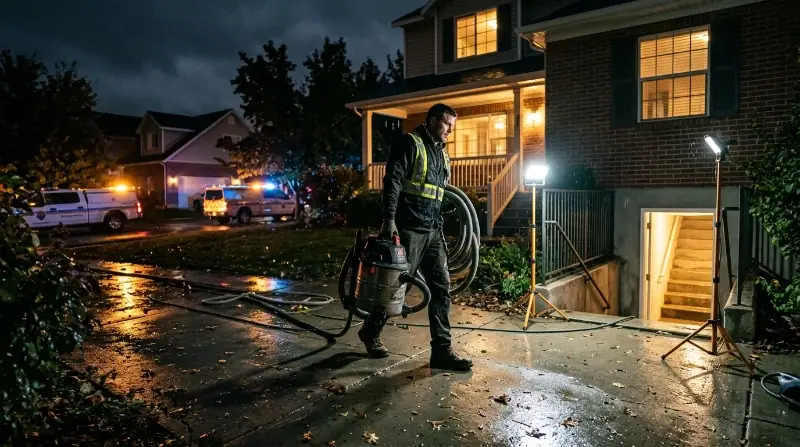
Containment barriers and negative air pressure are established before this equipment runs — IICRC S500 requires it for Category 3.
IICRC S500 Extraction Protocol — Step by Step
- 1
Containment Barrier Setup
Physical polyethylene barriers seal off the affected area from unaffected rooms. Negative air pressure established with HEPA-filtered air scrubbers pulling air from the contaminated zone out through filtration — not into your living space.
- 2
Industrial Extraction Under Containment
Truck-mounted and high-capacity portable extractors remove standing sewage under negative air containment. All extracted material is biohazardous waste — no contact with living areas, no open-air transfer.
- 3
Biohazard Manifesting & Documentation
Every load of extracted sewage is manifested as biohazardous waste per EPA and DOT standards. Manifest documentation provided to your insurance carrier — required for most Category 3 claim approvals in Utah.
- 4
Post-Extraction Moisture Mapping
Calibrated moisture meters map absorption depth across all affected surfaces. This defines the porous material removal scope — the extraction is complete, the remediation scope is now documented in writing before any demo work begins.
What is containment-first sewage extraction?
Containment-first means physical barriers and negative air pressure are established before any extraction equipment runs. This prevents Category 3 bioaerosols from spreading to unaffected rooms during extraction. IICRC S500 requires this protocol for all Category 3 events. Contractors who skip containment spread pathogens to rooms that had no direct water contact — expanding your health risk and decontamination scope.
What does biohazard manifesting mean for sewage extraction?
Category 3 sewage is biohazardous waste under EPA regulations. Manifesting creates a chain-of-custody document for each load of extracted sewage, recording type, quantity, origin, and approved disposal destination. This documentation is required by most Utah insurance carriers for Category 3 claim approval and protects you from liability questions about improper waste disposal.
About this page: Written and reviewed by Marcus R. Webb (IICRC Water Restoration Technician, IICRC Applied Microbial Remediation Technician) and Dana L. Sorenson (IICRC Water Restoration Technician). Content reflects IICRC S500, S520, Provo City Code §10.03.060, EPA & CDC guidelines, and 2026 HomeGuide pricing. Last reviewed September 2026. Last updated: 2026-10-20.
Industrial vs. Consumer Extraction — Why It Matters
| Factor |
Industrial Truck-Mounted |
Consumer Wet-Dry Vac |
| Extraction rate |
High-volume continuous flow |
10–15x slower |
| Aerosolization |
Contained — sewage goes directly to sealed waste tanks |
High — particles expelled during operation |
| Biohazard disposal |
EPA/DOT manifested biohazard waste |
Not documented — insurance may dispute |
| Containment compatible |
Yes — operates within negative air barrier |
No — exhaust spreads particles |
| IICRC S500 compliant |
Yes |
No |
High-Volume Extraction Periods in Provo — When Calls Spike
Provo and Utah County sewer backup extraction calls follow two seasonal peaks. The primary peak is March through April — Wasatch snowmelt raises total sewer system flow volume, and the oldest sections of Provo's network (built for 1950s–1970s population levels) surge backward into floor drains. NRCS SNOTEL data shows that in peak snowmelt years, flow volumes reach 216% of normal.
The secondary peak is August, specific to the BYU campus corridor (ZIP 84602 and the northern sections of 84601). The return of approximately 33,000 students over 2–3 weeks spikes water usage in high-density rental housing well beyond design capacity for the aging laterals in University Avenue corridor. Extraction calls from rental properties in this zone cluster in the last week of August and the first week of September.
Our truck-mounted extraction equipment remains in service 24/7 during these peak periods. Arrival times may extend slightly during major snowmelt events when multiple simultaneous calls are dispatched — we communicate estimated arrival honestly rather than quoting an optimistic time we cannot meet.
After Extraction: What the Moisture Map Tells You
Industrial extraction removes standing water — it does not remove the sewage that has already absorbed into drywall, concrete block, subfloor wood, and carpet pad. After extraction, our technicians run calibrated moisture meters across a grid of test points on every affected surface. The readings show how deep contamination has absorbed and define exactly which materials must be removed.
This moisture map is the written documentation that determines your remediation scope — and it is what separates a defensible insurance claim from one an adjuster can dispute. In a 200 sq ft finished Provo basement, this mapping process takes approximately 20 minutes and produces the written scope used to authorize every subsequent step.
Extraction in Finished vs. Unfinished Provo Basements
Finished basements add two complications that don't exist in open concrete spaces: hidden structural cavities and a cost calculation that's four to six times higher per square foot. When sewage enters a finished basement with drywall, carpet, and drop ceilings, the water migrates into wall cavities and insulation bays where extraction hoses cannot reach.
In finished basements, drywall and insulation that touched sewage are cut out, which opens the wall cavities so standing water can be extracted and the framing cleaned and dried. Skip that step and the cavities hold water that evaporates over days, pushing humidity above the 60% RH level where mold grows.
Unfinished basements are more forgiving: concrete floors, exposed block walls, and no hidden cavities mean extraction reaches all affected surfaces directly. In unfinished spaces, extraction takes 60–90 minutes per 1,000 sq ft of standing water; finished basements with wall cavity work typically run 3–5 hours for the same footprint. The labor difference is reflected in your estimate line items — not markup.
What to Do Before the Extraction Crew Arrives
The 30–60 minutes before our crew reaches your Provo address matter more than most homeowners realize. Three actions protect your insurance claim and reduce your total restoration bill: Those steps hold for any Utah sewage cleanup: the less water used after a backup, the less sewage there is to extract.
- Photograph everything at water level — get a phone camera at floor level and shoot toward walls, under furniture, and into utility closets. Adjusters need proof of high-water mark; photos taken before extraction begins are the only evidence of original water depth.
- Don't run fans or dehumidifiers yourself — moving air over Category 3 water aerosolizes pathogens and spreads contamination to unaffected areas. Leave the ventilation work to the crew, who will establish negative air containment before any air movement begins.
- Locate your main cleanout cap and leave it accessible — if we need to rod the line before extraction to prevent re-flooding, a blocked or buried cleanout adds 30–45 minutes. Most Provo homes built before 1990 have a 4-inch cleanout cap either inside the basement floor or outside the foundation wall near the front of the house.