
Alpine ZIP 84004 — Why Premium Finishes Change Everything About Sewer Backup
Alpine is one of Utah's most affluent communities — median home value over $800,000, with premium finishes that make a sewer backup far more complex than the $7–$15/sq ft baseline suggests. Thirty- to fifty-year-old oak and cottonwood root systems exploit every joint in 25–45 year old laterals, and steep foothill terrain creates slope-related belly deflections.
Alpine, Utah occupies the foothills of Mount Timpanogos's northern face — a position that gives it some of the best views in Utah County and some of the most challenging sewer infrastructure conditions. ZIP code 84004 covers the entire city of approximately 12,000 residents. Most development occurred between 1978 and 2000, making Alpine's pipe systems 25–48 years old — a mix of vitrified clay pipe from the 1970s and early 1980s, and the first-generation PVC pipe that replaced clay through the late 1980s and 1990s. Neither pipe type was installed with 30-year trees growing directly above it. Alpine is covered from our Provo office by the same team that handles sewer backup calls in Provo.
What makes Alpine categorically different from any other city in Utah County is not the cause of the backup — it is the cost of cleanup. Median home value exceeds $800,000, and Alpine homes commonly include finished lower levels with Brazilian hardwood, custom cabinetry, wine cellars, home theaters, and Italian tile — materials that cost $50–$200 per square foot to install and that require specialized assessment before any decision is made about removal versus salvage. A sewer backup that costs $4,500 to remediate in a standard Provo basement can cost $18,000–$25,000 in an Alpine home with premium lower-level finishes.
Root Intrusion — The Primary Cause of Repeat Backup in Alpine
Alpine's mature residential streetscapes are one of its defining characteristics — neighborhoods lined with 30–50 year old Gambel oak, Fremont cottonwood, box elder, and American elm. These trees are a landscape asset and a sewer maintenance liability. A 40-year-old cottonwood with a 60-foot canopy has a root system that extends 80–100 feet laterally from the trunk, actively seeking moisture. Sewer laterals carry both moisture and nutrients. Clay and early PVC joints at 10-foot intervals are the entry points — tree roots find hairline gaps of less than 1/16 inch and exploit them over years, growing from a fiber-thin root to a 2-inch mass that fills the pipe interior.
Root intrusion in Alpine laterals is not subtle — it is the primary cause of backup in the city. The cycle is predictable: initial slow drain, followed by a full backup event when the root mass reaches critical density, followed by hydro-jetting or root cutting that clears the pipe temporarily, followed by root regrowth. Homeowners who have had a root-related backup and responded only with root cutting — without camera inspection, pipe assessment, and discussion of CIPP lining or lateral replacement — will have the same backup again in 12–36 months. Root cutting is not a solution. It is a 1–3 year delay.
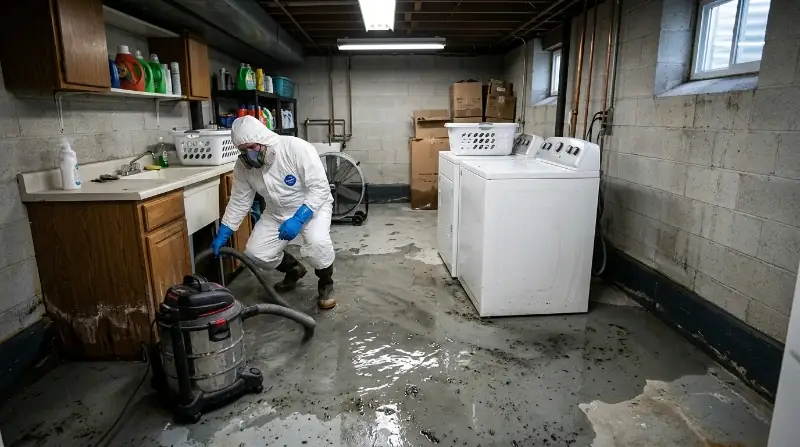
After any root-related sewer backup in Alpine, IICRC S500/S520 decontamination protocol is mandatory regardless of how "minor" the event appeared at first. Category 3 sewage contamination of porous materials — including subfloor, wall framing, and insulation below the contamination line — requires removal and proper disposal. There is no such thing as a "small" Category 3 backup in an Alpine home; there are only backups where remediation cost was kept manageable by fast response, and backups where delay allowed contamination to spread further.
Slope-Related Belly Deflections in Alpine's Foothills Terrain
Alpine lots are often steeply pitched. The northern face of Timpanogos and the canyon drainage channels that define Alpine's topography mean many properties have grade changes of 10–30 feet from the rear of the lot to the street. Sewer laterals on steep lots must navigate these elevation changes, and proper installation requires careful grading — the pipe must maintain a consistent downhill slope (typically 1/4 inch per foot) to prevent solids from settling. When the original grade is set incorrectly, or when subsequent soil movement on a steep lot changes the grade, a "sag" or belly develops — a low section where solids accumulate rather than flow through.
Steep-lot bellies in Alpine are particularly insidious because they are difficult to detect without a camera scope. The lateral drains adequately for years while solids slowly accumulate in the belly — the first indication of a problem is often a slow drain, which homeowners attribute to partial blockage that can be cleared with a drain snake. A plumber's snake will clear the path through the belly temporarily, but the sag remains and the accumulation begins again. When the backup finally occurs, it is typically a full Category 3 event with significant sewage volume in the finished living space below.
What Can Be Saved in an Alpine Sewer Backup
The single most important thing that differentiates our Alpine response from a standard residential sewer cleanup is the pre-removal salvageability assessment. Under IICRC S500 Category 3 protocol, porous materials in contact with sewage must be removed. What constitutes "contact with sewage" and what specific materials are recoverable requires judgment that a certified IICRC technician makes at the scene — and in an Alpine home, that judgment can mean the difference between preserving $40,000 in custom hardwood flooring versus removing it unnecessarily. Salvage depends on speed, and our 24/7 sewer cleanup in Utah County means a crew can be assessing those finishes the same night.
What can typically be salvaged in Category 3 events when sewage contact was brief and decontamination begins promptly: sealed hardwood flooring that was waxed or polyurethane-finished (the finish is the barrier), porcelain tile over concrete substrate if the grout joints were sealed, custom cabinetry with solid wood construction and sealed interiors, metal fixtures and hardware, and Formica or stone countertops. What must be removed per IICRC S500 regardless of material quality: any wood flooring with unsealed edges where sewage wicked under the boards, all carpet and pad, unpainted or unsealed drywall below the contamination line, all fiberglass insulation, all particleboard or MDF components that absorbed sewage, and any subfloor material that contacted Category 3 water. Marcus R. Webb (IICRC WRT & AMRT) makes the salvageability call on every Alpine job before any demolition begins.
Alpine Sewer Rules — Homeowner Lateral Responsibility
Alpine's sewer rules place full responsibility for the service lateral on the property owner. Note that some properties in Alpine's outer areas may be on private septic systems rather than the municipal sewer — verify your service type at the time of the call. For properties on municipal sewer, the lateral from your foundation to the Alpine City main is your property and your financial responsibility. If a city main event was the cause — rare in Alpine's relatively well-maintained system, but possible during peak snowmelt — tell us when you call and we report it to Alpine City Public Works before cleanup begins to document the event. For the vast majority of Alpine backups, the cause is root intrusion or pipe age in the private lateral.
Alpine Sewer Backup Cleanup — Cost Ranges
Alpine's premium finishes drive cleanup costs well above the standard national $7–$15 per square foot range (HomeGuide). The benchmark applies to the affected area — but in an Alpine home with Brazilian hardwood, the salvageability assessment, the careful documentation, the selective removal, and the specialized reinstallation of salvaged materials all add complexity and cost that the benchmark does not capture.
| Scenario | Typical Range |
|---|---|
| Standard finish basement, 400 sq ft, root-related backup | $5,500 – $10,000 |
| Premium finish lower level, 600 sq ft, hardwood + drywall | $12,000 – $18,000 |
| Custom lower level — wine cellar, home theater, hardwood | $16,000 – $25,000 |
| Multi-room contamination, HVAC involved, premium throughout | $20,000 – $35,000+ |
Premium finishes in Alpine add 40–60% to cleanup cost over standard materials. Use the free calculator for a specific estimate →
Down the hill, American Fork deals with older downtown clay laterals and canyon snowmelt, a different risk profile from Alpine's root-heavy, sloped lots.
Frequently Asked Questions — Alpine Utah Sewer Backup
How quickly can you respond to sewer backup in Alpine Utah?
We respond to Alpine sewer backup emergencies (ZIP 84004) in 1–3 hours, 24/7. Alpine's premium homes require our most experienced IICRC WRT and AMRT certified technicians — we always dispatch Marcus Webb or Dana Sorenson to Alpine calls. Call (877) 394-0234.
What makes Alpine sewer backup especially damaging?
Alpine's premium finishes — Brazilian hardwood, custom cabinetry, home theaters, wine cellars — dramatically increase cleanup complexity and cost. Our technicians conduct a detailed salvageability assessment before removing anything. Per IICRC S500/S520 protocol, we preserve everything that CAN be saved and document everything that must be removed for your insurance claim. Call (877) 394-0234.
Why do Alpine homes with mature trees back up repeatedly?
Alpine's 30–50 year old oak, cottonwood, and elm trees have root systems perfectly sized to exploit joints in 25–45 year old clay and early PVC laterals. Root cutting provides 1–3 years of relief but pipe relining (CIPP) or replacement is the permanent solution. After a root-caused backup, full IICRC S500/S520 decontamination is required. Call (877) 394-0234.
What does sewer backup cleanup cost in Alpine Utah?
Alpine's premium homes average $12,000–$22,000 for a Category 3 sewer backup cleanup. Custom finishes, lower levels with premium materials, and complex multi-room contamination drive costs higher than the $7–$15/sq ft baseline. A documented $7,300 case from a comparable but standard-finish home illustrates why premium finishes add 40–60% to cleanup cost. Call (877) 394-0234 for a free detailed estimate.
IICRC S500/S520 Cleanup — The Alpine Protocol
Every Alpine sewer backup response follows the full IICRC S500/S520 framework with the addition of a mandatory pre-demolition salvageability assessment unique to premium properties: (1) stop the sewage source; (2) dispatch — 1–3 hour arrival to ZIP 84004, 24/7; (3) full PPE and negative air pressure containment; (4) salvageability assessment by Marcus Webb (IICRC WRT & AMRT) before any material is touched — each material photographed and documented; (5) industrial sewage extraction; (6) selective material removal per IICRC S500 Category 3 — only what must be removed is removed; (7) EPA-registered antimicrobial decontamination, HEPA air scrubbing; (8) written clearance testing and full insurance documentation package before reconstruction. Full IICRC S500 process →