
⚠ Sewage backup is a Category 3 biohazard — every hour raises cost and risk.  Call (877) 394-0234 now — 24/7
IICRC WRT & AMRT Certified
IICRC S500 & S520 Protocol
24/7 — No Extra Charge
Written Estimate Before Work Starts
Insurance Documentation from Hour One

Sewer Backup Restoration Provo, Utah — Cleanup Through Rebuild

Full-service sewer backup restoration: emergency extraction, IICRC-protocol cleanup, structural drying, demolition, and complete rebuild coordination. One company from the first call through the final coat of paint. Insurance documentation from hour one.

Emergency Through RebuildInsurance DocumentationWritten Estimate FirstIICRC Certified

One Company — Emergency Call Through Finished Restoration

Sewer backup restoration in Provo involves two distinct phases most companies handle separately — and the handoff between them costs homeowners time and money. Utah Hills Restoration handles the full chain: emergency response, IICRC-protocol cleanup and decontamination, structural drying, and complete rebuild coordination. You deal with one company, one contact, and one claim file from start to finish. It starts with our 24/7 sewer cleanup service for Utah County, then moves to drying and rebuild with the same team.

Complete Restoration Process

  1. 1

    Emergency Response & Stabilization

    24/7 dispatch, IICRC crew on site in 1–3 hours. Water source confirmed off. Electrical safety check. Containment established before any work begins. Immediate stabilization stops the damage from progressing further. Restoration is the second half of sewage cleanup in Utah: once the affected area passes clearance, the rebuild can be scheduled.

  2. 2

    Scope Documentation for Insurance

    Written scope with photographs, moisture meter readings, and material inventory before any demolition begins. Insurance documentation starts here — adjusters need pre-demo condition documented. We photograph every affected surface before it is touched.

  3. 3

    Category 3 Extraction & Demo

    Industrial extraction of standing black water. All porous materials in contact with sewage removed per IICRC S500 — drywall, insulation, carpet, subfloor. Debris manifested as biohazardous waste with disposal documentation.

  4. 4

    AMRT Decontamination

    EPA-registered antimicrobials applied to all structural surfaces. HEPA air scrubbing throughout. Clearance testing verifies decontamination before drying equipment is installed.

  5. 5

    Structural Drying to IICRC Dry Standard

    Air movers and industrial dehumidifiers run until calibrated moisture meter readings across all test points confirm dry standard. Daily drying logs documented for insurance. Reconstruction does not begin until dry standard is confirmed — building on wet materials traps moisture and causes mold.

  6. 6

    Full Reconstruction

    Drywall, insulation, flooring, paint, trim, and finish work. We coordinate or directly perform all trades needed to return your home to pre-loss condition. Final inspection confirms the space meets or exceeds original specifications.
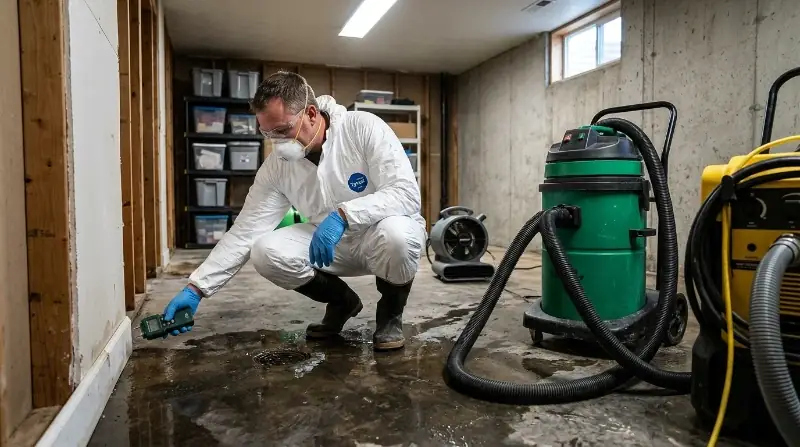
Two IICRC-certified technicians removing sewage-contaminated carpet from Provo, Utah basement per IICRC S500 Category 3 protocol
All porous materials that absorbed Category 3 sewage must be removed — IICRC S500 leaves no exceptions. Carpet, padding, drywall, and subfloor all go.

Sewer Backup Restoration Costs in Provo

ScopeTypical CostWhat Drives It
Emergency cleanup only — no rebuild$2,000–$5,000Single room, limited material removal, fast response
Cleanup + partial rebuild$5,000–$12,000Finished basement with drywall, flooring, painting
Full restoration — multi-room or delayed$10,000–$25,000+Extended exposure, mold involvement, structural damage
Insurance endorsement coverage$5,000–$25,000Typical Utah policy endorsement limit (Insurance Information Institute)

What does full-service sewer backup restoration include?

Full-service restoration covers emergency response and extraction, IICRC S500 Category 3 cleanup, porous material removal, AMRT-certified decontamination, structural drying to calibrated dry standard, and complete reconstruction including drywall, flooring, paint, and finish work. One company handles everything from the first call through the final inspection.

Will insurance cover sewer backup restoration in Utah?

Standard HO-3 homeowners policies typically exclude sewer backup. A separate endorsement is required — typically $40–$250 per year for $5,000–$25,000 in coverage. If you have the endorsement, we provide full insurance documentation from hour one and work directly with your adjuster. Check your declarations page now — most Provo homeowners discover this gap only after a backup. (Insurance Information Institute, 2026)

What sewage restoration services do sewer backup companies offer?

Full-service sewer backup companies like Utah Hills Restoration provide sewage restoration services covering every phase: 24/7 emergency extraction, Category 3 porous material removal, AMRT decontamination, structural drying, clearance testing, and complete reconstruction. Most homeowners only need one call — we handle everything from the first hour through final inspection.

About this page: Written and reviewed by Marcus R. Webb (IICRC Water Restoration Technician, IICRC Applied Microbial Remediation Technician) and Dana L. Sorenson (IICRC Water Restoration Technician). Content reflects IICRC S500, S520, Provo City Code §10.03.060, EPA & CDC guidelines, and 2026 HomeGuide pricing. Last reviewed September 2026. Last updated: 2026-10-20.

Typical Restoration Timeline for a Provo Finished Basement

The most common sewer backup event Utah Hills Restoration responds to in Provo: a finished basement with 150–300 sq ft of contaminated area, main line backflow through the floor drain, response within 4 hours of the event. Here is what the timeline typically looks like from call to completed restoration:

Hours 0–4: Emergency response. Source identified. Containment established. Industrial extraction of standing black water completed. Pre-demo documentation photographed and logged.
Hours 4–8: Porous material demo begins. Drywall removed to 2 feet above contamination line. Carpet, pad, and affected subfloor sections removed. Debris manifested as biohazardous waste.
Day 1–2: AMRT decontamination of all exposed structural surfaces. EPA-registered antimicrobials applied at specified contact times. HEPA air scrubbing throughout. Post-decontamination samples collected.
Days 2–5: Structural drying. Air movers and dehumidifiers run continuously. Daily moisture meter readings logged. Drying complete when all test points reach IICRC dry standard — typically 3–5 days for a Utah County finished basement in normal ambient conditions.
Day 5–7: Clearance testing. Written clearance issued. Insurance claim file submitted — pre-demo photos, extraction manifests, moisture logs, decontamination records, clearance certificate.
Weeks 2–4: Reconstruction phase begins. New drywall, insulation, flooring, paint, and trim. Timeline depends on scope and material availability. We coordinate with your insurance adjuster on the rebuild estimate.

Timeline assumes a single-room finished basement event, response within 4 hours, no mold involvement, and active sewer backup endorsement. Multi-room events, delayed response, or mold scope extend the timeline and cost.

Working With Your Insurance Adjuster

Sewer backup endorsement claims in Utah are typically processed by a field adjuster or desk adjuster who has not seen your property. They work from photographs and documentation — which is why our pre-demo documentation is the single most important part of the claim file. An adjuster who cannot see what the basement looked like before demo has nothing to approve against. We document before touching anything.

For larger claims — $15,000 and above — Utah insurers frequently assign a field adjuster who will walk the property. We schedule that walk-through before demolition whenever possible, and coordinate directly with the adjuster on scope questions. You do not need to be the intermediary between your restoration company and your insurance carrier.

Most Utah sewer backup endorsements cover $5,000–$25,000 per event (Insurance Information Institute, 2026). If your restoration cost exceeds your endorsement limit, we provide a complete scope breakdown so you know exactly what is and is not covered before reconstruction begins.