
Mapleton's Code: Below-Basement Sewers and Lift Systems
Mapleton City runs its own sewer collection under City Code Title 14, Chapter 14.20. Section 14.20.200 sets the rules for building sewers, the pipe from your house to the public sewer: all costs of installing and connecting it are borne by the owner, and whenever possible it should leave the building at an elevation below the basement floor. Where a building drain sits too low for gravity flow, sewage "shall be lifted by an approved means," with the owner paying to install, maintain, and operate it.
That last rule is why ejector pumps matter here. Mapleton's bench homes often have deep, finished basements, and where a basement bathroom or laundry sits below the sewer line, a sealed pump pit collects that sewage and pumps it up. If the pump fails, the float sticks, or the power goes out, the pit overflows into the basement. That is a sewer backup with nothing wrong in the city line at all.
Ejector Pump Backups: Signs and First Steps
Warning signs include a high-water alarm on the pit, a pump that runs constantly or hums without moving water, sewage odor near the basement bathroom, and slow drains only on the lowest level. If you hear the alarm, stop using basement fixtures right away; upstairs fixtures that drain by gravity are usually unaffected.
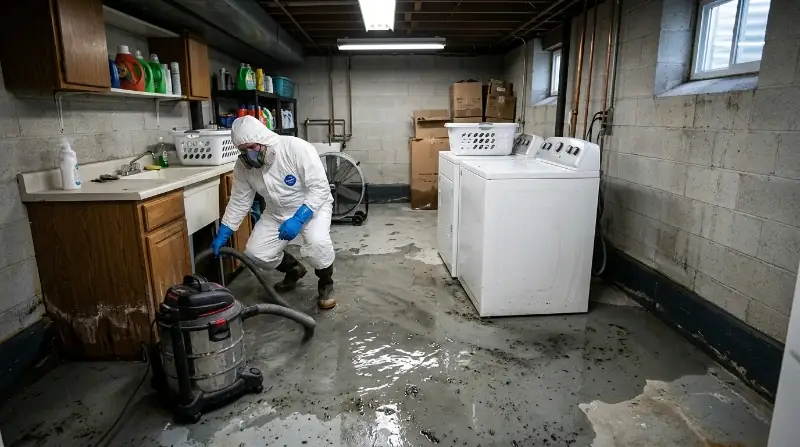
Once sewage overflows the pit, it is Category 3 under the IICRC S500 standard. We extract it, remove carpet, pad, and drywall it reached, disinfect with EPA-registered antimicrobials, and dry the space to a measured standard. A plumber repairs or replaces the pump. Note for your insurer: many water backup endorsements specifically mention sump or pump failure, so read yours, and keep the failed pump if possible as evidence.
Where Mapleton's Sewage Goes
Mapleton's wastewater is treated at the joint Spanish Fork–Mapleton water reclamation facility, not in Springville. The two cities signed an interlocal agreement in 2020, and Mapleton covers about 20% of the plant's cost. The new facility at 2028 North 200 East in Spanish Fork started up in summer 2025, and Mapleton raised its sewer rate in 2024, from $56.14 to $66.14 per equivalent residential unit, to help pay for it.
Under Utah Code § 11-8-4, the city must remind customers twice a year who is responsible for repairing the sewer lateral. Combined with the code's rule that owners bear building sewer costs, the practical answer after most Mapleton backups is that the line and the pump are the owner's to fix.
Large Lots, Long Laterals, and Hobble Creek
Mapleton began as Union Bench, an agricultural extension of Springville, and sits about 150–200 feet higher than its neighbor. Minimum lot sizes range from about a third of an acre to two acres, so laterals here can run a long way from house to main. Census data compiled from the ACS puts the median home at 2005, with about 59% built in 2000 or later, a median value of about $745,200, and an average of about 3.55 people per household, which means heavy daily water use.
Hobble Creek forms the city's northern boundary and the Mapleton Lateral canal crosses the east side. In April 2023 the mayor urged residents to fill sandbags, clear ditches, and consider flood insurance ahead of record runoff. Creek or canal water entering a basement is floodwater, not a sewer backup, and is insured differently.
Sewage Cleanup in Mapleton's Finished Basements
High-value finishes do not change the IICRC rules: carpet, pad, insulation, and drywall that touch Category 3 sewage are removed. What we can control is scope. We measure the wet line before cutting, protect cabinetry and built-ins the water did not reach, and move unaffected contents early. Cleanup typically runs $7–$15 per square foot; the Utah County cost guide explains the separate pump, plumbing, and rebuild costs.
Ejector Pump Maintenance for Mapleton Basements
Most ejector pump failures are preventable. Test the pump a few times a year by running enough water in the basement fixtures to lift the float and watching it cycle. Make sure the high-water alarm works and that someone in the house knows what it sounds like. Keep wipes, paper towels, and feminine products out of basement toilets, since they jam impellers. Check that the pit lid stays sealed, both for odor and safety. Have a plumber inspect the pump, check valve, and float every few years, and plan on replacement as pumps age. A pump on a dedicated circuit, with a backup plan for power outages, protects a finished basement far better than any cleanup can.
How Gravity and Pressure Push Sewage Into a Mapleton Basement
Mapleton's sanitary sewer works by gravity, like every city system in the valley: sewage runs downhill from the house through the lateral to a main, and manholes give crews access along the way. A gravity line cannot lift sewage uphill, which is why a basement below the main needs a pump. The ejector pump has a check valve on its discharge pipe; if that valve sticks open, sewage the pump just lifted drains straight back into the pit and the pump short-cycles until it burns out.
The other risk comes from the street. When a main surcharges, the pressure pushes sewage back through the lowest gravity drain in the house. A backwater valve on that drain, and a known, accessible cleanout outside, give you protection and a way for a plumber to relieve the line. Most Mapleton homes are recent, so laterals are usually PVC rather than clay, but PVC can still sag in settled backfill.
If the pit overflows, unplug the pump before touching anything near it, and do not try to bail sewage with buckets and a shop vac. Tenants in a rented basement should report it to the owner right away. Our IICRC sewer backup cleanup crew handles the rest.
Sewer Backup Cleanup Mapleton Response
Mapleton is about 10 miles from our Provo base, roughly 20 minutes, and our crew arrives in 1–3 hours, 24/7, anywhere in 84664, from Main and Maple near the city park to the bench neighborhoods toward Maple Canyon.
Mapleton shares a treatment plant with Spanish Fork but borders Springville along Hobble Creek. For how the rules differ across the valley, see the Utah County overview.
Mapleton Sewer Backup Cleanup: Common Questions
Why did my Mapleton basement back up when the city line is fine?
Often an ejector pump failure. Mapleton code requires a lift system where a basement drains below the sewer, and if the pump fails, the pit overflows into the basement.
Who maintains an ejector pump in Mapleton?
The owner. Mapleton City Code § 14.20.200 says the owner pays to install, maintain, and operate any lift system.
Does Springville treat Mapleton's sewage?
No. Mapleton's wastewater goes to the joint Spanish Fork–Mapleton water reclamation facility under a 2020 agreement.
Does insurance cover an ejector pump backup?
Usually only with a water backup endorsement; many endorsements mention sump or pump failure. Check your policy and keep the failed pump.
How fast can you reach Mapleton?
Our crew arrives within 1–3 hours, 24/7, in ZIP 84664. Call (877) 394-0234.
- Mapleton City Code § 14.20.200
- Mapleton City Council staff report — joint treatment plant (2023)
- Mapleton City Council — Resolution 2024-31 sewer rate (2024)
- Spanish Fork City — Sewer (serves Spanish Fork and Mapleton)
- Daily Herald — South Utah County cities prepare for runoff (2023)
- U.S. Census QuickFacts — Mapleton
- Utah Code § 11-8-4 — Sewer lateral disclosure