
Why Riverside Has Unique Sewer Backup Risk
Riverside sits adjacent to the Provo River corridor, creating a dual backup threat. When Wasatch snowmelt raises the river in March and April, groundwater infiltrates basements through floor drains — usually a Category 2 event separate from main line backflow. Simultaneously, the same snowmelt surge overwhelms Provo's sanitary sewer capacity, causing Category 3 main line backups. Riverside homeowners can face both events at once — requiring source identification on arrival to determine which protocol applies. Riverside calls go to the same crew that handles sewer backups in Provo citywide.
Pipe Age and Infrastructure in Riverside
Riverside housing stock is primarily 1960–1980 construction — cast iron laterals now 45–65 years old. Cast iron corrodes internally from hydrogen sulfide gas produced by sewage, losing wall thickness over decades. Many Riverside laterals are at or past their functional lifespan. Riverside cast iron in areas closest to the river shows accelerated corrosion from the elevated soil moisture environment.
Frequently Asked Questions
How fast can you respond to a sewer backup in Riverside, Provo?
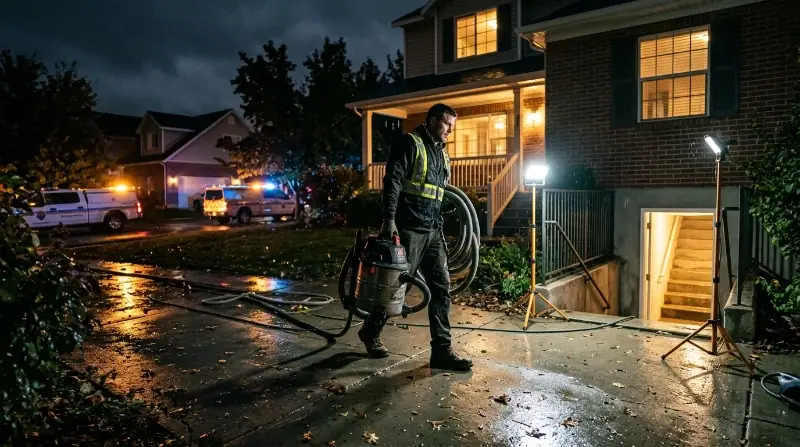
Riverside calls are dispatched the moment you hang up, and our crew arrives within 1 to 3 hours, day or night — including the spring weeks when river levels and main line flows peak together. No extra charge for nights, weekends, or holidays. Call (877) 394-0234.
What causes sewer backups in Riverside?
Riverside faces a dual backup threat. When Wasatch snowmelt raises the Provo River in March and April, groundwater infiltrates basements through floor drains. Simultaneously, the same snowmelt surge overwhelms Provo's sanitary sewer capacity, causing Category 3 main line backups. Source identification on arrival determines which protocol applies — Category 2 groundwater or Category 3 sewage.
Does homeowners insurance cover sewer backup cleanup in Riverside?
A standard Utah HO-3 policy excludes sewer backup; you need a separate endorsement, typically $40–$250 a year for $5,000–$25,000 of coverage. In Riverside, groundwater damage is a different coverage question again, so our report records which water came from where. That split is the first thing adjusters ask about.
What is IICRC Category 3 sewage cleanup?
Category 3 is the IICRC S500 term for raw sewage — water carrying E. coli, Norovirus, Hepatitis A, and Giardia (CDC). River groundwater on its own is usually Category 2, which is why we test before deciding what has to be torn out. Anything porous that sewage reached is removed, never dried in place.
An Illustrative Riverside Backup Scenario
In a scenario typical for this neighborhood: a homeowner on Riverside Drive — 1973 construction, cast iron lateral — calls about the basement floor drain backing up slowly. Toilet is fine, no sewage smell. Provo River crested overnight. This is groundwater intrusion through the floor drain — Category 2 water, not sewage. Our crew identifies the source in 15 minutes. Protocol: water extraction, structural drying, temporary standpipe on the drain. No antimicrobials, no containment. Cost: in the $1,200–$1,800 range for a groundwater-only extraction event. Had this been misidentified as sewage and treated with full Category 3 protocol, cost could have reached $5,000–$8,000 for unnecessary treatment. Actual costs vary with square footage, materials affected, and contamination level — this example is illustrative, not a quote.
Highest-Risk Streets in Riverside
Riverside Drive and 900 East between 500 and 1000 North are among the higher-frequency water intrusion areas — direct Provo River adjacency, cast iron laterals, 1965–1978 construction. The 800–900 North block along the river trail is especially exposed to dual-source events (groundwater plus main line simultaneously). Homes within 200 feet of the river bank face more groundwater exposure than valley-floor Provo properties.
Seasonal Backup Risk in Riverside
Peak risk: March–May — Provo River snowmelt plus Wasatch runoff combined. The dual threat in Riverside means cleanup requires careful source identification: groundwater intrusion through floor drains (usually Category 2 — lower protocol, lower cost) versus main line sewage backflow (Category 3 — full biohazard protocol required). Misidentifying the source leads to either over-treatment or under-treatment. During the March–April peak, our 24/7 sewer cleanup crews for Utah County often run back-to-back Riverside calls, so call as soon as you see water at a floor drain.
How the Provo River Affects Riverside Sewer Systems
The Provo River Trail corridor runs through Riverside. Homes within two blocks of the river have documented higher floor drain backup frequency during high water events. The NRCS SNOTEL station shows Wasatch snowpack reaching 216% of normal in peak years — when that snow melts in March, Riverside is in the direct path.
Our IICRC S500 Cleanup Process
Riverside jobs start with a source check — river groundwater and sewage need different handling — then containment, industrial extraction, removal of porous materials, AMRT decontamination, drying to a measured dry standard, and written clearance testing. Our Provo sewage cleanup process → It is the same process we use for sewage cleanup in Utah County and the Salt Lake Valley; in Riverside, the extra step is separating river groundwater from sewage.
Cleanup Cost in Riverside
Most Riverside cleanups land in the Provo range of $2,000–$10,000, or $7–$15 per square foot. Costs climb when groundwater and sewage arrive together during snowmelt, because both the water and the contaminated materials have to be handled. Calling within 6 hours instead of 24 can cut the bill roughly in half. Use the free cost calculator for a specific estimate →