
Why Vineyard Homes Back Up Despite Brand-New Pipes
Vineyard is Utah County's newest city — incorporated in 2016 and built almost entirely on former Geneva Steel industrial land and Utah Lake wetlands. New PVC pipe does not protect against a high water table and expansive clay soils, which is why backups still happen in brand-new homes.
Most homeowners assume that new construction equals new infrastructure equals zero problems. In Vineyard (ZIP 84059), that assumption has cost thousands of dollars in cleanup bills for residents who never saw the backup coming. Every structure in Vineyard was built after 2010. The city itself wasn't incorporated until 2016, making it the newest municipality in Utah County. Every sewer lateral is Schedule 40 PVC — the modern standard that replaced clay pipe decades ago. So why is the sewer backup rate here so high?
The answer is ground conditions, construction speed, and a water table that doesn't care how new your pipes are. Vineyard was developed almost entirely on two types of problematic land: the former Geneva Steel plant site along Geneva Road, and former Utah Lake wetlands to the east. Both soil profiles — former industrial fill and lacustrine wetland deposits — create the conditions for pipe failure that no amount of quality PVC can prevent if the installation was rushed. Vineyard is a short drive from our Provo base, and the crew that handles Provo sewer backup cleanup covers every Vineyard call.
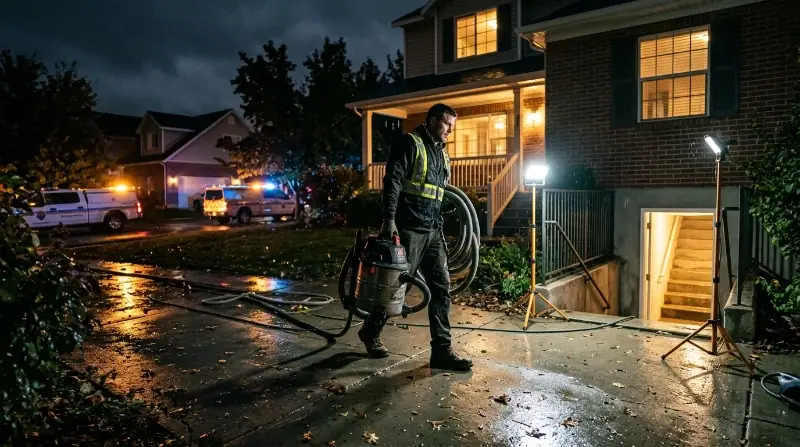
The Geneva Steel Wetland Problem: Soil That Moves After Installation
The land Vineyard sits on was never meant to support high-density residential development at this pace. Geneva Steel operated on this site from 1944 until 1986, leaving industrial fill deposits of irregular composition. The eastern portions of the city border Utah Lake directly — lacustrine soils with expansive clay and peat deposits that compress, swell, and settle depending on moisture levels. Neither soil type provides the stable trench base that sewer pipe installation requires.
When a sewer trench is excavated through these soils, the material removed is loose and uncompacted. Best practice requires mechanical compaction of backfill in 6-inch lifts, with moisture content controlled to within a few percent of optimum. During Vineyard's rapid development phase — the city's population roughly doubled between 2018 and 2024 — production pressure meant some contractors were compacting in thicker lifts or skipping moisture control steps. The result: trench backfill that continues to settle for years after the Certificate of Occupancy is issued.
As the trench settles, the pipe below it deflects. PVC is flexible under normal design loads, but sustained uneven bedding causes the pipe to deform from its circular cross-section. Once deflection reaches 5% of the pipe diameter, joint gaps open. Debris accumulates. The pipe that was flowing 100% capacity at installation may be at 60% capacity five years later — and the homeowner sees slow drains, gurgling, and eventually the backup itself. A camera scope at that point will show visible deflection and joint separation that wasn't present when the home was new.
Utah Lake Proximity: When the Water Table Becomes Your Problem
Vineyard's eastern edge sits directly on Utah Lake's shoreline. The water table across much of Vineyard ranges from 2 to 8 feet below the surface — some lots near the lake measure as shallow as 12 inches below grade during peak spring snowmelt. This is not a theoretical risk. When the water table rises, two things happen to your sewer system.
First, groundwater infiltrates the sewer lateral through any small crack, joint gap, or connection that isn't perfectly sealed — a problem called inflow and infiltration (I/I). The city's sewer main is designed for a certain flow rate. When the mains fill with groundwater during snowmelt, their capacity drops and private laterals have nowhere to drain. The result is surcharging — the main backs up pressure into your lateral and sewage emerges from the lowest fixture in your home.
Second, high water table pressure acts against the bottom of your basement slab and floor drain. Even a partially blocked lateral creates enough back-pressure to push contaminated water through the floor drain when the ground around your foundation is saturated. Vineyard homeowners with finished basements in the 84059 ZIP code are particularly vulnerable because the typical Vineyard home has a 9-foot foundation — more below-grade space exposed to hydrostatic pressure than the Utah County average.
What IICRC S500 and S520 Require for Vineyard Homes
The IICRC S500 Standard for Professional Water Damage Restoration classifies sewer backup as Category 3 water — the highest contamination classification. Category 3 includes raw sewage containing E. coli, Norovirus, Hepatitis A, and Giardia. The S520 Mold Remediation Standard adds requirements for microbial assessment when the 24-hour mold window has passed. It is the same standard used for Utah sewage cleanup across the valley; the difference in Vineyard is the water table, which can keep slabs and lower walls wet longer.
For Vineyard homeowners, IICRC S500 protocol means: all carpet and carpet pad that contacted sewage must be removed and disposed of as biohazardous waste. All drywall up to at least 12–24 inches above the wet line must be removed. Particleboard or OSB subfloor layers that absorbed sewage are removed. Fiberglass batt insulation in any affected cavity is removed. These are not optional steps — drying sewage in place is expressly prohibited under IICRC S500 protocol because it leaves biological contamination embedded in structural materials.
What can typically be cleaned and retained: concrete floor slabs, ceramic tile set in thinset mortar, sealed cabinet interiors, metal fixtures and plumbing trim, painted masonry block walls above the contamination line. Vineyard's newer homes sometimes have LVP (luxury vinyl plank) floating floors — LVP itself is non-porous and can be cleaned, but the foam underlayment beneath it must be removed if it contacted sewage.
Vineyard Utah Sewer Backup Cleanup — Cost Ranges
Vineyard's homes run larger than the Utah County average, and finished basements are common. Vineyard's larger home sizes push costs toward the upper end of the $7–$15 per square foot range.
| Scenario | Typical Range |
|---|---|
| Unfinished basement, 200–300 sq ft, PVC lateral event | $1,800 – $3,800 |
| Finished basement, 400–600 sq ft, carpet and drywall | $6,500 – $12,000 |
| Large finished basement, 700+ sq ft, 9-ft ceiling | $10,000 – $16,000 |
| Spring I/I event, multiple fixtures affected | $5,000 – $14,000 |
Based on IICRC S500 scope requirements and the $7–$15/sq ft restoration benchmark. Vineyard's 2,800–3,800 sq ft homes with 9-ft basements place most jobs in the upper half of these ranges. Use the free calculator for a specific estimate →
Builder Warranty vs. HO-3 Insurance: What Vineyard Homeowners Need to Know
Vineyard's all-new housing stock means many homeowners are still within their builder warranty period. The typical new-construction warranty in Utah includes one year for workmanship, two years for mechanical systems, and ten years for structural components. Sewer lateral defects — including trench compaction failures that cause pipe deflection — may fall under the mechanical or workmanship categories if identified early enough.
The problem: most builder warranties exclude sewer backup damage to personal property and finished spaces. They may cover the cost of repairing the pipe, but the cleanup of sewage in your basement is generally your expense. Additionally, the two-year mechanical warranty window is short — pipe deflection from poor trench compaction often takes three to seven years to develop into an actual backup. By the time the backup occurs, the builder warranty coverage has expired.
Standard Utah HO-3 homeowners insurance excludes sewer backup as a base coverage. A separate sewer backup endorsement — typically $40–$250 per year and providing $5,000–$25,000 in coverage — is required. Vineyard homeowners who purchased new construction between 2015 and 2022 should verify whether they added this rider at closing. Many did not, because the assumption of new pipes meant "no need." We provide complete documentation for both builder warranty claims and insurance adjuster submissions: itemized scope of work, moisture mapping, contamination logs, and photographic documentation from hour one.
Vineyard City Growth and Infrastructure Capacity
Vineyard's population approximately doubled between 2018 and 2024. The city's sewer mains were designed with growth projections, but the pace of actual development has consistently outrun those projections in Utah County's fastest-growing municipalities. When mains run near capacity during dry weather, they have little surge buffer for the I/I events common in spring. A heavy rain event or rapid snowmelt can sharply increase sewer main flows in affected areas. As the city grows, our 24/7 sewer cleanup coverage in Utah County keeps pace, with Vineyard reached in under an hour from Provo.
Vineyard City is currently expanding its infrastructure inspection programs. When we respond to a Vineyard backup, we check with Vineyard City Public Works to determine whether a main-line event contributed. However, even when the main is implicated, the cleanup cost for your home is typically your responsibility. We coordinate with Vineyard City on documentation when a main-line event appears to have contributed to a residential backup.
Frequently Asked Questions — Sewer Backup Cleanup Vineyard Utah
Why does sewer backup happen in new Vineyard Utah homes?
Even brand-new PVC pipe systems can fail in Vineyard due to improperly compacted trench backfill during rapid development. Pipe deflection and joint gap opens within 3–7 years. Vineyard also sits on former Geneva Steel wetlands with a water table as shallow as 2 feet below surface — spring inflow routinely overloads laterals. Call (877) 394-0234 if you notice slow drains or gurgling — early camera scope ($200–$400) prevents the backup.
How quickly can you respond to sewer backup in Vineyard Utah?
We respond to Vineyard sewer backup emergencies (ZIP 84059) in 1–3 hours, 24/7. Our IICRC WRT and AMRT certified crew carries truck-mounted extraction equipment. Call (877) 394-0234 for immediate dispatch.
Does the builder warranty cover sewer backup in Vineyard?
Builder warranties vary. Some cover lateral defects if reported within the first 1–2 years; others exclude sewer backup entirely. Homeowner's HO-3 insurance requires a separate sewer backup rider. Either way, call us first — we document the cause and provide itemized reports for builder warranty claims or insurance adjusters. Call (877) 394-0234.
How much does sewer backup cleanup cost in Vineyard?
Vineyard's larger homes (2,800–3,800 sq ft) with 9-ft finished basements run $8,000–$16,000 for Category 3 sewer backup cleanup. IICRC protocol requires removing carpet, pad, drywall up to at least 12–24 inches above the wet line, and any porous material the sewage contacted. The $7–$15/sq ft benchmark applies to the affected area, not the whole home. Call (877) 394-0234 for a free estimate.
IICRC S500 Cleanup Process — Vineyard Utah
Our response to every Vineyard sewer backup follows the published IICRC S500 and S520 framework. Step one: stop all plumbing use and call (877) 394-0234 — if neighbors in your development are also backing up, tell us when you call and we report a potential main event to Vineyard City Public Works. Step two: our IICRC crew arrives in 1–3 hours with truck-mounted extraction equipment. Step three: full PPE deployed and negative air pressure containment established before extraction begins. Step four: industrial sewage extraction with biohazardous waste manifesting per EPA standards — high water table conditions in 84059 may require additional dewatering steps. Step five: all porous materials removed and documented per IICRC S500. Step six: EPA-registered antimicrobials applied, HEPA air scrubbing, and written clearance testing before reconstruction begins.
For Vineyard homeowners within the builder warranty period, we provide a separate documentation package covering cause-of-loss — including camera scope findings, moisture mapping, and expert notation of trench compaction failure indicators — to support any builder warranty claim or homeowner insurance submission. Full IICRC S500 process →
Our Certified Technicians Serving Vineyard 84059
Marcus R. Webb, Lead Restoration Technician, holds dual IICRC certification — Water Restoration Technician (WRT) and Applied Microbial Remediation Technician (AMRT). The AMRT certification is specific to microbial contamination, the type present in every sewer backup event. Marcus leads Category 3 response in Vineyard and coordinates with Vineyard City on main-line event documentation when applicable.
Dana L. Sorenson, Lead Field Technician, holds IICRC Water Restoration Technician (WRT) certification and leads extraction and material removal operations. Dana has specific experience with high-water-table extraction conditions common in Vineyard's lakeside and former wetland areas — conditions that require additional dewatering steps not needed in drier inland locations.