
Cedar Valley ZIP 84013 — What to Know About Sewage Backups Here
Cedar Valley is rural southwest Utah County — acreage lots, horse properties, ranch-style homes, and a mix of municipal sewer and private septic systems. Long laterals (150–350 ft on 1–5 acre lots), Orangeburg pipe in pre-1980 homes, and freeze-thaw joint damage at 4,700–5,200 ft elevation create a distinct set of risks.
Cedar Valley is not a single city — it is a rural geographic area in southwest Utah County, centered on the small community of Cedar Fort and encompassing surrounding rural subdivisions, acreage homesites, and ranch properties throughout the valley floor and lower foothills. ZIP code 84013 covers this entire area. The valley sits at 4,700–5,200 feet above sea level, significantly higher than the Provo–Orem valley floor, with winters that are harsher and freeze-thaw cycles that are more frequent and severe than in central Utah County. Cedar Valley calls are dispatched from our Provo base, the same crew behind every Provo sewer backup job.
Cedar Valley's sewer situation is genuinely bifurcated: some properties connect to municipal sewer service through Cedar Fort's limited system and newer 2010–2020 rural subdivisions, while the majority of established and older rural properties are on private septic systems. Knowing which system your property uses is step one in any backup response. If you are not certain, your property's sanitary permit (on file with Utah County Health Department) will specify. Our crew is equipped for both municipal lateral cleanup and septic system sewage events — the IICRC S500 Category 3 protocol is identical regardless of source.
The Long Lateral Problem — Cedar Valley's Defining Municipal Sewer Risk
For Cedar Valley properties that do connect to municipal sewer, the service lateral presents a risk profile unlike any other part of Utah County. On a standard 7,500-square-foot residential lot in Provo, the lateral from the foundation to the street main might be 50 feet. On Cedar Valley's acreage lots — commonly 1–5 acres — that same lateral must run 150–350 feet, and on larger rural parcels, even farther. Every additional foot of lateral is another 10-foot pipe joint, another potential belly location from soil settlement, another length exposed to freeze-thaw damage, and more surface area where tree roots from rural windbreaks and ornamental plantings can intrude.
The physics of belly formation on a 200-foot lateral are straightforward: even a perfect installation with proper grade develops some settling over years as the backfill compresses under normal use and seasonal freeze-thaw cycles. A 200-foot lateral that settles unevenly by just 1 inch in the middle has a belly that accumulates solid waste with every flush. Over months, the accumulation builds. The first symptom is a slow drain — slow enough that residents attribute it to partial blockage or grease buildup. When the belly is full and the next major water use (a load of laundry, a long shower, running the dishwasher) hits, the lateral blocks completely and sewage backs up through the lowest fixture.
Cedar Valley homeowners on municipal sewer should have their long laterals camera inspected every 3–5 years, and more frequently if they have experienced any previous slow drain events. The inspection should note the precise location and angle of any belly sections so that if a backup occurs, the plumber who responds to clear the lateral has a documented baseline to work from. We do not perform sewer scoping ourselves, but we coordinate with licensed plumbing contractors who serve the 84013 area.
Septic System Backup — What Cedar Valley Homeowners Need to Know
A significant portion of Cedar Valley's residential properties, particularly older rural homes and ranch properties established before the 2010s, are on private septic systems. When a septic system fails and sewage backs up into the living space, the IICRC classification is identical to a municipal sewer backup: Category 3 black water containing E. coli, Hepatitis A, Norovirus, Giardia, and other pathogens. The cleanup protocol under IICRC S500/S520 is not different based on the source — the contamination level and health risk are the same. Septic or sewer, sewage cleanup in Utah follows the same IICRC S500 rules; only the repair outside the house is different.
Septic backup events in Cedar Valley typically arise from one of four causes: (1) a full or failing septic tank that has not been pumped on the recommended 3–5 year schedule; (2) a drain field that has been saturated by spring snowmelt or multiple heavy rains, causing the field to fail to absorb effluent; (3) a broken or crushed distribution pipe between the tank and the drain field; (4) full septic tank failure from overloading or structural collapse. Causes 1 and 2 are correctable without major expense; causes 3 and 4 may require significant septic system repair or replacement ($3,000–$12,000 in materials and labor) beyond the cleanup cost.
Our role in a Cedar Valley septic backup event is the sewage cleanup and decontamination of the living space — we are not septic system contractors. We will remove sewage from the home, remove all contaminated porous materials per IICRC S500 Category 3 protocol, decontaminate structural surfaces, and provide clearance testing before reconstruction. The septic system itself must be evaluated and repaired by a licensed septic contractor. We can coordinate with local septic contractors in the 84013 area as part of our job coordination service.
Orangeburg Pipe — What It Is and Why Cedar Valley Is at Risk
Orangeburg pipe was manufactured in Orangeburg, New York from roughly 1945 to 1970. It is a composite of tar paper layers and pitch — a material developed during World War II as a substitute for cast iron pipe when metal was rationed for the war effort. It was widely used in rural residential construction through the late 1960s and found its way into sewer laterals, drain lines, and even water supply lines in rural properties throughout the western United States. Cedar Fort and the older rural parcels in Cedar Valley were settled and developed primarily in the 1950s, 1960s, and 1970s — squarely within the Orangeburg era.
The fundamental problem with Orangeburg is its failure mode. Unlike clay pipe that cracks or PVC that deflects, Orangeburg absorbs moisture over decades and softens until it simply cannot support the weight of the soil above it. It then deforms into an oval, then an irregular shape, and finally collapses entirely into a pile of wet tar-fiber that completely blocks the lateral. This process is irreversible and the result is not repairable — the collapsed Orangeburg must be excavated and replaced with modern PVC. In Cedar Valley's freeze-thaw environment (where frost penetration can reach 3–4 feet in hard winters), the stress on old Orangeburg pipe is amplified by seasonal freeze-thaw cycles that accelerate the pipe's structural breakdown.
When an Orangeburg pipe collapses and sewage backs into a Cedar Valley home, the cleanup follows the same IICRC S500 Category 3 protocol as any other sewage backup. The lateral replacement by a licensed plumber (a separate engagement from the cleanup) typically runs $8,000–$20,000 for a 150–300 foot rural lateral given excavation costs, materials, and backfill at current Cedar Valley contractor rates. Our documentation of the backup event — with contamination extent photographs, moisture maps, and material removal manifests — supports the property owner's records and any insurance claim that may apply.
Freeze-Thaw Damage at Cedar Valley's Elevation
Cedar Valley's elevation of 4,700–5,200 feet above sea level places it in a significantly colder winter zone than the Provo valley floor at 4,550 feet. The difference seems small but the practical effect on sewer infrastructure is substantial. At Cedar Valley elevations, ground frost can penetrate to 36–48 inches in hard winters. PVC pipe joints at shallow depths — common on the entry-point of a lateral near the foundation, before the pipe descends to deeper frost-protected depth — are stressed by freeze-thaw cycling over years. Each freeze-thaw cycle creates a small amount of movement at the joint; over 10–20 cycles, the rubber gasket seal fatigues and groundwater infiltration begins. In extreme winters, shallow laterals can experience frost damage that shifts the pipe angle and creates an immediate belly.
Cedar Valley homeowners who experience sewer backups consistently in late winter or early spring — January through March — should specifically discuss freeze-thaw lateral damage with the plumber who inspects their system. The annual cycle of freeze-thaw damage is often the explanation for recurring slow drains that appear every winter and clear up as temperatures rise, only to return the next year with greater severity.
Our Response Time and Service Commitment to Cedar Valley
Cedar Valley (ZIP 84013) is in southwest Utah County, and the drive from our Provo dispatch center takes 45–75 minutes depending on the specific property location within the valley and road conditions (SR-73 in winter, for example, can add 10–15 minutes). We want to be direct about this: our response time to Cedar Valley is 45–75 minutes from the moment we dispatch, and we dispatch the moment you call — 24/7, 365 days per year, including Christmas and New Year's Eve. No extra charge for nights, weekends, or holidays. Cedar Valley sits at the far edge of our 24/7 sewer cleanup area in Utah County, UT, but nights and weekends are covered the same as weekdays.
In a rural area like Cedar Valley, we are typically one of the only IICRC-certified remediation crews willing to make the drive. Many restoration companies in the Provo–Orem corridor have informal service area cutoffs that exclude ZIP 84013. We serve Cedar Valley because rural homeowners deserve the same standard of care — the same IICRC S500/S520 protocol, the same written estimate before work begins, the same insurance documentation package — as homeowners in central Utah County.
Cedar Valley Sewer Backup Cleanup — Cost Ranges
Cedar Valley's rural homes often have large finished lower levels and walk-out basements — common in this terrain — which can mean large affected areas when a backup occurs. The cleanup cost reflects the national $7–$15 per square foot range (HomeGuide) for the affected area, plus any materials that require replacement.
| Scenario | Typical Range |
|---|---|
| Unfinished basement, 300 sq ft, municipal or septic backup | $2,000 – $4,500 |
| Finished lower level, 500–700 sq ft, carpet and drywall | $7,000 – $13,000 |
| Large walk-out basement, 900–1,200 sq ft | $10,000 – $18,000 |
| Septic backup + lateral/tank repair (combined estimate) | $12,000 – $27,000+ |
Lateral or septic repair costs are separate from cleanup and depend on the system's condition. Use the free calculator →
Frequently Asked Questions — Cedar Valley Utah Sewer Backup
Do you serve rural Cedar Valley Utah for sewer backup?
Yes. We serve all of Cedar Valley, including Cedar Fort and surrounding rural areas (ZIP 84013), including both municipal sewer connections and private septic backup events. Our IICRC S500/S520 protocol applies to all Category 3 sewage events regardless of source. Drive time from our Provo dispatch is typically 45–75 minutes. Call (877) 394-0234.
Does private septic backup in Cedar Valley count as sewer backup?
Yes. When a private septic system backs sewage into your living space, IICRC classifies it identically to municipal sewer backup — Category 3 black water containing E. coli, Norovirus, Hepatitis A, and Giardia. IICRC S500/S520 decontamination protocol is identical. We service both municipal and septic backup events throughout Cedar Valley. Call (877) 394-0234.
What is Orangeburg pipe and why is it a risk in Cedar Valley?
Orangeburg pipe is a tar-fiber composite pipe manufactured from 1945–1970 and commonly used in rural home construction. It has an expected service life of 50 years — and it is now 55–80 years old throughout rural Utah. Orangeburg fails catastrophically (collapses under weight of soil) and cannot be repaired — only replaced. If your Cedar Valley home was built pre-1980, schedule a camera scope immediately. Call (877) 394-0234.
What does sewer backup cleanup cost in Cedar Valley Utah?
Cedar Valley cleanup costs depend on affected area. Rural homes with large finished lower levels average $7,000–$15,000. Septic system events can add lateral or tank repair costs of $3,000–$12,000 beyond the cleanup. Our IICRC crew provides a full itemized estimate including what must be demolished and what can be saved. Call (877) 394-0234.
IICRC S500 Cleanup — The 6-Step Process for Cedar Valley
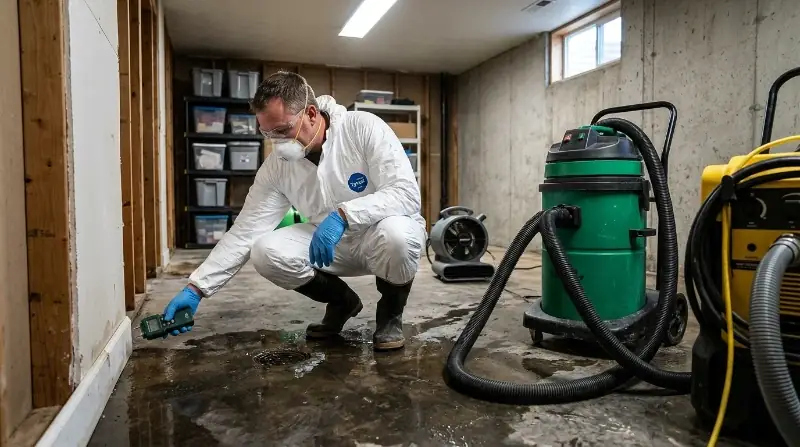
Every Cedar Valley sewer backup response — municipal or septic — follows the IICRC S500/S520 framework without exception: (1) system type identification and source assessment; (2) dispatch — typical 45–75 minute arrival to ZIP 84013, 24/7; (3) full PPE and negative air pressure containment; (4) industrial truck-mounted sewage extraction with EPA-compliant biohazardous waste manifesting; (5) full Category 3 material removal — carpet, drywall, insulation, subfloor, all documented for insurance; (6) EPA-registered antimicrobial decontamination per IICRC S520, HEPA air scrubbing, written clearance before reconstruction. Full insurance documentation package at no extra charge. Full IICRC S500 process →