
Why a Sewer Backup Turns Into Three Separate Bills
Most people expect one number. What they get is three, often from three different companies. The first is the sewage cleanup itself: extraction, tear-out of contaminated materials, disinfection, and drying. The second is the plumbing work to find and fix what caused the backup, usually a root-clogged or broken sewer lateral (the private pipe between your house and the city main). The third is the rebuild: new drywall, insulation, flooring, trim, and paint.
That split matters because each bill is paid differently. Insurance may cover the cleanup and rebuild under a backup endorsement but almost never the pipe repair. A city may help with cleanup when its main failed, but not when your lateral did. Knowing which bill is which is the fastest way to understand a Utah County sewer backup cost and to spot an estimate that bundles things it should not.
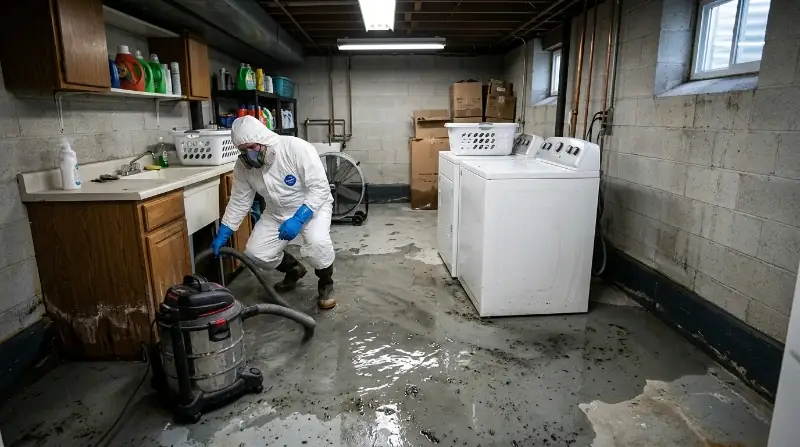
Bill One: Sewer Backup Cleanup Cost
National cost guides put sewage cleanup at roughly $7 to $15 per square foot, with most jobs landing between $2,000 and $15,000 (HomeGuide). HomeGuide breaks it down by scope:
| Scope | Typical cleanup cost |
|---|---|
| Small spill, one room | $2,000–$3,000 |
| Medium, several rooms | $3,000–$7,000 |
| Large contamination | $7,000–$15,000 |
| Extensive damage with repairs and restoration | $15,000–$50,000+ |
Three things move a job up that table. Square footage is the obvious one. Material type is the second: carpet, pad, drywall, and insulation that touch Category 3 water must be removed rather than dried, while concrete and tile can be cleaned in place. Time is the third and the one you control. Sewage that sits overnight wicks higher into drywall and deeper into subfloor, and the EPA advises drying water-damaged areas within 24–48 hours to prevent mold. A backup handled the same morning is a smaller job than the same backup found after a weekend away.
Common add-ons also show up on cleanup invoices: mold remediation if drying was delayed (HomeGuide lists $15–$30 per sq ft), indoor air quality testing ($200–$500), and after-hours emergency fees ($200–$500 with many companies). We do not charge extra for nights or weekends, but it is worth asking any contractor before they start.
Bill Two: Finding and Fixing the Sewer Line
Cleaning the basement does nothing if the cause is still there. Most Utah County backups trace to the private lateral: tree roots in clay joints, a sagging section that collects solids, or grease. Cities in the county are clear that this pipe belongs to the owner. Payson City, for example, states that maintenance and repair of the lateral line is the owner's responsibility and lists grease, tree roots, hair, and solid materials as the main private-side causes.
Camera inspection is the first step. Most sewer scopes run about $100–$500 (This Old House and HomeGuide); HomeAdvisor's national average, which includes harder jobs, is close to $1,000. Access through an exterior cleanout is cheaper than pulling a toilet or going through a roof vent.
Repair or replacement is priced per linear foot. HomeAdvisor's June 2026 figures:
| Method | Cost per linear foot | When it fits |
|---|---|---|
| Traditional dig-and-replace | $60–$250 | Collapsed pipe, shallow lines, open yards |
| Trenchless CIPP lining | $90–$250 | Cracked or root-damaged pipe that still holds its shape |
| Pipe bursting | $60–$200 | Replacing a full run under driveways or landscaping |
HomeAdvisor puts the national average sewer main repair at $3,319. To see how length changes things, take a 60-foot lateral: at $60–$250 per foot, full replacement lands anywhere from $3,600 to $15,000. Lot depth is why a home on a short downtown lot and one on a deep bench lot in the same county can get very different plumbing quotes.
Bill Three: Rebuild After Sewage Cleanup
Once the space is dry and cleared, it has to be put back. HomeGuide's per-unit numbers give a fair way to sanity-check a rebuild estimate:
- Drywall: $2–$4 per sq ft
- Flooring: $4–$15 per sq ft, depending on material
- Insulation: $1–$5 per sq ft
- Interior painting: $350–$850 per room
Worked example. A 600 sq ft finished basement with a 2-foot flood cut on 140 linear feet of wall needs about 280 sq ft of new drywall ($560–$1,120), insulation behind it ($280–$1,400), 600 sq ft of new flooring ($2,400–$9,000), and three rooms of paint ($1,050–$2,550). That is roughly $4,300 to $14,000 for the rebuild alone, before the cleanup bill. The spread is mostly flooring choice, which is why two honest estimates for the same basement can be thousands apart.
How Insurance Treats a Sewage Backup in Utah
A standard HO-3 homeowners policy excludes water that backs up through sewers or drains. Coverage comes from a separate water backup endorsement, which The Zebra reports typically adds $40–$250 a year, with limits most often between $5,000 and $25,000. Limits vary by carrier: one insurer's Utah underwriting guide offers up to $50,000, with a deductible equal to your other-perils deductible or $1,000, whichever is greater, and only lets you add it at renewal. Check your declarations page for the exact wording; "water damage" coverage is not the same thing.
Even with the endorsement, the policy usually pays for cleanup and the damage to your home, not for fixing the sewer line itself. Flood insurance is a separate question. The Utah Insurance Department notes that the NFIP covers a sewer backup only when it was directly caused by an active surface flood in the area, and flood policies usually carry a 30-day waiting period.
Utah also sets claim-handling deadlines. Under Utah Admin. Code R590-190, an insurer must acknowledge your claim within 15 days and, once it has a complete proof of loss, accept or deny within 30 days or explain in writing why it needs longer. Adjusters price most claims in Xactimate, which its maker Verisk says uses local completed-bid data updated monthly across more than 460 markets. An estimate written in the same line items is easier for an adjuster to approve, which is why we write ours that way.
When the City Main Causes Your Backup
If the blockage is in the public main rather than your lateral, the picture changes. West Jordan, for example, states that the city is responsible for mains and manholes and handles main repairs when a main blockage backs sewage into a home. A few Utah cities go further with limited no-fault assistance: Spanish Fork adopted a policy in 2015 offering up to $7,500 ($4,000 for cleanup and $3,500 for repair) when the city main is the cause, after homeowner insurance pays first. Policies like this change, so confirm the current terms with your city.
Timing matters here. Under the Utah Governmental Immunity Act (Utah Code 63G-7-402), a written notice of claim against a city or district must be filed within one year. When several homes on your street back up at once, tell us when you call; we report it to the city and document the timing so the main-line question is on record from the start.
What Prevention Costs Compared With a Backup
A backwater valve lets sewage leave the house but blocks it from coming back in, which is how the Insurance Information Institute describes it. Installed cost is usually $200–$1,000 (HomeServe, citing HomeGuide), more when the line must be excavated in an older home. Payson City recommends a back-flow valve on the lowest drains, especially in homes with basements.
Put next to a $7,000 cleanup, a $1,000 rebuild deductible, and a $3,000 lateral repair, a valve plus a camera inspection every few years is cheap. The endorsement is cheaper still. If your home has a finished basement and you do not have backup coverage, that is the single highest-value phone call to make this week.
DIY, Insurance, and Renters: Where the Money Really Goes
The most common question in homeowner forums after a backup is whether to clean it up yourself. For a few inches of sewage on bare concrete, people try a shop vac and bleach. The problem is what that misses: sewage carries pathogens into drywall, carpet pad, and insulation, a household vac sprays contaminated mist, and bleach mixed with ammonia-based cleaners gives off toxic gas. An incomplete cleanup can also give an insurer a reason to question the claim.
The second question is whether the water backup endorsement is worth it. It usually costs $50 to $250 a year; one finished-basement cleanup can cost $5,000 or more. Read the limit, because a $5,000 cap may not cover a large job. Septic owners, such as in Goshen, should check whether the endorsement mentions septic systems.
Renters ask who pays. Generally, the owner covers the building and the sewer line, and the renter's policy covers belongings. Where a city main caused the backup, a notice of claim must be filed within a year. Each city's rules are on our Utah County sewer backup cleanup page, and our Provo sewer backup cleanup team gives written estimates before work starts.
Utah County Sewer Backup Cost: Common Questions
How much does sewer backup cleanup cost in Utah County?
National guides put sewage cleanup at about $7–$15 per square foot, or roughly $2,000–$15,000 for most jobs. The plumbing repair and the rebuild are separate costs on top of that. Call (877) 394-0234 for a written estimate before any work starts.
Does homeowners insurance pay for the sewer line repair?
Usually not. A water backup endorsement typically covers cleanup and damage to the home, while repairing or replacing the private lateral is treated as maintenance and paid by the owner.
Is a backwater valve worth the cost?
For a home with a basement, usually yes. Installation commonly runs $200–$1,000, compared with several thousand dollars for one cleanup, and some Utah cities recommend one on the lowest drains.
How long do I have to file a claim if the city sewer main caused my backup?
Under Utah Code 63G-7-402, a written notice of claim against a city or district must be filed within one year. Document the date, photos, and whether neighbors were affected.
Why are two cleanup estimates for the same basement so different?
Usually the scope differs: how much drywall is cut, whether subfloor is replaced, and which flooring goes back in. Ask each contractor for line items, which makes the comparison clear.
Get a Written Number Before Work Starts
We measure, photograph, and write an itemized estimate before any tear-out begins, in the same line-item format adjusters use. For a quick range first, try the sewage cleanup cost calculator, or see the Provo cost breakdown for city-specific pricing. Call (877) 394-0234 any time, day or night.
- HomeGuide — Sewage Cleanup Cost
- HomeAdvisor — Sewer Main Repair Cost (2026)
- HomeAdvisor — Sewer Inspection Cost (2026)
- The Zebra — Sewer Backup Coverage
- Utah Insurance Department — Flood FAQ
- Utah Admin. Code R590-190-10
- Utah Code 63G-7-402
- Payson City — Sewer Backup Information
- Spanish Fork Resolution 15-11 (2015)
- EPA — A Brief Guide to Mold, Moisture and Your Home