
⚠ Sewage backup is a Category 3 biohazard — every hour raises cost and risk.  Call (877) 394-0234 now — 24/7
IICRC WRT & AMRT Certified
IICRC S500 & S520 Protocol
24/7 — No Extra Charge
Written Estimate Before Work Starts
Insurance Documentation from Hour One

Sewer Odor Removal Provo, Utah — AMRT Certified Source Elimination

Sewer odor removal in Provo starts with one fact: sewage smell after a cleanup means contamination remains. Our AMRT-certified team finds the source, removes contaminated material, applies EPA-registered antimicrobials, and verifies clearance. Masking agents are not acceptable under IICRC S520.

Source Elimination — Not MaskingAMRT CertifiedEPA-Registered AntimicrobialsClearance Testing

Sewage Smell After Cleanup Is a Warning, Not a Minor Issue

The IICRC S520 standard is explicit on this point: odor masking is not an acceptable remediation outcome. If sewage smell persists after cleanup, the contamination that caused it persists. The source must be identified and removed — not covered with deodorizers, ozone generators, or air fresheners. Odor that lingers after a Provo sewer backup cleanup almost always means contaminated material was left behind.

Persistent sewage smell after a Provo cleanup can indicate: porous materials that were not fully removed, decontamination applied incorrectly or at insufficient concentration, contamination that wicked into wall cavities beyond the visible cleanup zone, or drain P-trap failures unrelated to the original backup that are allowing sewer gas entry.
Do Not Use Ozone Generators or Deodorizers: Ozone generators mask odor temporarily and do not eliminate contamination. Deodorizers cover the smell of active microbial decomposition. IICRC S520 does not permit odor masking as a remediation outcome — it is a sign that the underlying contamination has not been addressed.
Utah Hills Restoration technician arriving at Provo home at night for emergency sewer odor removal service
24/7 emergency response — same price at 2 AM as 2 PM. Utah Hills Restoration is Provo's AMRT-certified sewer odor removal company. Sewage odor after cleanup means contamination remains. We find it and remove it.

AMRT Odor Elimination Process

  1. 1

    Source Identification

    Moisture meters and visual inspection identify where residual contamination is located. Common missed areas: inside wall cavities beyond the drywall removal line, under floor trench drains, inside HVAC ductwork that ran during the backup event, and in crawl space framing below the basement floor.

  2. 2

    Residual Material Removal

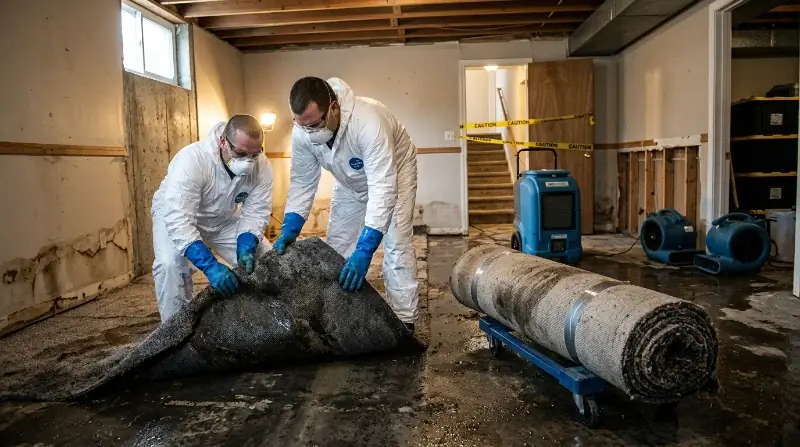
    Any porous materials identified as contaminated sources are removed. This may include additional drywall, subfloor sections, insulation, or HVAC components depending on the source. Removal documented with photographs for insurance records.

  3. 3

    EPA Antimicrobial Treatment

    EPA-registered antimicrobials applied at AMRT-specified concentrations to all affected structural surfaces. Contact time maintained per product label. HEPA air scrubbing continues throughout treatment to capture airborne particles.

  4. 4

    Clearance Verification

    Post-treatment air and surface samples confirm that odor-causing organic contamination has been eliminated and that airborne pathogen and mold levels are within safe baseline parameters. Written clearance provided before the job is closed.

Why does sewage smell remain after cleanup?

Residual sewage odor after cleanup indicates remaining contamination — either porous materials were not fully removed, decontamination was incomplete, or contamination wicked into areas beyond the visible cleanup zone. Odor-masking agents (ozone, deodorizers, air fresheners) cover the smell temporarily without addressing the source. IICRC S520 does not permit masking as an acceptable outcome.

Is sewer smell dangerous after cleanup?

Yes. Persistent sewage odor indicates ongoing organic decomposition from residual contamination. Hydrogen sulfide and methane are present in sewage gas at concentrations that cause headaches, nausea, and respiratory irritation. Residual E. coli, Norovirus, and other pathogens may remain in materials generating the odor. A space with persistent sewage smell after cleanup is not safe for normal occupancy.

About this page: Written and reviewed by Marcus R. Webb (IICRC Water Restoration Technician, IICRC Applied Microbial Remediation Technician) and Dana L. Sorenson (IICRC Water Restoration Technician). Content reflects IICRC S500, S520, Provo City Code §10.03.060, EPA & CDC guidelines, and 2026 HomeGuide pricing. Last reviewed September 2026. Last updated: 2026-10-20.

Sewage Odor Sources — What Each Smell Indicates

Odor Type Likely Source Protocol
Rotten egg / sulfur Hydrogen sulfide from active microbial decomposition in remaining porous material or drain P-trap failure Source identification — AMRT inspection required
Musty / earthy Mold growth on wet organic material — drywall, subfloor, wood framing — that remained after cleanup IICRC S520 mold protocol — additional remediation required
Sewage / fecal Residual contamination in porous materials — concrete block, subfloor, wall cavity insulation not fully removed Additional porous material removal and AMRT decontamination
Intermittent sewer gas Dry P-trap allowing sewer gas entry — common after basements sit unused post-cleanup, or in floor drains that are rarely used P-trap water refill or cap — not a remediation issue
Chemical / sweet after cleanup Masking agents applied by prior contractor covering active contamination Full source identification — previous cleanup may need to be re-done per IICRC S520

Seasonal Odor Patterns in Provo Basements

Provo homeowners frequently report sewer smell in March and April — even in homes that did not experience a visible backup. During Wasatch snowmelt events, the increase in sewer system flow volume can create positive pressure in the lateral, pushing sewer gas up through dry P-traps and into basements. This is distinct from a contamination issue — it indicates a backup occurred at the main line level (Provo City's responsibility under §10.03.060) that temporarily pressurized your lateral without causing standing water at the floor drain.

A second seasonal pattern: basements cleaned up after a January or February backup often develop odor in April, 6–8 weeks after cleanup. This is typically mold growth beginning on porous materials that were inadequately dried — the cold Utah winter slowed mold growth, which becomes active as temperatures rise in spring. If this describes your situation, the cleanup was not completed to IICRC dry standard.

Our AMRT source identification protocol distinguishes between these scenarios on arrival — the remediation required and its cost differ significantly between a dry P-trap and incomplete prior remediation.

HVAC Ductwork and Sewer Odor — A Frequently Missed Source

In Provo homes where forced-air HVAC systems ran during a sewage backup event, the ductwork becomes a secondary contamination source that most cleanup contractors do not address. Bioaerosols drawn into the return air register during the backup — especially if the air handler is in the basement — can contaminate duct surfaces throughout the system. Six months after a cleanup that did not include duct evaluation, a Provo homeowner may notice sewage odor recurring each time the furnace runs for the first time in fall.

Our AMRT source identification protocol includes a check of the air handler and return registers in the affected area. If the HVAC was running during the event, we note it in the scope document. Full duct cleaning and decontamination is a separate specialty — we can refer you to NADCA-certified duct cleaning contractors in Utah County who can address the ductwork after our structural decontamination is complete.

Written Clearance Before Re-Entry — What the Document Means

The written clearance Utah Hills Restoration provides at job close is not a marketing document — it is a record of the post-remediation clearance test results showing that surface and air samples from the affected area returned values within acceptable baseline parameters for the pathogen markers tested. It names the specific tests performed, the sampling locations, the test results, and the IICRC standard against which they were evaluated.

Keep this document with your home records. If you sell the home within 5 years, disclosure of a prior sewage backup is required in Utah. The written clearance document is your evidence that the event was remediated to standard — significantly more valuable in a disclosure context than a verbal statement from a contractor. It also establishes the baseline for any future claim: if another backup occurs and the question arises of whether prior contamination caused new damage, the clearance document shows the condition of the space after the prior event.

Do not re-enter a Category 3 affected space for extended periods — sleeping, working from home, cooking nearby — until written clearance is in hand. Short-duration entries with normal precautions (no touching affected surfaces, good ventilation) while the space is being dried are typically acceptable. Your crew will advise based on the specific conditions of your space.