
Utah County: One County, Many Sewer Systems
Utah County grew from 659,399 people in the 2020 Census to 759,859 in the 2025 estimate, about 15% in five years, making it the second most populous county in Utah. There is no single county sewer. Each city runs its own collection system, and treatment is split among city plants and districts. In the south county alone, Payson treats wastewater for Payson, Elk Ridge, and Woodland Hills; Spanish Fork and Mapleton share a new plant that started up in 2025; Springville, Salem, and Santaquin each run their own; and Goshen has no public sewer at all, relying entirely on septic. For sewage cleanup, Utah County homeowners deal with a different set of sewer rules in nearly every city.
What every city shares is a state rule. Under Utah Code § 11-8-4, each public sewer provider must tell customers twice a year whether the owner or the provider is responsible for repairing the sewer lateral, the private pipe from the house to the main. In the Utah County cities we have checked, the answer is the owner. That makes the private lateral the most common source of the backups we clean.
Sewage Backup Cleanup by City
Each city page covers who runs the sewer, local rules, and the risks that drive backups there.
| City | ZIP | What to know locally |
|---|---|---|
| Provo | 84601–84606 | Pre-1980 clay and cast iron laterals; Utah Lake water table on the west side |
| Orem | 84057, 84058, 84097 | 1960s–80s clay pipe; dense rentals near UVU |
| Springville | 84663 | Owner maintains lateral (§ 4-14-202); 14 lift stations |
| Spanish Fork | 84660 | City no-fault help up to $7,500 for main-line backups |
| Mapleton | 84664 | Ejector pumps required where basements drain below the sewer |
| Salem | 84653 | Storm water and window wells vs sewage; Snake Creek floods |
| Payson | 84651 | City lists grease, roots, hair and solids as main causes |
| Santaquin | 84655 | Laterals are residents' responsibility; newest homes in the south county |
| Goshen | 84633 | All properties on septic; town sewer targeted around 2036 |
| Elberta | 84626 | Unincorporated; rural septic systems and private wells |
| Lindon | 84042 | PVC laterals at 20–35 years |
| Pleasant Grove | 84062 | Old downtown clay laterals; Timpanogos runoff |
| American Fork | 84003 | Canyon snowmelt; historic downtown laterals |
| Lehi | 84043 | Old Town clay and newer Silicon Slopes PVC |
| Alpine | 84004 | Mature tree roots; high-end finishes |
| Vineyard | 84059 | High water table on former lakeside land |
| Saratoga Springs | 84045 | Utah Lake shoreline groundwater |
| Eagle Mountain | 84005 | Long laterals; shifting clay soils |
| Cedar Valley | 84013 | Rural lots; mix of sewer and septic |
Utah Lake Rules Are Rebuilding the County's Treatment Plants
Phosphorus limits meant to protect Utah Lake are driving a wave of plant rebuilds in the south county: Salem commissioned a new plant in 2020, Spanish Fork and Mapleton's plant started up in 2025, Santaquin began a third expansion in 2025, and Payson's replacement plant is due to take over in 2026–2027. Springville added phosphorus removal in 2021.
These are real improvements, but they work downstream. None of them change the condition of the pipe under your yard. A 1960s clay lateral in Provo or a sagging new PVC line in Santaquin is just as likely to back up the week a new plant opens.
2023: The Record Runoff Year
In April 2023, Utah's statewide snowpack peaked at about 30 inches of snow water equivalent, roughly twice normal and an all-time record according to the Utah Department of Natural Resources and the NRCS Snow Survey. Utah County declared a flood emergency, the Spanish Fork River ran at about 2,000 cubic feet per second, and Springville's Hobble Creek and Payson Canyon both saw high flows and damage. In early 2024, Utah Lake reached its legal compromise elevation of 4,489 feet for the first time in more than a decade, triggering controlled releases into the Jordan River.
Runoff years cause two kinds of basement water: groundwater and floodwater coming in from outside, and sewer backups when high groundwater infiltrates cracked pipe and fills lines. They are classified and insured differently. Our guide to Category 3 water damage in Utah County explains how to tell them apart.
Utah Sewage Cleanup: How We Work Across the County
Every job follows the IICRC S500 and S520 standards: stop the source, contain the area, extract with truck-mounted equipment, remove porous materials that touched sewage, apply EPA-registered antimicrobials, and dry to a measured standard before clearance. We photograph and itemize everything in the format adjusters use, and when a city main may be involved, we report it and document the timing, because a written notice of claim against a city must be filed within one year in Utah. Every Utah sewage cleanup we take on starts with the same steps; what changes from city to city is the paperwork and who owns the pipe.
Cleanup typically costs $7–$15 per square foot; the Utah County sewer backup cost guide covers the separate plumbing and rebuild costs, and this timeline explains how long each stage takes.
The First Hour of a Sewage Backup in a Utah County Home
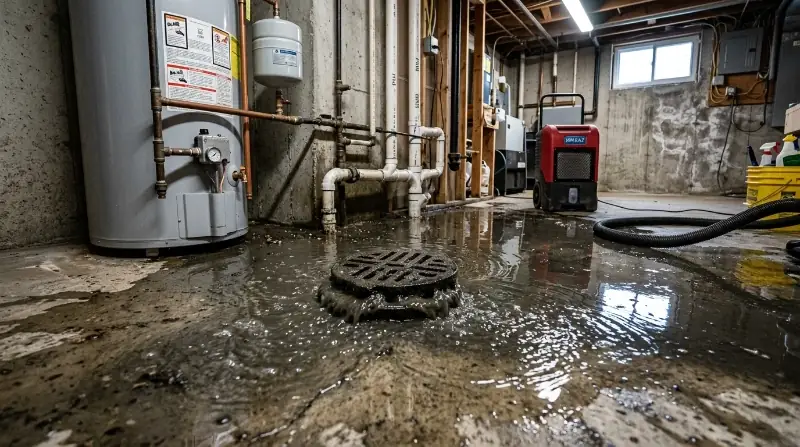
Every city sewer in Utah County is a sanitary sewer that runs on gravity. Wastewater leaves the house through the lateral, drops into a city main, and flows through larger trunk lines and manholes to a treatment plant. When a clog or a surge raises the pressure in that main, sewage looks for the lowest open exit, and in most homes that is a basement floor drain or shower.
What you do before the crew arrives matters. Stop all water use in the house. Keep children and pets out of the room, because sewage carries E. coli, norovirus, and other pathogens. Skip the shop vac and the bleach: a household vac spreads contaminated mist, and bleach mixed with ammonia-based cleaners gives off toxic chloramine gas. If there is an outdoor cleanout, a plumber can open it to take the pressure off the house. Photograph everything before moving anything, then check whether your policy has a water backup endorsement, since standard homeowners policies exclude backups without one. Renters should notify the landlord in writing the same day. Our Provo sewer backup cleanup team runs every Utah County call this way.
Response Times From Our Provo Base
We dispatch from 356 N 100 W in Provo, near the middle of the county. Springville is about 15 minutes away, Spanish Fork about 16, Mapleton about 20, Payson about 22, Salem about 24, Santaquin about 27, Goshen about 37, and Elberta about 41. Our promise is the same everywhere in the county: a crew on site in 1–3 hours, 24/7, with no extra charge for nights, weekends, or distance. That is what 24/7 sewer cleanup in Utah County, UT, means in practice: the same crew and the same rates at any hour.
Utah County Sewer Backup Cleanup: Common Questions
Who is responsible for a sewer backup in Utah County?
It depends on where the blockage is. Utah cities must tell customers twice a year who repairs the lateral; in the cities we have checked, the owner is responsible for the private lateral and the city for its mains.
Do you serve all of Utah County?
Yes. We serve every Utah County community, from Lehi and Eagle Mountain to Payson, Santaquin, Goshen and Elberta, with a 1–3 hour response, 24/7.
Is a septic backup handled differently?
The cleanup is the same Category 3 process. The repair outside is done by a septic contractor instead of a sewer plumber.
Does any Utah County city help pay for sewer backups?
Spanish Fork has a no-fault policy that may pay up to $7,500 when a city main causes the backup, after the owner's insurance. Ask your own city about its policy.
How much does sewer backup cleanup cost in Utah County?
Typically $7–$15 per square foot, or roughly $2,000–$15,000 for most jobs, with plumbing and rebuild billed separately. Call (877) 394-0234 for a written estimate.
- U.S. Census QuickFacts — Utah County
- Utah Code § 11-8-4 — Sewer lateral disclosure
- Utah DNR — Record snowpack expected to trigger flooding (2023)
- NRCS — Water supply outlook details record snowpack (2023)
- KSL — Controlled releases planned at Utah Lake (2024)
- Spanish Fork City — Sewer
- Goshen General Plan (2022)