
Why Grandview Has Unique Sewer Backup Risk
Grandview sits on elevated terrain above the Provo Valley floor. Hillside construction reduces standing water risk but introduces a different failure mechanism: steep grades put significant mechanical stress on lateral joints as Lake Bonneville clay soil shifts seasonally on the slope. Offset joints from soil movement are Grandview's primary backup cause — a different problem than root intrusion (Joaquin) or groundwater (West Provo), requiring different diagnostic approach on arrival. Grandview is part of our core Provo sewer backup service area, with the same 1–3 hour response as the rest of the city.
Pipe Age and Infrastructure in Grandview
Grandview developed heavily in the 1960s–1980s. Laterals running downhill on steep grades experience more joint movement than flat-grade installations in the valley. Joints that were properly aligned in 1970 have shifted 1–2 inches over 50 years of seasonal freeze-thaw cycles. PVC laterals installed in the 1980s — usually more durable — show stress cracking in Grandview from hillside soil dynamics not present in valley neighborhoods.
Frequently Asked Questions
How fast can you respond to a sewer backup in Grandview, Provo?
Grandview is a short drive up from our downtown office, and our crew reaches hillside addresses within 1 to 3 hours, 24 hours a day. No extra charge for nights, weekends, or holidays. Call (877) 394-0234 for immediate dispatch.
What causes sewer backups in Grandview?
Grandview's hillside location puts mechanical stress on lateral joints as Lake Bonneville clay soil shifts seasonally on the slope. Offset joints from soil movement are the primary backup cause — different from root intrusion in Joaquin or groundwater in West Provo. Joints that were aligned in 1970 may have shifted significantly after 50 years of freeze-thaw cycles on Grandview's steep grades.
Does homeowners insurance cover sewer backup cleanup in Grandview?
Not under a standard Utah HO-3 policy — sewer backup needs its own endorsement, typically $40–$250 a year for $5,000–$25,000 of coverage. With finished basements common in Grandview, check that your limit covers a full lower level. We document the job from hour one to support the claim.
What is IICRC Category 3 sewage cleanup?
Category 3 is the IICRC S500 classification for raw sewage — E. coli, Norovirus, Hepatitis A, and Giardia (CDC). In Grandview's finished basements that usually means carpet, pad, baseboards, and the bottom of the drywall come out. Drying porous materials in place is never allowed.
An Illustrative Grandview Backup Scenario
In a scenario typical for this neighborhood: a homeowner on Grandview Avenue calls about sewage backing up through the basement floor drain. No history of backups in 18 years. Camera inspection finds a 1.8-inch lateral joint offset at the 22-foot mark — hillside soil movement shifted the pipe section. Root intrusion is minimal on this lot. The offset catches tissue and builds blockages over months, then backs up dramatically in winter when flow slows. Cleanup cost: in the $3,500–$5,500 range for a finished basement event of this scope. Lateral repair: typically $3,500–$5,000 for directional boring under the grade (standard excavation is difficult on Grandview's slope). Actual costs vary with square footage, materials affected, and contamination level — this example is illustrative, not a quote.
Highest-Risk Streets in Grandview
Grandview Avenue and surrounding hillside streets between 1500 and 2200 North carry the steepest grade in the area. Homes above Grandview Hill Road carry elevated lateral joint displacement risk due to grade and soil type. Construction era 1965–1982 dominates this slope — solvent-weld PVC connections from this period are more vulnerable to joint displacement than modern push-fit fittings installed after 2000.
Seasonal Backup Risk in Grandview
Peak risk: November–February — freeze-thaw cycles stress hillside lateral joints more aggressively than valley-floor areas. When wet soil freezes, it expands laterally and vertically, moving lateral pipe joints. Spring thaw creates the opposite movement. After 50 cycles of this annual stress, joints that looked fine on camera in 2010 may have shifted significantly by 2026.
Why Hillside Location Changes the Backup Diagnosis
Grandview's elevation advantage means gravity drainage works better than lower Provo neighborhoods — main line surges affect Grandview less than Joaquin or Riverside. However, the hillside location means that when a Grandview lateral fails, it tends to fail from soil movement rather than root intrusion, which requires camera inspection to diagnose accurately before any lateral repair is planned.
Grandview sits inside ZIP 84604; that page covers the wider North Provo area, including Edgemont and Rock Canyon.
Our IICRC S500 Cleanup Process
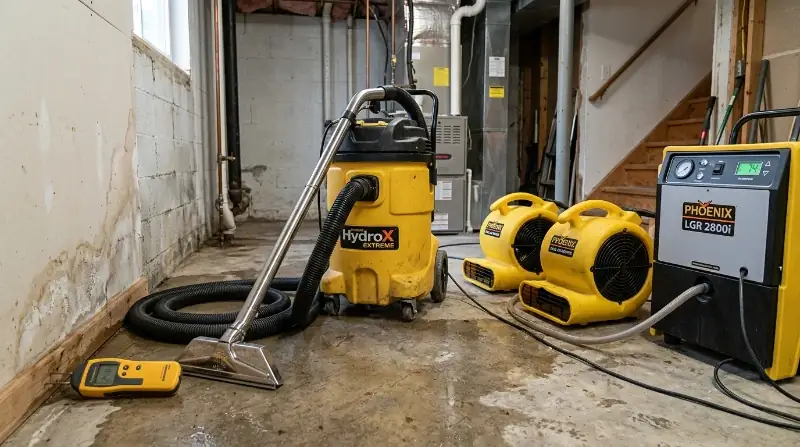
On Grandview's hillside lots we also trace where the lateral offset, because the same joint can fail again. The cleanup itself follows the published protocol: containment, industrial extraction, porous material removal, AMRT decontamination, drying to a measured standard, and written clearance testing. See the sewage cleanup steps we use across Provo →
Cleanup Cost in Grandview
Grandview homes from the 1970s–1990s often have finished lower levels, which pushes many jobs toward the upper half of the Provo range of $2,000–$10,000 ($7–$15 per square foot). A fast call keeps the damage to one room; at 24+ hours the cost can double. Use the free cost calculator for a specific estimate →