Why AMRT Certification Matters for Sewage Decontamination
Decontaminating a Category 3 sewage event requires more than bleach and a mop. AMRT (Applied Microbial Remediation Technician) certification from the IICRC covers EPA-registered antimicrobial application chemistry, contact time requirements for specific pathogens, HEPA air filtration during treatment, and post-remediation verification methods. Generic water damage contractors without AMRT certification often apply incorrect products at incorrect concentrations — leaving your family at risk from a space that looks clean but is not. Decontamination is a required stage of every sewer backup cleanup in Provo we handle, never an optional add-on.
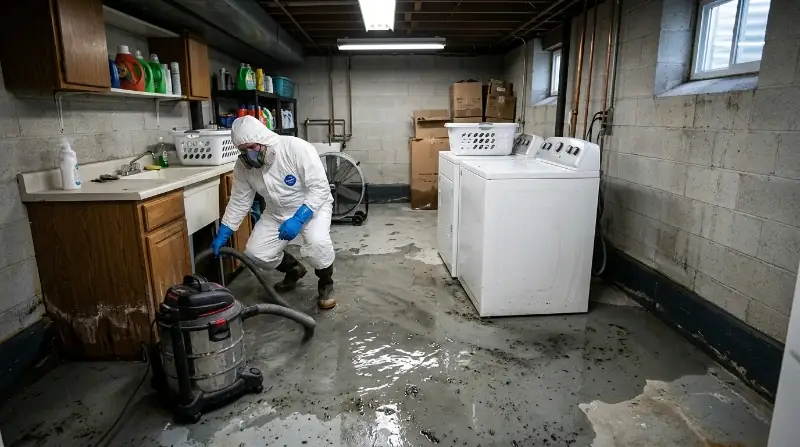
AMRT-certified technician logs moisture readings across all surfaces before antimicrobial application begins.
The AMRT Decontamination Process
- 1
Surface Preparation After Extraction
All porous materials have been removed per IICRC S500. Remaining structural surfaces — concrete, framing lumber, block, tile — are cleaned of gross contamination before antimicrobial application. Antimicrobials applied to soiled surfaces have significantly reduced efficacy.
- 2
EPA-Registered Antimicrobial Application
EPA-registered antimicrobials are applied to all affected structural surfaces at IICRC-specified coverage rates. Contact time is maintained per product label requirements — the most common error is insufficient dwell time that leaves pathogens alive.
- 3
HEPA Air Scrubbing Throughout
HEPA-filtered air scrubbers run continuously throughout decontamination to capture bioaerosols, antimicrobial mist, and residual sewage particles from the air. Air changes per hour maintained at IICRC-specified rates for the volume of the affected space.
- 4
Post-Remediation Clearance Testing
Surface samples and air samples taken after decontamination to verify pathogen and mold levels have returned to baseline. Written clearance provided before your family re-enters the space. No clearance = do not re-enter.
What does AMRT certification mean for sewage decontamination?
AMRT (Applied Microbial Remediation Technician) is an IICRC certification for microbial contamination including sewage, mold, and biohazard cleanup. AMRT-certified technicians are trained in EPA antimicrobial chemistry, pathogen-specific contact time requirements, HEPA air filtration, and post-remediation verification. Not all water damage contractors hold AMRT certification — always verify before allowing decontamination work to begin.
What is clearance testing after sewage decontamination?
Clearance testing takes surface and air samples after decontamination to verify pathogen and mold levels have returned to safe baseline. Without clearance testing, there is no documented proof that decontamination succeeded. Utah Hills Restoration provides written clearance before leaving any decontaminated space — do not allow your family to re-enter without it.
About this page: Written and reviewed by Marcus R. Webb (IICRC Water Restoration Technician, IICRC Applied Microbial Remediation Technician) and Dana L. Sorenson (IICRC Water Restoration Technician). Content reflects IICRC S500, S520, Provo City Code §10.03.060, EPA & CDC guidelines, and 2026 HomeGuide pricing. Last reviewed September 2026. Last updated: 2026-10-20.
Why Contact Time Is the Most Overlooked Decontamination Variable
EPA-registered antimicrobials require a minimum dwell time on the surface — called contact time — to eliminate specific pathogens. For E. coli and Norovirus, the most common Category 3 contaminants found in Provo sewer events, contact time requirements range from 1 to 10 minutes depending on the specific product and its concentration. The most frequent decontamination error we see behind failed previous remediation attempts: antimicrobial was applied, then immediately wiped or dried before the minimum contact time was reached.
A surface that looks clean and dry after an antimicrobial wipe is not necessarily decontaminated. Our AMRT technicians follow product label contact time protocols for every surface, every time — and our clearance testing verifies the result before we leave the property.
Pathogens in Category 3 Sewage — Survival and Risk Profile
| Pathogen |
Category |
Surface Survival |
Infectious Dose |
| E. coli O157:H7 |
Bacterium |
Days to weeks on dry surfaces |
As few as 10–100 cells (CDC) |
| Norovirus |
Virus |
Weeks on non-porous surfaces without decontamination |
As few as 18 viral particles (CDC) |
| Hepatitis A |
Virus |
Up to 1 month on surfaces at room temperature |
Low — fecal-oral route |
| Giardia lamblia |
Parasite (cyst) |
Months in moist environments |
10–100 cysts (CDC) |
| Clostridium difficile |
Bacterium (spore) |
Up to 5 months on hospital surfaces |
Spore-forming — resistant to standard cleaning |
Sources: CDC, EPA. This table illustrates why AMRT-certified decontamination with verified contact time is required — not optional — for Category 3 sewage events.
Provo-Specific Decontamination Considerations
Provo's older housing stock — particularly in Joaquin, Riverside, and Franklin — presents specific decontamination challenges. Pre-1980 concrete block basement walls are porous. Sewage absorbed into unsealed block is difficult to fully decontaminate because antimicrobials cannot penetrate the block matrix. Our protocol for block basement walls: thorough surface cleaning of gross contamination, AMRT-specified antimicrobial at full concentration on all exposed surfaces, extended dwell time, and clearance testing that samples from both surface and air — because block walls can off-gas even after surface decontamination appears complete.
In finished Provo basements — drywall over block, with carpet and subfloor — the decontamination scope after porous material removal includes the block surface behind the removed drywall, the bottom plate, and any framing studs that were in contact with the sewage zone.
HEPA Air Scrubbing After Sewage Decontamination
Liquid disinfection eliminates surface pathogens, but aerosolized bioparticles remain suspended in basement air for hours after sewage removal. During extraction and demo, sewage solids are disturbed — releasing E. coli, Norovirus, and mold spores into the breathing zone. This is why AMRT protocol requires HEPA air scrubbing as a mandatory final stage, not optional cleanup.
HEPA filters capture particles down to 0.3 microns at 99.97% efficiency. Bacteria measure 1–10 microns; mold spores 3–40 microns — both fully within HEPA capture range. Air scrubbers run continuously for a minimum 4-hour post-decontamination cycle in a sealed containment zone before we remove negative air equipment.
In Provo's older concrete-block basements — common in Riverside and Joaquin — unsealed block face creates micro-pockets where bioaerosols settle. We run air scrubbers positioned to pull cross-circulation through block wall faces specifically. On Category 3 calls in finished basements, we add a second 24-hour HEPA cycle after drywall demo to clear disturbed wall cavities before reconstruction starts.
Re-Remediation vs. New Decontamination: What the Difference Costs You
Re-remediation occurs when a decontamination job is incomplete on first pass — missed areas, inadequate dwell time, or structural materials that weren't tested post-treatment. Insurance adjusters track re-remediation frequency as a contractor quality metric. A second dispatch for the same loss event is billed under a separate line item and often triggers a coverage review.
The most common driver of re-remediation in Utah County is mold growth that develops 48–72 hours after a sewage event when wet organic materials weren't fully removed. IICRC S520 treats mold co-occurring with Category 3 water as a combined protocol — both must be addressed in the same remediation scope. If an initial contractor documented sewage cleanup only and missed early mold indicators, the subsequent mold job is a new claim event under a different endorsement.
When you call us on a sewage backup, our scope assessment includes a moisture mapping pass on all adjacent materials before decontamination begins. If wood framing shows readings above 19% MC or drywall above 1% WME, those materials go into the demo scope before decontamination — not after, which is the sequence that prevents re-remediation calls 10 days later.