
Magna Water District Runs Its Own Sewer and Treatment Plant
Unlike most of the Salt Lake Valley, Magna has its own wastewater treatment plant. Magna Water District, formed by the Salt Lake County Commission in 1949, provides water and sewer to Magna and parts of West Valley City and Salt Lake City, with more than 9,700 connections. Its 2020 Sewer Master Plan describes a plant built in 1985 at 3.3 million gallons a day, with permitted capacity raised to 4.0 million gallons a day in 2009.
The collection system is about 103 miles of pipe across roughly 9.25 square miles, bounded by the Oquirrh Mountains to the west. It has no lift stations; everything flows by gravity. That is an advantage, because there is no pump to fail, but it also means slope and pipe condition do all the work, and a sagging or root-filled lateral has nothing to push flow past it.
Groundwater in the Pipes: Magna's Infiltration Problem
The most useful number in the master plan for homeowners is infiltration. Groundwater entering the district's pipes was planned at about 0.72 million gallons a day, roughly 34% of domestic flow, with a historical range of 22–34%. It later dropped to about 0.47 million gallons a day, partly because less flood irrigation lowered the groundwater.
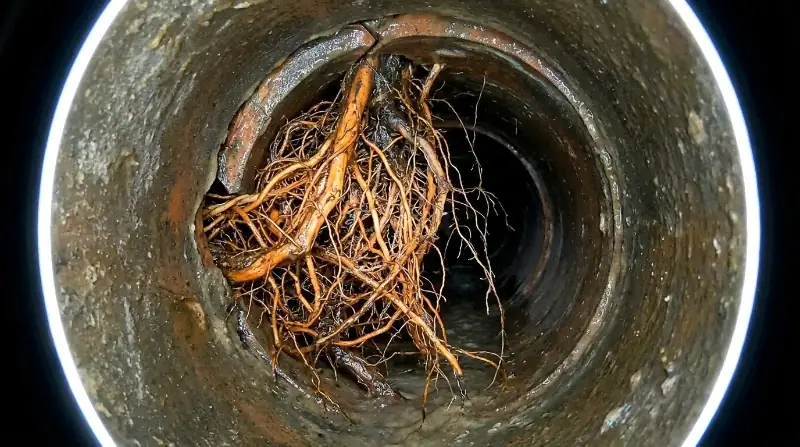
Infiltration happens through cracked pipe, loose joints, and old manholes. The same defects in a private lateral let groundwater in and let roots through, and both reduce how much sewage the line can carry. That is why Magna backups often follow wet periods: the ground is saturated, the pipes are carrying extra water, and the weakest lateral on the block fails first.
It also means some basement water in Magna is not sewage. Water seeping evenly through a slab is usually Category 2 under the IICRC S500 standard. Water from a floor drain or toilet is Category 3 and needs a different cleanup. We confirm which one you have before any tear-out.
Old Mill Town and New Subdivisions
Magna was settled in 1868 as Pleasant Green. Utah Copper built the Magna Mill in 1906, the town took the name Magna, Latin for "great," when its post office adopted it in 1915, and the historic Main Street with the Empress Theatre still anchors the old core. Census data compiled from the ACS shows about 9% of Magna homes built before 1940, far more than most west-side communities, and those homes carry the oldest building sewers in town.
Magna is also one of the fastest-growing places in the county: from 29,251 residents in the 2020 Census to 35,401 in the 2025 estimate, about 21% growth in five years. New subdivisions bring PVC laterals that resist roots, but new pipe can still settle in fresh trench backfill or be connected at a poor slope. Both old and new homes back up here, for different reasons.
After the 2020 Magna Earthquake
On March 18, 2020, a magnitude 5.7 earthquake struck with its epicenter just north of Magna. The Utah Geological Survey documented liquefaction features near the epicenter, including sand boils and small ground cracks, and Unified Fire reported brick damage on more than 13 buildings along historic Main Street. More than 2,500 quakes were recorded in the sequence through early 2021.
There are no public reports of widespread sewer damage from the quake, and we will not claim there were. But ground shaking and liquefaction are the kind of movement that can crack or offset older buried pipe, and damage like that can stay hidden for years until roots exploit it or a joint separates. If your Magna home has an older lateral and you have noticed slow drains or sewer odor since 2020, a camera inspection is a sensible, inexpensive check.
Sewage Cleanup in Magna: What Gets Removed
Once sewage reaches a finished basement, porous materials come out: carpet and pad, drywall cut above the wet line, insulation, and particleboard cabinets and trim. Concrete, tile, and metal are cleaned and disinfected in place. We extract with truck-mounted equipment, apply EPA-registered antimicrobials, and dry the structure to a measured standard before clearance. Our decontamination page covers that stage in detail.
Who Pays for a Magna Sewer Line Repair?
Across the Salt Lake Valley, sewer providers place the private lateral on the property owner: Salt Lake City, Granger-Hunter, and Midvalley all say so in writing. Confirm the specific rule for your address with Magna Water District. In most cases the plumbing repair is the owner's cost, cleanup is covered only if your homeowners policy has a water backup endorsement, and a public-main failure should be reported promptly, because a written notice of claim against a public entity in Utah must be filed within one year.
Protecting a Magna Basement: Cleanouts, Valves, and Sump Lines
Magna's infiltration problem works both ways. Groundwater entering cracked pipe adds flow to the district's gravity sanitary sewer, and a sump pump plumbed into a floor drain adds even more. The sanitary sewer is meant for household wastewater only; storm and sump water belong outdoors or in storm drains. When the mains run full, surcharge pressure finds the lowest fixture, and a backwater valve on that line is the fix.
Know where your cleanout is. Older Magna homes near Main Street may not have an outdoor cleanout at all, and adding one gives a plumber a way to clear the lateral without pulling a toilet. Cleanup itself typically runs $7 to $15 per square foot, with plumbing repairs on top.
First steps if it happens: stop all water use, keep everyone out of the sewage, and do not mop it toward the drain or use bleach. If you rent, tell the owner the same day. Our Provo sewer backup cleanup crew responds to Magna in 1–3 hours.
Our Response in Magna
We dispatch from Provo, roughly 45–50 miles away, and arrive in 1–3 hours, 24/7, with no extra charge for nights or weekends. We cover all of 84044, from the Main Street core to the newer neighborhoods toward the Oquirrh foothills. Call (877) 394-0234 and tell us whether water is coming from a drain or through the floor; it changes what we bring.
East of Magna, West Valley City falls under Granger-Hunter, and West Jordan to the southeast runs a city system.
Magna Sewer Backup Cleanup: Common Questions
Who treats Magna's sewage?
Magna Water District operates its own wastewater treatment plant, built in 1985 and permitted for 4.0 million gallons a day since 2009, according to its 2020 Sewer Master Plan.
Why does my Magna basement get water after wet weather?
High groundwater can seep through the slab and also infiltrate cracked sewer pipe, filling lines that are already near capacity. We confirm whether it is seepage or sewage before cleanup.
Could the 2020 earthquake have damaged my sewer line?
There are no public reports of widespread sewer damage, but ground movement can crack older pipe. A camera inspection is an easy way to check if you have slow drains or odor.
How fast can you reach Magna?
Our crew arrives within 1–3 hours, 24/7, across ZIP 84044. Call (877) 394-0234.
Is sewage cleanup covered by insurance in Magna?
Only with a water backup endorsement on your homeowners policy. Standard policies exclude sewer backup.