
Goshen Has No Public Sewer: Every Backup Is a Septic Backup
Goshen's 2022 General Plan states that "all residential, industrial, and commercial uses in Goshen currently rely on a septic sewer system," and sets a goal of funding and building a town sewer around 2036. Until then, there is no city main to blame and no city to call. When sewage comes up a Goshen drain, the cause is somewhere between the house and the septic system: the line to the tank, the tank itself, or the drain field.
Onsite wastewater systems in Utah are regulated under state rule R317-4 and administered through local health departments, so repairs or replacements usually require a permit. The cleanup inside the house is our job; pumping, inspecting, and repairing the system is a septic contractor's.
Why Goshen Septic Systems Back Up
Septic backups have a short list of causes. A tank that has not been pumped fills with solids until they block the outlet. Baffles inside older tanks corrode or collapse. Roots grow into the line or the drain field. And a drain field that is saturated, by heavy use, a broken pipe, or high groundwater, cannot accept more water, so it backs up toward the house.
Goshen has two local factors. First, its housing is old: Census data compiled from the ACS shows about 32% of Goshen homes built in 1939 or earlier, the oldest stock in south Utah County, with a median build year of 1976, so many tanks and lines are decades old. Second, the town sits at the southern end of Goshen Bay on Utah Lake; the General Plan describes fluvial soils and a high liquefaction potential across much of the northern half of town, a sign of wet, loose ground near the lake. Saturated soil around a drain field is a classic cause of slow drains and backups in spring.
Warning Signs Before a Septic Backup
- Gurgling from drains or toilets, especially after laundry or showers
- Slow drains on the lowest level of the house
- Sewage odor indoors or near the tank and drain field
- Soggy ground, standing water, or unusually green grass over the drain field
- Water backing into a tub or floor drain when the washing machine empties
If you notice any of these, cut water use to a minimum and have the tank pumped and inspected before it overflows into the house. A pump-out is far cheaper than a basement cleanup.
Septic Sewage Cleanup in a Goshen Home
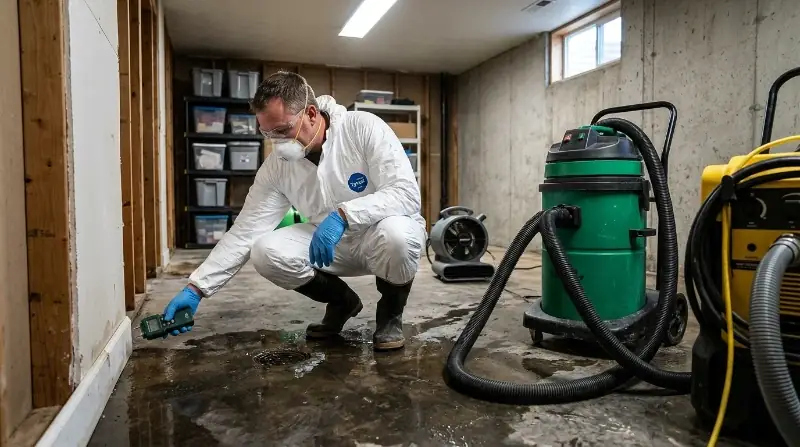
Septic sewage carries the same pathogens as city sewage, so the IICRC S500 standard treats it as Category 3. That means carpet, pad, drywall that wicked water, and insulation are removed rather than dried, and every affected surface is cleaned and disinfected with EPA-registered antimicrobials. We contain the area, extract with truck-mounted equipment, and dry to a measured standard before clearance.
Do not run the washing machine or flush to "test" the system, and do not pour bleach or additives into a backed-up tank. Stop water use, keep people and pets away from the affected room, and call both a septic pumper and us. For deeper detail on removal, see sewage decontamination.
Insurance and Septic Backups
A standard homeowners policy excludes water that backs up through sewers or drains, and septic backups are usually treated the same way. Coverage comes from a water backup endorsement, typically $40–$250 a year, and it generally pays for cleanup and damage to the house, not for repairing the septic system, which is treated as maintenance. Read your endorsement: some name septic systems specifically. Our itemized estimate and photos are written for your adjuster.
Goshen, Then and Now
Goshen was settled in 1857 and named after Goshen, Connecticut, and incorporated in 1910. The 2020 Census counted 978 residents. Irrigation runs deep here, from an 1857 dam on Current Creek to the Goshen Irrigation Company ditches and the Strawberry High Line Canal that reaches the town. Between Goshen and Elberta sits the Church's motion picture studio south campus, whose Jerusalem set has been used for Bible videos and The Chosen.
Septic Tank vs Sanitary Sewer: What Changes for Goshen Owners
In a city, a sanitary sewer carries wastewater by gravity from each house to a main, through manholes and trunk sewers, to a treatment plant. When a city main clogs, the city may share responsibility. Goshen has none of that. The pipe from your house, the building sewer, runs by gravity to your own tank, and the drain field does the treatment. There is no main to surcharge and no city to file a claim with, so the owner pays for every repair, and the cause is almost always on the property.
A cleanout between the house and the tank lets a pumper or plumber check whether the blockage is in the line or the tank. A backwater valve, which protects city homes from a surcharged main, does little for a full septic tank. Old cast iron or clay building sewers, common in older Goshen homes, crack and let roots in. Surface runoff ponding over the drain field saturates the soil, so grade the yard to send water away from it.
Goshen's 2015 boil order involved the town's culinary water, not wastewater, but a septic failure near a private well is a reason to test that well. Renters should report a backup to the owner the same day. Our Utah sewer backup cleanup crew handles septic jobs the same as sewer jobs.
Sewer Backup Cleanup Goshen Response
Goshen is about 30 miles from our Provo base, roughly 37 minutes, and our crew arrives in 1–3 hours, 24/7, anywhere in 84633, along Main Street, Center Street, 350 South, and the outlying farm roads.
Our crew comes through Santaquin to reach Goshen and serves neighboring Elberta, also on private systems. For city sewer areas, see the Utah County overview.
Goshen Sewer and Septic Backup: Common Questions
Does Goshen have a city sewer system?
No. Goshen's 2022 General Plan says all uses in town rely on septic systems, with a goal of building a town sewer around 2036.
Is a septic backup as dangerous as a sewer backup?
Yes. Septic sewage is Category 3 under IICRC S500, so porous materials must be removed and surfaces disinfected.
Why does my Goshen septic back up in spring?
Saturated soil around the drain field cannot accept water. Goshen sits near Utah Lake on wet, loose soils, and spring is when ground is wettest.
Who fixes the septic system after cleanup?
A licensed septic contractor pumps, inspects and repairs the system; repairs usually need a health department permit. We handle the cleanup inside the home.
How fast can you reach Goshen?
Our crew arrives within 1–3 hours, 24/7, in ZIP 84633. Call (877) 394-0234.