
Who Owns the Sewer Line in West Valley City
Most of West Valley City gets sewer service from the Granger-Hunter Improvement District, formed in 1950 and serving roughly 2100 South to 4700 South between 1300 West and 7200 West. Its lateral maintenance policy is unusually specific: the property owner maintains and repairs the lateral from the house to the public main, including "the portion under the grass, sidewalk, and street." The district does not accept responsibility for blockages caused by tree roots or other plants.
The policy adds that for a problem between the property line and the main, the district will assess it and "may, at its discretion," help, but the owner must locate and clear the cleanout first. Parts of the city fall under other providers, including Magna Water District on the west side, so your sewer bill is the quickest way to confirm who serves your address.
What this means after a backup: the plumbing repair is almost always the owner's cost, and a camera inspection from the cleanout is what tells you whether the main was involved. If it was, tell us when you call; we report it to the district and document the timing.
Inside the Granger-Hunter System
The district operates more than 300 miles of wastewater lines, over 6,600 manholes, and 12 pumping (lift) stations, and runs CCTV inspection trucks and combination jet-vac trucks to clean lines on a schedule. Lift stations matter because they move sewage uphill where gravity alone cannot; a power or pump failure at one is one of the ways a neighborhood can back up at the same time.
Wastewater flows to the Central Valley Water Reclamation Facility, which averages about 50 million gallons a day and is adding phosphorus removal. Central Valley also treats sewage for Cottonwood, Kearns, Mt. Olympus, and Taylorsville-Bennion improvement districts, Murray, and South Salt Lake.
West Valley City Homes Built in the 1970s Boom
West Valley City incorporated on July 1, 1980, from the communities of Granger, Hunter, Chesterfield, and Redwood, and grew from 72,299 people in 1980 to 140,230 in the 2020 Census (137,491 in the 2025 estimate). Census data compiled from the ACS puts the median home at 1985, and the 1970s were the single biggest building decade, with about 24% of homes.
Homes from that era are now 45 to 55 years old, and many have split-level or basement designs with a floor drain as the lowest opening in the house. When a lateral partially clogs with roots or grease, that drain is where sewage appears first. Newer homes in Hunter and the western subdivisions have PVC laterals that resist roots better, but they can still sag or separate where trench backfill settled.
Basement Sewage Backup and the West Valley Water Table
The city's own General Plan describes a historically high water table that once left farmland waterlogged, and canals built in the 1870s and 1880s brought Jordan River water west for farming in Hunter. The Jordan River still forms the city's eastern edge. High groundwater has two effects on basements: water can seep in through the slab, and it can infiltrate cracked sewer pipe and add volume to a line that is already struggling.
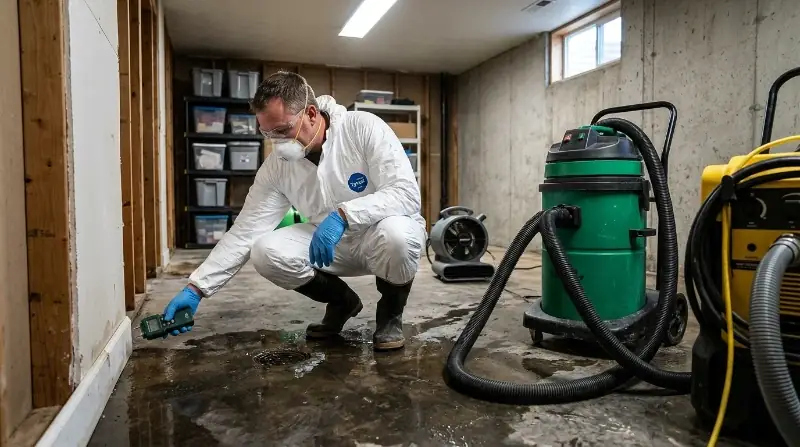
Seepage alone is usually treated as Category 2 water under the IICRC S500 standard; sewage coming up a drain is Category 3, and the cleanup is different. Carpet, pad, and wet drywall come out after Category 3 contact. We test and look at where the water entered before deciding the scope, so you are not paying for tear-out you do not need, or drying materials that should have been removed.
When the Whole Street Backs Up: The 2015 Hunter Example
Not every backup starts with your pipe. In April 2015, FOX13 reported that sewage flooded the basements of about 10 homes near Hunter Dawn Way after gravel and debris got into a sewer line during a project connecting two lines. Basements had 2 to 6 inches of sewage, and the district repaired the line.
Events like that are why the first questions on our call matter: Are neighbors affected? Is there construction on the street? Did it start suddenly? A main-line or construction-caused backup can change who is responsible, and a written notice of claim against a public entity in Utah must be filed within one year. Photos, times, and the names of neighbors affected make that claim much stronger.
Sewage Cleanup Cost for West Valley City Homes
Cleanup usually runs about $7–$15 per square foot, or roughly $2,000–$15,000 for most jobs, with the lateral repair and rebuild billed separately. With the median owner-occupied home in West Valley valued at about $419,000 (Census), a finished lower level is often worth protecting with a backwater valve and a water backup endorsement, which typically costs $40–$250 a year. Our sewer backup cost guide covers each bill in detail.
Fixing a West Valley City Lateral Without Tearing Up the Street
Because Granger-Hunter makes owners responsible for the lateral all the way to the main, a broken pipe under the street is your repair. That makes trenchless methods worth asking about. A cured-in-place liner rebuilds a cracked line from inside, and pipe bursting pulls a new HDPE pipe through the old one between two small pits. Both can avoid a full street cut, the most expensive part of an open-trench repair, though a collapsed pipe may still need digging.
The district runs a sanitary sewer, separate from the city's storm drains, and it works by gravity. Storm water that reaches it through illegal connections or cracked pipe adds flow and pressure, which is why a heavy storm can cause a sewer overflow in a basement on a dry street. A backwater valve on the lowest drain stops that pressure from reaching the house.
Raw sewage is a health hazard. Do not vacuum it with a household shop vac or mix bleach with other cleaners. Renters should report it to the landlord immediately. Our sewer backup cleanup team covers West Valley City 24/7.
Our West Valley City Response
We dispatch from Provo, about 40 miles away, and arrive in 1–3 hours, 24/7, across 84119, 84120, and 84128, from Granger and Chesterfield to Hunter and the Redwood Road corridor. We contain the area, extract with truck-mounted equipment, remove contaminated materials, apply EPA-registered antimicrobials, and dry to a measured standard. Every step is photographed and itemized for your adjuster. For what happens after cleanup, see our restoration service.
Neighboring Magna runs its own water district, and Salt Lake City handles sewer through its public utilities department; we serve both on the same 1–3 hour promise.
West Valley City Sewer Backup Cleanup: Common Questions
Who pays when my West Valley City sewer line backs up?
Granger-Hunter Improvement District policy makes the owner responsible for the lateral from the house to the main, including under the street. The district handles the public main.
Will Granger-Hunter fix roots in my sewer line?
No. The district policy says it does not accept responsibility for blockages caused by tree roots or plants. Clearing and repairing the lateral is the owner's job.
How quickly can you get to West Valley City?
Our crew arrives within 1–3 hours, 24/7, in all West Valley City ZIP codes. Call (877) 394-0234.
Several homes on my street backed up at once. What should I do?
Stop water use, photograph everything, note the time, and tell us when you call. We report it to the district, since a main or construction issue can change responsibility.
Can I dry sewage-soaked carpet myself?
No. Carpet and pad that touch sewage are Category 3 materials and must be removed, not dried, under IICRC S500.
- Granger-Hunter ID — Lateral Maintenance Policy
- Granger-Hunter ID — Wastewater
- Granger-Hunter ID — Service Area
- Central Valley Water Reclamation Facility
- West Valley City — History
- West Valley City — General Plan Introduction
- U.S. Census QuickFacts — West Valley City
- FOX13 — Sewage floods basements of about 10 homes (2015)