
South Jordan's Sewer: Jordan Basin Improvement District
South Jordan does not run its own sewer. Service comes from the Jordan Basin Improvement District, which the city describes as "formerly known as South Valley Sewer," and sewer bills come from the district, not the city. Salt Lake County created the district in 1961; it took the South Valley Sewer name in 2001 and was renamed in June 2024. Today it maintains about 1,100 miles of public sewer across roughly 110 square miles, serving Bluffdale, Draper, Riverton, South Jordan, Herriman, southern Sandy, and part of West Jordan.
Flow goes to one of two plants: the district-owned Jordan Basin Water Reclamation Facility in Bluffdale, commissioned in 2012 as a 15 million gallon-a-day membrane bioreactor with plans to expand to 30, or the South Valley Water Reclamation Facility in West Jordan.
The District's Lateral Rules, and Why They Matter After a Backup
The district's 2024 lateral installation rules say each owner installs their lateral, "including the pipe, cleanouts, inspection tees, and the connection to the main line," and that "damage to the lateral is the owner's responsibility." The same rules require a cleanout within 5 feet of the building, another at least every 100 feet and at every bend over 45 degrees, and no 90-degree bends.
Those rules are useful after a backup. The cleanout near your foundation is where a plumber or camera goes in, and the 100-foot cleanouts on long runs show roughly where a problem sits. If a newer home is missing a required cleanout, or has a sharp bend, that detail often explains why the line keeps clogging. The district's position on the public side is also clear: it fixes its own mains, and it says it is against the law for it to work on private property.
Why Newer South Jordan Homes Still Back Up
Census data compiled from the ACS puts South Jordan's median home at 2007, with the 2010s alone accounting for about a third of all homes and only about 13% built before 1990. That rules out the century-old clay pipe common in Salt Lake City, but not backups. New construction has its own failure modes: trench backfill that settles and leaves a sag in the lateral, construction debris left in a new line, and connections made at a poor slope. A belly in the pipe collects solids slowly until a high-water-use day pushes sewage up the lowest drain.
Many South Jordan homes have finished basements, and with a median home value around $650,500 (Census), what is down there is often costly: carpet, built-ins, a home theater, or a basement apartment. That is why the first hour matters more here than the age of the pipe.
Shallow Groundwater on the West Side
Not every wet basement in South Jordan is sewage. In 1985 the Utah Geological and Mineral Survey published a study of basement flooding along 11800 South near 3800 West, where shallow groundwater began flooding three basements in the summer of 1984; leakage from evaporation ponds upslope was one suspected cause. More recent Utah Geological Survey hazard maps from 2014 cover parts of South Jordan, Herriman, and West Jordan for shallow groundwater and problem soils.
Groundwater seeping through a slab is usually Category 2 under the IICRC S500 standard and is handled differently from sewage, which is Category 3. We check the entry point and water condition before deciding what to remove, so you are not tearing out materials that could have been dried.
Sewage Cleanup in South Jordan, Including Daybreak
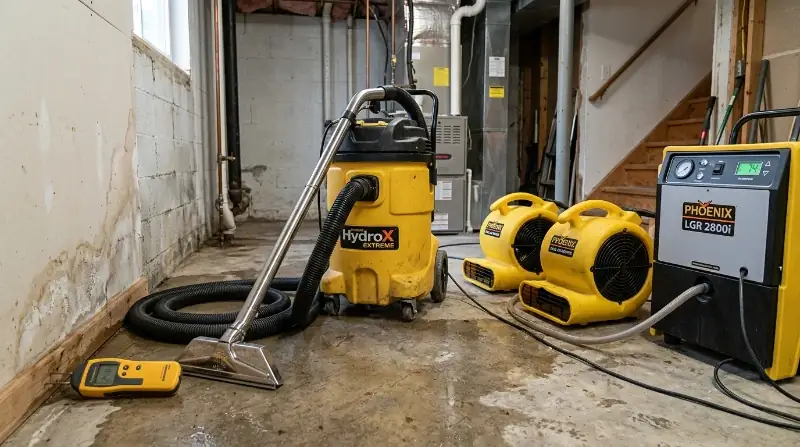
Daybreak began in 2004 on about 4,200 acres and is planned for more than 20,000 homes, with Oquirrh Lake at its center and a new downtown that opened in 2025. Its townhomes and attached homes add a wrinkle: one blocked line can affect a shared wall or a neighboring unit, so we check moisture beyond the obvious room. Across the city we contain, extract, remove contaminated porous materials, disinfect with EPA-registered antimicrobials, and dry to a measured standard. Cleanup typically costs $7–$15 per square foot; the cost guide explains the separate plumbing and rebuild bills.
From Daybreak to the Treatment Plant: How Sewage Leaves a South Jordan Home
South Jordan's wastewater travels through a gravity sanitary sewer: from your house through the lateral, into Jordan Basin Improvement District mains, and through manholes and trunk sewers to the district's water reclamation facilities. Storm drains are a separate system. Shallow groundwater on the west side can infiltrate cracked pipe or poorly sealed joints, and when a main runs full, pressure pushes sewage into the lowest fixture in the house. A backwater valve on that drain is the standard protection.
Newer homes often lack one thing owners assume they have: a water backup endorsement. Standard homeowners policies exclude sewer backups, and the endorsement, often $50 to $250 a year, is what pays for cleanup. Check before you need it. If you rent out a basement, both you and your tenant need to know which policy covers what.
If sewage appears, stop all water use, keep everyone out, and do not use a shop vac or bleach. Our sewer backup cleanup team responds across South Jordan.
Sewer Backup Cleanup South Jordan Response
South Jordan is about 32 miles north of our Provo base, and our crew arrives in 1–3 hours, 24/7, in 84009 and 84095, from Daybreak and the west side to River Heights and the Jordan River corridor. If neighbors are backing up too, tell us when you call so the district can be notified and the timing documented.
Nearby Riverton and Herriman share the same district, while West Jordan runs its own city sewer.
South Jordan Sewer Backup Cleanup: Common Questions
Who handles sewer service in South Jordan?
The Jordan Basin Improvement District, formerly South Valley Sewer District. Sewer bills come from the district, not the city.
My South Jordan house is new. Why did the sewer back up?
New laterals can sag where trench backfill settled, collect construction debris, or be connected at a poor slope. A camera inspection usually shows which.
Who pays for a backup in my South Jordan lateral?
The owner. District rules say damage to the lateral is the owner's responsibility; the district repairs its own mains.
Is water seeping into my basement floor sewage?
Often not. Groundwater seepage is usually Category 2. Water from a floor drain or toilet is sewage and Category 3.
How fast can you reach South Jordan?
Our crew arrives within 1–3 hours, 24/7, in 84009 and 84095. Call (877) 394-0234.
- Jordan Basin Improvement District — History
- Jordan Basin ID — 2024 Lateral Installation Instructions
- South Jordan City — Sewer service notice (2026)
- Jordan Basin Water Reclamation Facility
- U.S. Census QuickFacts — South Jordan
- UGMS RI-195 — Basement flooding along 11800 South (1985)
- Utah Geological Survey — Hazard maps for western Salt Lake Valley