
Two Sewer Providers Serve Midvale
Midvale is one of the few cities where your sewer provider depends on your address. Midvale City Public Works owns and operates a sewer system, and the Midvalley Improvement District collects sewage within its own boundaries. Midvalley says it CCTV-inspects its lines every 12–14 months and cleans them at least every 12 months. Your sewer bill shows which one serves you.
Both send wastewater to the South Valley Water Reclamation Facility on the west bank of the Jordan River in West Jordan, in service since 1985 and governed by Midvale City, West Jordan, Midvalley, Sandy Suburban, and the Jordan Basin Improvement District (formerly South Valley Sewer District). Midvale is not part of the Central Valley plant that serves many neighboring cities.
On ownership, Midvalley is direct: "The laterals are owned and maintained by the property owner." A lateral is the privately owned pipe connecting a property to the public main. When roots or a break in that pipe cause a backup, the repair is the owner's cost.
The 2025 Sewer Rehabilitation in Old Midvale
In 2025 the city bid a sewer rehabilitation project covering about 3,200 feet of pipe replaced with new 8-inch and 10-inch PVC and about 7,100 feet of cured-in-place (CIPP) lining, plus manhole replacements and reconnection of laterals. The work schedule names streets in the older part of town, including Holden and Lennox, Wasatch, Olympus, Wilson, LaSalle, Pioneer, Main and Wasatch, and Midvale's own Avenues (1st through 7th Avenue and Rio Grande Street).
Relining the mains is good news for those streets, but two points are worth knowing. First, it renews the public pipe, not your private lateral. Second, any time laterals are reconnected, a poor connection or debris in the line can cause problems at individual homes. If your basement backs up during or soon after work on your street, photograph it, note the date, and tell us when you call so it can be reported and documented.
Sewer Backup in a Midvale Rental: Owner vs Tenant
Census data shows only about 43% of Midvale homes are owner-occupied, so many backups we clean here involve a landlord and a tenant. Responsibilities usually split like this:
- The owner is responsible for the lateral and the building, and a water backup endorsement on the owner's policy is what typically pays for cleanup of the structure.
- The tenant's belongings are covered only under their own renters policy, and many renters policies also exclude sewer backup unless a backup endorsement was added.
- Both benefit from the same documentation: time of discovery, photos of the water line on walls, and a list of damaged items.
Tenants should report the backup to the owner in writing right away and avoid using any plumbing. Owners should get cleanup started quickly; sewage that sits raises the cost and the health risk for everyone in the building. We work for whoever calls, and our report is written so both claims can use it.
From Slag Site to Bingham Junction: Two Generations of Pipe
Midvale incorporated in 1909 and grew up around smelting; the Sharon Steel and Midvale slag sites left lead and arsenic contamination from mining slag deposited between 1871 and 1958. After a 17-month, $17 million cleanup, the Midvale Slag Superfund site was removed from the National Priorities List in 2006, and the city's Redevelopment Agency funded new infrastructure, including sewer lines, for what became Bingham Junction.
That history shows in the housing. Census data compiled from the ACS puts Midvale's median home at 1987, with the 2010s the biggest building decade as Bingham Junction filled in, while about 40% of homes predate 1980. Bingham Junction's apartments sit on newer sewer, while the historic downtown along Main Street and the Avenues carries much older pipe. Your street's era tells you a lot about your risk.
Sewage Cleanup in Midvale Apartments and Homes
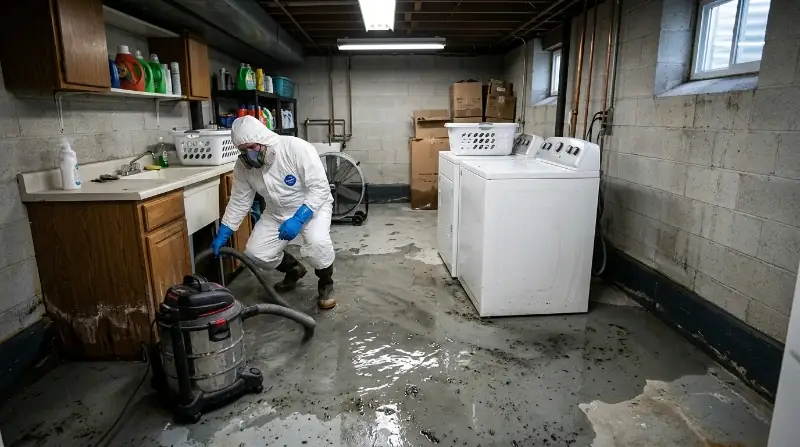
In multi-unit buildings, one blocked line can back up into the lowest unit while the units above keep draining into it. The first step is getting everyone in the building to stop running water. Then we contain the affected unit, extract with truck-mounted equipment, remove porous materials such as carpet, pad, and wet drywall, apply EPA-registered antimicrobials, and dry to a measured standard. Shared walls are checked with moisture meters so neighboring units are not missed. See how our sewage extraction works.
Why Relining Midvale's Mains Does Not Fix Your Lateral
Relining an old gravity main stops groundwater infiltration and root intrusion in the public pipe, and it reduces the risk of a main collapsing. After the liner cures, crews use a robotic cutter to reopen each lateral connection. What relining does not touch is the private lateral from your house to that connection. If your line is old clay with root-filled joints, it will keep backing up into the basement no matter how new the main is.
Where the water table is high near the Jordan River, cracked laterals also take in groundwater. Midvale's sanitary sewer is separate from its storm drains, so storm water should never reach it. A surcharged main pushes sewage back into the lowest drain, which a backwater valve stops. A camera run from the cleanout shows what your lateral needs.
If you are cleaning up after a small backup, skip the shop vac and bleach; they spread contamination and can create toxic fumes. Stop water use and keep people out. Our sewer backup cleanup service covers Midvale homes and apartments.
Sewer Backup Cleanup Midvale Calls: Our Response
Midvale is about 33 miles north of our Provo base on I-15, and our crew arrives within 1–3 hours, 24/7, across 84047, from Fort Union and the State Street corridor to Bingham Junction, Jordan Bluffs, and the historic Main Street area. There is no extra charge for nights or weekends. Cleanup typically runs $7–$15 per square foot; our cost guide explains the separate bills for cleanup, plumbing, and rebuild.
Midvale borders Sandy to the south and West Jordan across the Jordan River, and we serve both with the same crew.
Midvale Sewer Backup Cleanup: Common Questions
Who is my sewer provider in Midvale?
Either Midvale City Public Works or the Midvalley Improvement District, depending on your address. Your sewer bill shows which one. Both send wastewater to the South Valley Water Reclamation Facility.
Who pays for a sewer backup in a Midvale rental?
The owner is generally responsible for the lateral and the building; the tenant's belongings fall under the tenant's renters policy. Backup coverage often requires an endorsement on either policy.
My street was just relined. Could that cause a backup?
Relining renews the public main, but laterals are reconnected during the work. If your home backs up during or after construction, photograph it, note the date, and tell us when you call.
How fast can you get to Midvale?
Our crew arrives within 1–3 hours, 24/7, across ZIP 84047. Call (877) 394-0234.
Can a tenant clean up a sewer backup?
Tenants should not handle sewage. Report it to the owner in writing, stop using plumbing, and let a certified crew remove contaminated materials.
- Midvalley Improvement District — What We Do
- Midvalley Improvement District — Lateral Ownership
- Midvale Code §13.08.020
- Midvale 2025 Sewer Rehabilitation bid (IFB #MID25-137)
- Utah Association of Special Districts — South Valley WRF
- U.S. Census QuickFacts — Midvale
- Deseret News — Midvale slag site is clean (2006)