
What ZIP 84601 Covers — and Why It Has the Highest Backup Frequency in Provo
Pre-1960 clay laterals, high-occupancy rental conversions, and the Center Street main corridor combine to make 84601 one of Provo's most active sewer backup zones.
ZIP code 84601 covers the downtown Provo core, the Joaquin neighborhood, the Franklin Avenue corridor south of Center Street, and streets running east to approximately 400 East. This is Provo's oldest settled residential and commercial zone — most housing stock dates to 1930–1975. In a city where water is everything (the Provo River is two miles west; Lake Bonneville soil is ubiquitous), pipe age determines your backup risk more than anything else. Our office at 356 N 100 W sits inside 84601, so downtown is the closest service area for our Provo sewer backup crew.
The clay sewer laterals underneath 84601 streets were installed when the neighborhood was built, mostly using vitrified clay pipe with lead-oakum joints that degrade after 40–50 years of use. A significant percentage of these pipes have never been scoped, replaced, or relined. When root intrusion cracks a joint at the 20-foot mark, or a pipe sags and retains debris, there is no warning — sewage backs up through the lowest fixture in the house, usually the basement floor drain or ground-floor toilet.
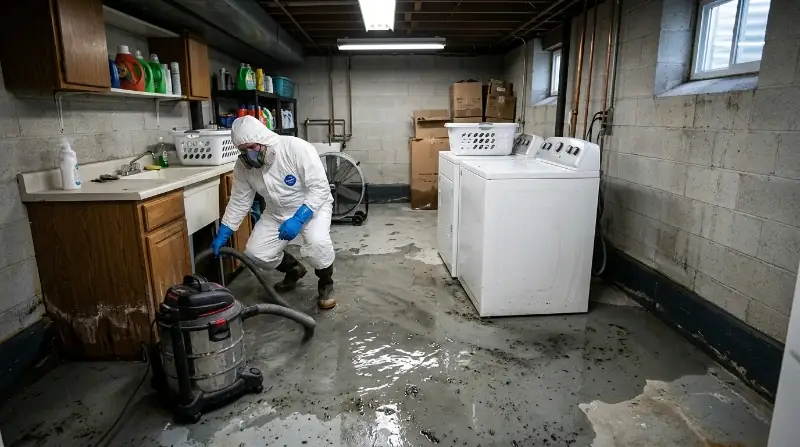
Infrastructure Age and Risk in 84601
The Provo City sewer main running through the Center Street corridor is the arterial line that serves all of 84601. During peak snowmelt — typically March and early April — this main runs at or above design capacity. When a main surges and a clay lateral is already partially blocked by root infiltration, the pressurized sewage takes the path of least resistance: back through your lateral and into your home.
Homeowners who purchased pre-1970 properties in 84601 without commissioning a sewer scope inspection are operating on the original pipe. Eighty-year-old clay with 70-year-old oakum joints is past its service life. Tree roots enter through crack points no wider than 1/16 inch. A 9-foot-deep connection to the Provo City main (documented in the downtown corridor) means excavation costs for lateral repair run high when camera inspection finally reveals the blockage point.
Streets and Sub-Areas with Highest 84601 Risk
The 300–700 North corridors between University Avenue and 300 East represent Joaquin's highest-density rental conversion zone — 1940s–1960s single-family homes converted to multi-unit student rentals. Any lateral event here commonly affects 6–12 units simultaneously because the converted structures share upgraded plumbing that still terminates at the original clay lateral connection to the city main.
Center Street between 100 West and 400 East sits directly above the primary Provo trunk sewer. Properties on Center Street and within one block north or south are closest to the main and experience the most direct pressure events during snowmelt. The Franklin Avenue corridor south of Center Street includes 1950s split-levels and ranch homes with original cast-iron drain stacks that corrode from the inside — the first sign is slow drains, the second is a backup.
What Homeowners in 84601 Commonly Save vs. What Must Go
Based on IICRC S500 protocol and real cleanup outcomes in this ZIP: concrete floors, ceramic tile, vinyl flooring, painted drywall above the contamination line, cabinets with sealed interiors, Formica countertops, and metal fixtures can typically be cleaned and decontaminated. What must be removed per IICRC S500: carpet and carpet pad with any sewage contact, unpainted drywall, particleboard or OSB subfloor, fiberglass insulation, mattresses and upholstered furniture, and any cardboard boxes or paper materials that contacted Category 3 water. Cost outcomes depend heavily on what flooring and wall finish the affected area has — finished basements cost more to restore than unfinished ones.
84601 Sewage Backup Cleanup — Cost Ranges
| Scenario | Typical Range |
|---|---|
| Unfinished basement, 200 sq ft, clay lateral event | $1,800 – $3,500 |
| Finished basement, 300–400 sq ft, carpet and drywall | $4,500 – $8,000 |
| First-floor kitchen/bath, crawl space involved | $3,000 – $6,500 |
| Multi-unit building, main line event, shared lateral | $8,000 – $18,000+ |
Estimates based on IICRC S500 scope requirements for the 84601 market. Actual costs vary with square footage, materials, and contamination level. Use the free calculator for a specific estimate →
Provo City Code §10.03.060 — What 84601 Homeowners Need to Know
Under Provo City Code §10.03.060, the sewer lateral from your house to the city main is your property and your financial responsibility. If a city main failure caused your backup, we report it to Provo City 311 before cleanup begins — this documents the city's involvement and protects your claim. If your lateral caused the backup (root intrusion, offset, collapse), the cleanup cost is yours. We coordinate with Provo City 311 on your behalf when main line events affect multiple properties on your block, which happens several times per year along the Center Street corridor.
Frequently Asked Questions — Provo 84601
What ZIP code is 84601 in Provo?
ZIP 84601 covers downtown Provo, the Joaquin neighborhood, the Franklin Avenue corridor, and areas south and east of Center Street. It is the oldest part of Provo's sewer infrastructure, where original clay laterals from the 1940s–1970s remain in service. Our IICRC crew responds here in 1–3 hours, 24/7. Call (877) 394-0234.
How fast can you respond to sewer backup in Provo 84601?
Our IICRC-certified crew responds to sewer backup emergencies in Provo 84601 within 1 to 3 hours, 24 hours a day, 7 days a week — including nights, weekends, and holidays at no extra charge. Call (877) 394-0234 for immediate dispatch.
Does homeowners insurance cover sewer backup in Provo 84601?
Standard Utah HO-3 policies exclude sewer backup. A separate endorsement is required — typically $40–$250 per year for $5,000–$25,000 in coverage. We provide complete insurance documentation from hour one, including moisture maps, contamination logs, and material removal records.
What is Category 3 sewer backup cleanup?
Category 3 is the IICRC S500 classification for grossly contaminated water — raw sewage containing E. coli, Norovirus, Hepatitis A, and Giardia per CDC data. All porous materials (carpet, drywall, insulation, subfloor) that contact Category 3 water must be removed. Drying in place is never acceptable under IICRC S500 protocol.
IICRC S500 Cleanup — The 6-Step Process
Our response to every 84601 sewer backup follows the same published IICRC S500 framework: (1) source identification and all plumbing stopped; (2) crew dispatch and 1–3 hour arrival; (3) full PPE and negative air pressure containment; (4) industrial truck-mounted sewage extraction with biohazardous waste manifesting; (5) all porous material removal per contamination category; (6) EPA-registered antimicrobial decontamination, HEPA air scrubbing, and written clearance testing before reconstruction begins. Full sewage cleanup process for Provo homes →