
Salem Basements: Sewage, Sump, or Window Well?
Salem has a well-documented storm-water problem, and it shapes how we handle every call. In July 2017, FOX 13 reported that about 50 homes were affected when a "100-year storm" sent water into window wells and overwhelmed sump pumps. In September 2026, KUTV reported a street flood on 620 South after 0.78 inches of rain over six hours, noting that Salem's older storm drains use sumps that let water soak into the ground and slow down once rain passes about half an inch. The city spent $2.2 million on storm drains in 2024.
Water that comes through a window well or a failed sump is surface or groundwater, usually Category 2 under the IICRC S500 standard, and it can worsen as it picks up contaminants. Sewage that comes out of a floor drain, toilet, or shower is Category 3. The difference changes the cleanup, because Category 3 porous materials must be removed, and it changes the insurance, because storm and surface water and sewer backup are covered differently.
Salem's New Wastewater Treatment Plant
Salem City treats its own sewage. In February 2020 it commissioned a new treatment plant using an Orbal oxidation ditch with biological nutrient removal, designed for 1.5 million gallons a day, replacing a three-cell aerated lagoon system built in 1988 that discharged through an irrigation ditch and Beer Creek to Utah Lake. In its first year, effluent phosphorus averaged about 0.3 mg/L.
Under Utah Code § 11-8-4, the city must tell customers twice a year who is responsible for repairing the sewer lateral, the private pipe between the house and the main. As in other Utah County cities, that is generally the owner, so check your city notice for the exact wording.
Snake Creek and Salem's Flood History
Snake Creek has flooded parts of Salem repeatedly, with major events recorded in 1969, 1984–86, 1993, 2008, 2010, 2019, 2023, and June 2024, especially near Richard Avenue, where water spills onto Highway 81. A 1996 diversion built with FEMA, about 1,900 feet of pipe and 4,600 feet of ditch, no longer handles the flows, and the city has explored a new open-channel diversion of more than 4,000 feet.
Creek water is floodwater. If it reaches your basement, the tear-out may resemble a sewage job, but the claim goes to flood insurance, not a sewer backup endorsement. Recording where the water entered, with photos, is what keeps the claim on the right track.
A Fast-Growing City With New Basements
Salem was settled in 1851 as "Pond Town" and incorporated in 1920. It grew from 9,298 people in the 2020 Census to 12,234 in the 2025 estimate, and local planning projects growth to more than 60,000 by 2035. Census data compiled from the ACS puts the median home at 2005, with about 15% built in 2020 or later, and about 94% of homes are owner-occupied, with a median value of about $605,700.
Newer homes mean newer pipe, but also finished basements and new laterals that can settle in fresh backfill. When a Salem backup is sewage, the lowest finished room usually takes the damage, and fast extraction keeps it to that room.
Sewage Cleanup in Salem: Our Process
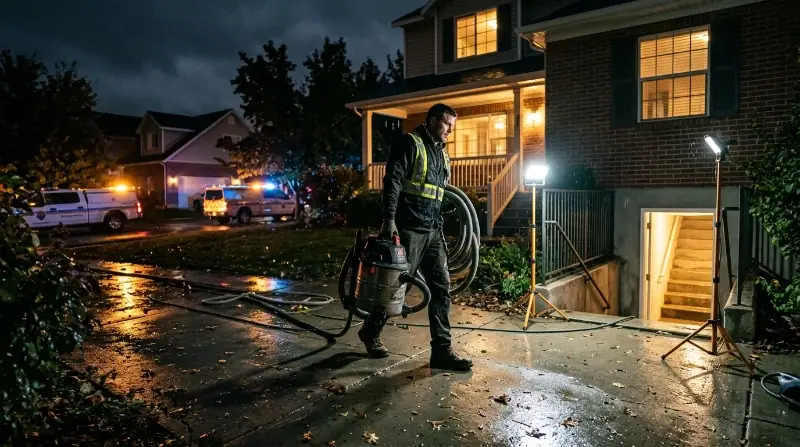
We stop the source, contain the area, extract with truck-mounted equipment, remove contaminated carpet, pad, drywall, and insulation, apply EPA-registered antimicrobials, and dry to a measured standard before clearance. For storm or sump water, we dry what can be dried and remove only what the water category requires. Either way you get photos and an itemized estimate for your adjuster. See sewage water removal for how extraction works.
Protecting a Salem Basement Before the Next Storm
Because Salem's risk is split between storm water and sewage, prevention comes in two parts. For storm water: fit clear covers over window wells, keep wells and their drains clear of leaves, slope soil away from the foundation, and check that downspouts discharge several feet from the house. If you rely on a sump pump, test it before summer cloudbursts and spring runoff, and consider a battery backup, since storms that flood streets often knock out power too.
For sewage: a backwater valve on the lowest drain stops sewage flowing back in from the main, and a camera inspection of the lateral finds sags and root intrusion before they block. Finally, read your policy. Many Salem homeowners discover after a storm that they need two different coverages: flood insurance for surface water and a water backup endorsement for drains and sumps.
Keep Storm Water Out of Salem's Sanitary Sewer
Salem, like other Utah cities, runs separate systems: a sanitary sewer that carries household wastewater to the treatment plant, and storm drains that handle rain. They are not combined sewers, so storm water is not supposed to enter the sanitary lines. The trouble starts inside homes. A sump pump discharging into a floor drain or laundry sink sends groundwater into the sanitary sewer, adding inflow during the same storms that already stress the system and raising pressure in gravity mains and manholes downstream.
Most Salem homes are new, with PVC laterals, but new pipe in fresh backfill can still sag. A camera inspection checks slope and joints, and a backwater valve on the lowest drain stops a surcharged main from pushing sewage into the basement. Route sump discharge outdoors, away from the foundation.
If sewage does come up, treat it as a health hazard: it carries bacteria and viruses that sump water usually does not. Stop using water, keep kids and pets out, and do not mop it into the floor drain. Renters should call the landlord first. Our Provo-based sewer backup cleanup team tells the two kinds of water apart on arrival.
Sewer Backup Cleanup Salem Response
Salem is about 15 miles from our Provo base, roughly 24 minutes, and our crew arrives in 1–3 hours, 24/7, anywhere in 84653, from Salem Pond and Main Street to the new subdivisions along Highway 198 and Salem Canal Road. No extra charge during Salem Days or any other night or weekend.
Salem sits between Spanish Fork and Payson, and we reach all three from the same Provo dispatch. Our Utah County sewer backup cleanup overview sets the cities side by side.
Salem Sewer Backup Cleanup: Common Questions
Is the water in my Salem basement sewage?
Not necessarily. Storms in Salem often flood window wells and overwhelm sump pumps. Water from a floor drain or toilet is sewage; window-well or sump water is surface or groundwater.
Who treats Salem's sewage?
Salem City's own treatment plant, commissioned in February 2020, which replaced lagoons built in 1988.
Does insurance cover Snake Creek flooding?
Creek flooding falls under flood insurance, not a sewer backup endorsement. Sewage from a drain needs a water backup endorsement.
How fast can you reach Salem?
Our crew arrives within 1–3 hours, 24/7, in ZIP 84653. Call (877) 394-0234.
Do you remove carpet after storm water?
Only when the water category requires it. Category 3 sewage means removal; cleaner storm or sump water can often be dried.