
⚠ Sewage backup is a Category 3 biohazard — every hour raises cost and risk.  Call (877) 394-0234 now — 24/7
IICRC WRT & AMRT Certified
IICRC S500 & S520 Protocol
24/7 — No Extra Charge
Written Estimate Before Work Starts
Insurance Documentation from Hour One

Sewage Water Removal Provo, Utah — Industrial Extraction

Sewage water removal in Provo with industrial truck-mounted extraction pulls standing black water out far faster than portable equipment. Biohazard manifesting and disposal documentation come with every job. IICRC-certified from the first minute on site.

Industrial Truck-Mounted ExtractionBiohazard Disposal DocumentedIICRC Certified24/7 Response
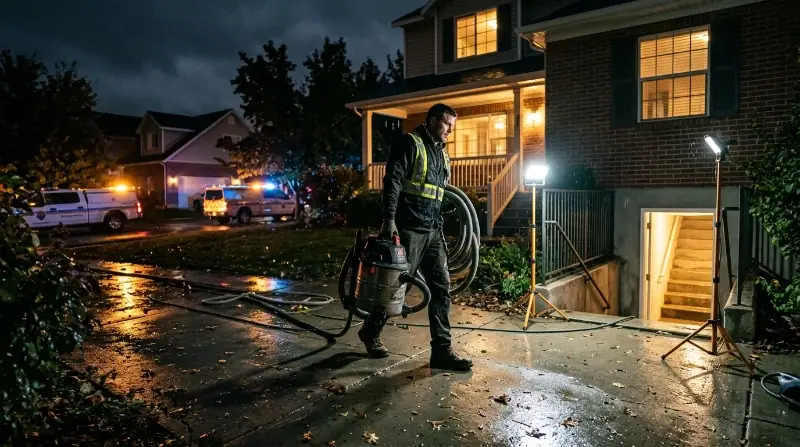
Industrial sewage water extraction equipment including HydroX extractor, air movers, and dehumidifier for Provo, Utah sewer backup
Industrial truck-mounted extraction removes Category 3 sewage at 10–15x the rate of consumer equipment. Biohazard disposal documented.

Why Industrial Extraction Matters for Sewage Water

Standing sewage water is not just a cleanup problem — it is an active health hazard. Every minute it remains in contact with your floor, walls, and subfloor, pathogens absorb deeper into porous materials. Industrial truck-mounted extraction removes sewage at 10–15 times the rate of any portable consumer equipment, stopping the absorption process faster and reducing the total scope of porous material that must be removed. Water removal is step one of our full sewer backup cleanup service in Provo.

Every gallon of Category 3 sewage extracted from your home is biohazardous waste under EPA and DOT regulations. We manifest and document every load — providing the disposal records your insurance carrier needs for claim approval.

Do Not Use Consumer Wet-Dry Vacuums for Sewage: Portable consumer extractors aerosolize sewage particles into the air during operation, increasing your family's exposure to E. coli, Norovirus, and other Category 3 pathogens. Industrial equipment with proper containment and HEPA filtration is required.

Sewage Water Removal Process

  1. 1

    Arrival & Safety Assessment

    Full PPE deployed before entry. Electrical panels checked — water and electricity require immediate source verification before any crew enters the affected area.

  2. 2

    Truck-Mounted Extraction

    Industrial truck-mounted extractors draw standing black water through containment hoses directly to sealed waste tanks in our service vehicle. No sewage is exposed to the air during transfer.

  3. 3

    Biohazard Manifesting

    All extracted sewage is manifested as biohazardous waste per EPA regulations. Documentation provided to your insurance carrier — most policies require this for Category 3 claim approval.

  4. 4

    Absorption Mapping

    After extraction, moisture meters map absorption depth in walls, floor, and subfloor. This determines what porous materials must be removed per IICRC S500 — the extraction scope is complete, now the remediation scope is defined.

How is sewage water removed from a home?

Industrial truck-mounted extractors remove standing Category 3 sewage water far faster than portable equipment. The sewage is classified as biohazardous waste and must be manifested and disposed of at approved facilities. Every gallon removed is documented for your insurance carrier. Following extraction, moisture meters map absorption into walls and subfloor to define the full remediation scope.

Can I remove sewage water myself?

No, for two reasons. First, Category 3 sewage contains E. coli, Norovirus, Hepatitis A, and Giardia — direct contact without full PPE is a serious health risk. Second, consumer equipment cannot achieve the extraction rates or containment standards required to prevent aerosolization of sewage particles during removal. IICRC-certified industrial extraction is required for safe, documented Category 3 water removal.

About this page: Written and reviewed by Marcus R. Webb (IICRC Water Restoration Technician, IICRC Applied Microbial Remediation Technician) and Dana L. Sorenson (IICRC Water Restoration Technician). Content reflects IICRC S500, S520, Provo City Code §10.03.060, EPA & CDC guidelines, and 2026 HomeGuide pricing. Last reviewed September 2026. Last updated: 2026-10-20.

How Long Standing Sewage Has Been Present Determines Your Total Cost

Time Elapsed What Has Happened Typical Cost Impact
0–2 hours Standing water only. Minimal absorption into porous materials. Lowest scope — $2,000–$4,500 unfinished basement
2–6 hours Capillary absorption begins pulling sewage 6–10 inches up drywall, into subfloor. Concrete absorbs at joints and cracks. Moderate scope increase — $4,000–$8,000 finished basement
6–24 hours Bioaerosols become airborne. HVAC spread risk. Wall cavity contamination past the drywall face. Significant scope — $7,000–$12,000 finished basement
24–48 hours Mold colonization begins on wet organic materials (EPA). Decontamination scope overlaps with mold remediation. Mold adds $1,500–$4,000 to base cleanup cost (IICRC S520)
48+ hours Established mold growth. Structural material saturation. Insurance carriers may dispute coverage on delayed-response claims. $10,000–$20,000+ — full mold and structural remediation

Why Utah County Basements Are Higher Risk Than Slab Construction

Provo and Utah County have a higher percentage of basement-construction homes than the Utah County average for newer suburbs. Older Provo neighborhoods — Joaquin, Riverside, Franklin, and downtown — are almost entirely basement construction. Basements concentrate sewage water in a confined low-point space. Standing water pools rather than draining, staying in contact with porous materials longer than it would in slab construction. The same backup volume that would cause $3,000 in damage on a slab causes $7,000+ in a finished Provo basement.

Newer communities in Vineyard, Saratoga Springs, and the southern expansion of Eagle Mountain trend toward slab construction — but the Utah Lake water table in those areas creates its own set of problems for floor-level intrusion events.

Sewage Water Removal and Your Insurance Claim

Most Utah insurance carriers require a specific set of documentation for Category 3 water removal to be covered under a sewer backup endorsement: pre-removal condition photographs showing the standing water level and affected areas, biohazard disposal manifests proving proper waste removal, and a moisture map showing absorption depth before and after extraction.

Utah Hills Restoration provides all of this documentation as a standard part of every water removal job. If you are filing a claim, call (877) 394-0234 before you start cleaning up. Any cleanup you do before our crew arrives — even mopping up visible water with towels — can complicate the pre-remediation documentation your adjuster needs. Let us document first, then begin extraction under IICRC protocol.

What Happens Immediately After Water Removal

Sewage water removal is hour one of a multi-day process, not the end of it. Once standing water is gone, Category 3 residue saturates every porous material that water contacted — carpet backing, drywall gypsum, wood subfloor, and concrete block face. The removal step eliminates the volume; decontamination eliminates the biological load.

Within two hours of completing extraction, we run an ATP (adenosine triphosphate) surface test on affected floor and wall materials. ATP testing quantifies biological contamination on a relative light unit (RLU) scale. There is no industry-wide RLU pass mark, so we take baseline readings on each surface type and retest the same spots after cleaning; a reading that does not drop sharply tells us the surface needs more mechanical scrubbing before disinfectant goes on.

After water removal and before reconstruction, all affected structural materials go through moisture mapping with a pin-type meter and calibrated non-invasive meter. We document readings every 4 feet across affected areas. Readings above 19% MC on wood or 1% WME on drywall set the drying target for the LGR dehumidifier placement. IICRC S500 calls for drying structural materials to a dry standard measured on unaffected materials of the same type before reconstruction begins — in Provo's 15–20% winter EMC and 25–30% summer EMC environment, that target shifts seasonally.

Sewage Water Removal Cost in Provo: What Drives the Number

The cost of sewage water removal in Provo ranges from $1,200 for a small unfinished space with minimal standing water to $6,000+ for a large finished basement with wall cavity contamination. Four variables account for most of the spread:

We provide Xactimate-compatible estimates that your adjuster can load directly into their valuation platform. If your Utah HO-3 policy includes a sewer backup endorsement, the water removal cost is typically the largest single line item in your claim — documented properly from the start, it's also the most defensible.