
Springville's Sewer Rule: The Lateral Is the Owner's
Springville City runs its own collection and treatment through Public Works. City Code § 4-14-202(3) states that "the property owner is responsible for the maintenance and repair of the sewer lateral service" that connects the property to the city's sewer main, and § 4-14-208 makes the owner responsible for making the connection, with a permit and city inspection. State law adds that the city must remind customers of that responsibility twice a year (Utah Code § 11-8-4).
In practical terms, a backup caused by roots, grease, or a broken joint in your lateral is your repair. A backup caused by a blocked city main or a lift station problem is the city's to fix. Telling them apart is the first step after any Springville backup, and a camera inspection from the cleanout usually answers it.
Inside Springville's System: 14 Lift Stations and Groundwater
Springville's February 2026 Collection System Master Plan describes nearly 150 miles of gravity pipeline, about 2,900 manholes, and 14 lift stations, including the Westfields lift station built in 1984. Lift stations pump sewage where gravity cannot carry it, and the plan flags future capacity limits at the Westfields, 1500 West, and Oakbrook stations as the city grows west of I-15 and around Lakeside Landing.
The plan also notes that groundwater getting into the pipes "can rise with seasonal or storm-driven groundwater increases." That matters for homeowners in two ways: wet seasons add flow to lines that are already busy, and the cracks that let groundwater into a pipe also let roots in. Springville backups that show up during spring runoff often trace back to both.
Hobble Creek and Basement Water in Springville
Springville was settled on September 18, 1850, and was first called Hobble Creek, after the creek that still runs through town. The city says Hobble Creek flows were high during the 2023 snowmelt, and that years of low flow let debris build up in the channel and reduce its capacity, so creekside owners are asked to clear their banks. A 2021 federal watershed plan proposed flood-control improvements along lower Hobble Creek, mainly between Main Street and I-15.
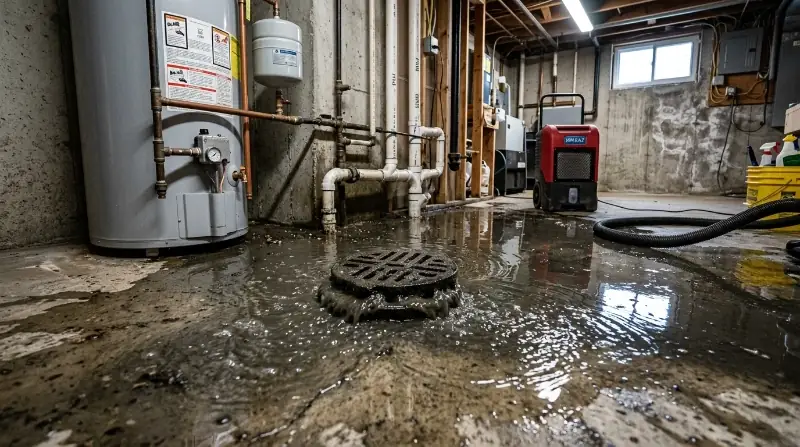
Creek water in a basement is floodwater, typically covered by flood insurance rather than a sewer backup endorsement, and seepage through a foundation is usually Category 2 water. Sewage from a floor drain is Category 3 and needs removal of porous materials. We confirm which you have before any tear-out.
Springville's Water Reclamation Facility
Wastewater is treated at the Springville Water Reclamation Facility at 700 North and 500 West, permitted for 6.6 million gallons a day, which discharges to Little Spring Creek rather than Hobble Creek. Parts of the plant date to 1985, chemical phosphorus removal was added in 2021, and a 2024 master plan lays out about $13.1 million in near-term work and $28.4 million more as nitrogen limits tighten. Springville's plant serves the city itself; neighboring Mapleton's sewage goes to the joint Spanish Fork–Mapleton plant.
Sewage Cleanup in Springville's Older and Newer Homes
Census data compiled from the ACS puts Springville's median home at 1996, with about 16% built before 1960, mostly in the original grid around Main Street, and the 2000s the biggest building decade. Older homes near downtown and the Springville Museum of Art are the likeliest to have clay or cast iron laterals with root problems; newer west-side homes have PVC lines that can still settle and sag.
Either way, cleanup follows IICRC S500: containment, truck-mounted extraction, removal of carpet, pad, wet drywall, and insulation, EPA-registered antimicrobials, and drying to a measured standard. Typical cost is $7–$15 per square foot; our sewage cleanup page explains each step.
Springville Sewage Backup: City Main or Your Lateral?
A few quick checks narrow it down before anyone digs. If only your house is affected and the backup appears when you run water, the blockage is almost always in your lateral. If neighbors on the same street report backups at the same time, or sewage rises when nobody is using water, a city main or lift station is more likely, and Springville Public Works should be called right away. If your home has an outdoor cleanout, a plumber can open it: standing sewage in the cleanout points to a blockage downstream toward the main, while an empty cleanout points to a problem inside the house or between the house and the cleanout.
Write down the time it started and take photos either way. If the city's side turns out to be involved, that record supports a claim, which must be filed in writing within one year under Utah law.
Sewer Line Repair in Springville: Relining, Pipe Bursting, or Digging
Cleanup is half the job; the lateral still has to be fixed. A camera run from the cleanout decides how. Roots in a sound clay line can often be cut and cleared. A cracked or offset pipe can usually be relined from inside with a cured-in-place liner. A collapsed section means excavation or pipe bursting, where a new HDPE pipe is pulled through the old one with two small pits instead of an open trench. Ask Springville Public Works about permits before any work near the main or in the street.
Keep storm water out of the sanitary sewer while you are at it. Sump pumps, roof drains, and yard drains tied into the sewer add inflow during storms and raise surcharge pressure in the mains, which is how a wet spring turns into overflows in basements downstream. A backwater valve installed during the repair costs far less than a second cleanup. Until the line is fixed, do not flush wipes or run long laundry cycles, and if you rent, tell your landlord before anyone digs. For the cleanup itself, see our sewer backup cleanup in Provo and Utah County.
Sewer Backup Cleanup Springville Response
Springville is about 6.5 miles from our Provo base, roughly 15 minutes, which makes it one of the fastest places we reach. We serve all of 84663, from the historic center and Hobble Creek neighborhoods to the growing areas west of I-15. Our crew arrives in 1–3 hours, 24/7, with no extra charge during Art City Days or any other night or weekend. Springville is one of the closest stops on our 24/7 sewer cleanup route through Utah County.
Next door, Mapleton homes sit higher on the bench and often rely on ejector pumps, while Spanish Fork offers city no-fault help for main-line backups. Our Utah County sewer backup cleanup page compares every city's rules.
Springville Sewer Backup Cleanup: Common Questions
Who is responsible for the sewer lateral in Springville?
The property owner. Springville City Code § 4-14-202(3) makes the owner responsible for maintaining and repairing the lateral that connects the property to the city main.
Does Springville treat Mapleton's sewage?
No. Springville's plant serves Springville; Mapleton's wastewater goes to the joint Spanish Fork–Mapleton water reclamation facility.
Why do Springville backups happen in spring?
The city's master plan notes that groundwater entering sewer pipes rises seasonally, adding flow to busy lines, and runoff years raise groundwater around older pipe.
How fast can you reach Springville?
Springville is about 15 minutes from our Provo base. Our crew arrives within 1–3 hours, 24/7. Call (877) 394-0234.
Is Hobble Creek floodwater a sewer backup?
No. Creek water is floodwater and usually falls under flood insurance. Sewage from a drain is a sewer backup and needs a water backup endorsement.