
American Fork Utah ZIP 84003: Canyon Geography Creates Utah County's Highest Spring Sewer Backup Risk
American Fork sits at the mouth of one of Utah County's most active snowmelt canyons — and that geography drives the highest spring I/I sewer backup risk in the north county. Aging clay pipe in historic AF downtown, aggressive cottonwood root systems on the east bench, Airbnb-load-stressed laterals, and American Fork Creek corridor groundwater all contribute.
American Fork (population approximately 35,000) is positioned at the mouth of American Fork Canyon — a fact that defines the city's sewer system performance from March through June every year. While every Utah County city faces some spring inflow and infiltration (I/I) pressure from snowmelt, American Fork is unique in the volume and speed of that pressure. The canyon delivers the second-highest snowmelt inflow rate in Utah County after Provo Canyon, and it delivers it into a city sewer system that serves a mix of aging downtown infrastructure and 1980s–2000s residential development along the east bench and canyon corridor. American Fork is served from our Provo base by the same crew that handles sewer backup cleanup across Provo.
American Fork ZIP 84003 contains the full city — from the historic 100 S / 100 W downtown grid to the canyon-mouth neighborhoods at the city's east edge. The Timpanogos Cave National Monument sits at the top of the canyon, making the American Fork Canyon corridor one of the most heavily visited recreational corridors in northern Utah County. That traffic, and the recreation-oriented homeowner demographic that chose to live near it, shapes both the risk profile and the response expectation when sewer backups occur.
American Fork Canyon Snowmelt: The I/I Event That Peaks Every Spring
From approximately March 15 through June 15, American Fork Canyon snowmelt runs at peak rate. The canyon drains a substantial watershed into American Fork Creek, which runs through the city's west side. During peak melt — accelerated when warm rain falls on deep snowpack, which occurs several times per decade — creek levels rise rapidly and groundwater tables across the city rise with them.
The result for homeowners: inflow and infiltration events that can triple or quadruple the flow volume entering the city sewer main in the northeast quadrant. When the main runs at or above capacity, service laterals lose their drainage gradient. Any partial blockage — root intrusion, grease accumulation, a bellied pipe section — that the system manages fine under dry conditions becomes a full backup under surcharge. The sewage takes the path of least resistance: back through the lateral and into your home.
The city's 2022 sewer main upgrade along American Fork Canyon Road addressed the primary trunk serving canyon-mouth development. However, center-city streets on the 100 S / 100 W grid — many still served by original 1940s–1960s clay laterals — remain at elevated risk during peak I/I events. American Fork City Public Works can confirm whether a specific street experienced main-level surcharge during a backup event. If the main was implicated, this documentation supports any claim you make against the city for contributing conditions. Under American Fork's sewer rules, however, your lateral and your cleanup costs remain your responsibility regardless of contributing main conditions.
Historic Downtown American Fork: Aging Clay Laterals and the Root Intrusion Timeline
The historic downtown grid — bounded roughly by State Street to the north, 200 South to the south, 100 West to the west, and 200 East to the east — contains American Fork's oldest housing stock. Homes here were built between the 1920s and 1960s. Their sewer laterals are vitrified clay pipe with lead-oakum bell-and-spigot joints, the same material and era as the most at-risk sections of Provo's Joaquin neighborhood and Lehi's Old Town.
Clay pipe in stable soil with no root intrusion can last 80 years. American Fork's downtown is not stable-soil territory: the city has a deep tradition of large-tree landscaping — silver maple, cottonwood, and box elder are common in historic neighborhoods, trees with root systems that actively seek moisture. Clay pipe with oakum joints provides exactly the moisture signal that cottonwood roots follow. Once a fine hair root enters through a hairline joint crack, it grows to fill the available space. Within 10–15 years, a mature cottonwood root mass can reduce a 4-inch clay lateral to zero effective capacity. The backup is the homeowner's first indication that anything is wrong.
Root intrusion produces a specific backup pattern: seasonal variation. The backup may clear temporarily after root cutting (hydro-jetting removes the root mass but leaves the entry point open). Homeowners who have had their lateral cut once typically experience the root re-establishing within 1–3 years. The permanent solution is pipe relining (CIPP — cured-in-place-pipe lining) or lateral replacement. After any root-caused backup, IICRC S500 and S520 decontamination is required regardless of the mechanical cause — sewage contact is what determines contamination category, not how the sewage got there.
East American Fork: Canyon-Mouth Root Systems and Steeper Lot Grades
Properties in east American Fork — the canyon-mouth neighborhoods between approximately 500 East and the canyon entrance — face a compounded challenge. The native vegetation in this zone includes large stands of cottonwood and quaking aspen along drainage corridors, plus mature landscaping established when the 1980s–2000s tract homes were built. Both cottonwood and aspen are aggressive root species: cottonwood roots are documented to travel 100+ feet in search of moisture; aspen root systems connect multiple trees through a shared rhizome network that extends well beyond the visible tree canopy.
East AF properties also have steeper lot grades than the flat downtown grid. Steeper grades create a mechanical challenge for sewer laterals: a longer run, more elevation change, and a greater potential for sagging or "bellying" — sections where the pipe drops below the grade line and creates a standing-water trap. Bellied pipes accumulate grease, debris, and root mass faster than properly sloped pipe because the material cannot flush through. Combined with the root pressure common in this zone, east AF laterals often fail sooner than their age would suggest.
Short-term rental (Airbnb and VRBO) conversions are also disproportionately concentrated in east AF, along the mountain recreation corridor. Homes converted to short-term rentals carry higher occupancy and corresponding higher plumbing load — more showers, more toilet flushes, more grease — than the single-family residential load the lateral was designed for. An undersized or already-degraded lateral that managed fine for a family of four may fail when 12 recreational guests use the home on a peak weekend.
American Fork Creek Corridor: Elevated Spring Groundwater on the City's West Side
Properties within approximately 500 feet of American Fork Creek — primarily on the city's west side, along and near 100 West and 200 West from the south end to the creek corridor — experience elevated spring groundwater that mirrors the creek level. When the creek rises during peak snowmelt, the water table in adjacent soils rises with it, reducing the drainage gradient for sewer laterals in those zones. Even a lateral without any root or structural problem can experience I/I-related backup when the surrounding soil is saturated to within a few feet of the pipe elevation.
The American Fork Creek drainage area is also the location of some of the city's oldest converted residential stock — 1960s single-family homes converted to duplexes and small apartments, with multiple units sharing a single service lateral that was installed for single-family use. When groundwater pressure coincides with higher occupancy load, the backup risk compounds. If you own or rent in a converted property near the creek corridor in 84003, the risk window is March through June — the same window that canyon snowmelt peaks.
American Fork Sewer Rules — Your Lateral, Your Cost
American Fork's sewer rules place full responsibility for the service lateral from the city main to the building structure on the property owner. The city maintains the public main under the street; everything from the point of connection to your foundation is your maintenance responsibility. This applies whether the backup was caused by root intrusion, pipe bellying, joint failure, or main surcharge contributing to your lateral — the cleanup cost remains yours under the code.
When a spring I/I event creates main surcharge that contributes to a residential backup, we coordinate with American Fork City Public Works on documentation: when the backup occurred, whether other properties on your street were simultaneously affected, and what the main-level conditions were at that time. This documentation supports any city claim process, though collection is typically slow and not guaranteed. Our priority is always to start the cleanup immediately — waiting for city documentation delays the work and increases the mold risk window.
What IICRC S500 and S520 Require for American Fork Homes
Every sewer backup is classified as IICRC Category 3 water — grossly contaminated with E. coli, Norovirus, Hepatitis A, and Giardia per CDC data. The IICRC S500 Standard for Professional Water Damage Restoration prohibits drying Category 3 material in place. All porous materials that contacted sewage must be removed: carpet and pad, drywall wetted below the contamination line, fiberglass batt insulation in any affected cavity, particleboard or OSB subfloor that absorbed sewage. When the IICRC S520 Mold Remediation Standard applies — when the 24–48 hour mold window has passed before cleanup begins — additional air sampling and remediation steps are required.
American Fork's historic downtown homes — 1920s–1960s construction with wood subfloor, plaster walls, and balloon framing — present specific challenges. Plaster walls can absorb moisture into wood lath behind them; the lath then becomes contaminated material that must be removed with the plaster. Old-growth wood subfloor typically requires more aggressive extraction and longer drying times than engineered wood products. If a finished basement in a historic AF home was renovated with modern drywall and carpet over the original subfloor, both layers are affected by a backup — the modern materials above the subfloor and the original structural wood below it.
American Fork Utah Sewer Backup Cleanup — Cost Ranges
American Fork's historic homes with plaster, lath, and wood subfloor can run higher than this benchmark due to the additional labor involved in lath and plaster removal. Newer east bench homes with standard drywall and carpet track closer to the $7,300 benchmark for similar square footage.
| Scenario | Typical Range |
|---|---|
| Historic downtown, unfinished basement or crawl space | $1,200 – $3,500 |
| Historic downtown, partially finished, plaster lath affected | $4,500 – $8,500 |
| East bench, finished basement, drywall and carpet, 300–500 sq ft | $6,500 – $11,000 |
| Canyon-mouth property, large finished basement, steep lot | $8,000 – $14,000 |
Based on IICRC S500 scope requirements and the $7–$15/sq ft benchmark for the American Fork 84003 market. Use the free calculator for a precise estimate →
Schedule a Pre-Spring Camera Scope — The Best Investment for American Fork Homeowners
The most cost-effective intervention in American Fork is a camera scope of your service lateral in February — before the snowmelt season begins. A professional sewer camera inspection costs $200–$400 and reveals: root intrusion at any point in the lateral, joint offset or cracking, bellied sections with standing water, grease accumulation, and any structural deformation. If the camera shows manageable root intrusion, jetting clears it before the season. If it shows structural deflection or severe root occlusion, relining or replacement can be scheduled at your timeline and budget — not as an emergency response after the backup has already occurred in your finished basement.
We do not perform camera scope inspections — that is a plumbing service. But we can refer you to licensed plumbers in American Fork who perform lateral scopes. Marcus R. Webb (IICRC WRT and AMRT) can review a scope video and advise on whether the findings indicate imminent backup risk, which saves you from paying a plumber's interpretation fee on top of the scope cost. Call (877) 394-0234 to discuss your findings.
Frequently Asked Questions — Sewer Backup Cleanup American Fork Utah
How fast can you reach American Fork Utah for sewer backup?
We respond to American Fork sewer emergencies (ZIP 84003) in 1–3 hours, 24/7. We cover all areas — historic downtown, canyon-mouth neighborhoods, and American Fork Creek corridor. Call (877) 394-0234 for immediate dispatch.
Why does American Fork get so many sewer backups in spring?
American Fork Canyon delivers the highest snowmelt inflow in Utah County after Provo Canyon. From March through June, I/I events can surcharge city sewer mains in the northeast quadrant, creating reverse pressure into service laterals. Combined with aging 1940s–1960s clay pipe in downtown, spring is the highest-risk season. Call (877) 394-0234 — schedule a post-winter camera scope in February.
Can root intrusion from canyon trees cause sewer backup in American Fork?
Yes. East American Fork properties near canyon lots have aggressive cottonwood and aspen root systems that can fully occlude a 4-inch clay lateral within 10–15 years. Root cutting provides temporary relief (1–3 years) but pipe relining or replacement is the permanent fix. After a root-caused backup, IICRC S500/S520 decontamination is required — sewage contact makes it Category 3 regardless of root cause. Call (877) 394-0234.
What is the cost of sewer backup cleanup in American Fork?
American Fork cleanup costs average $6,500–$13,000 for a finished basement, based on the national $7–$15/sq ft range (HomeGuide). Unfinished basement or crawl space: $1,200–$3,500. Call (877) 394-0234 for a free estimate — we provide full documentation for your HO-3 insurance adjuster.
IICRC S500 Cleanup Process — American Fork Utah
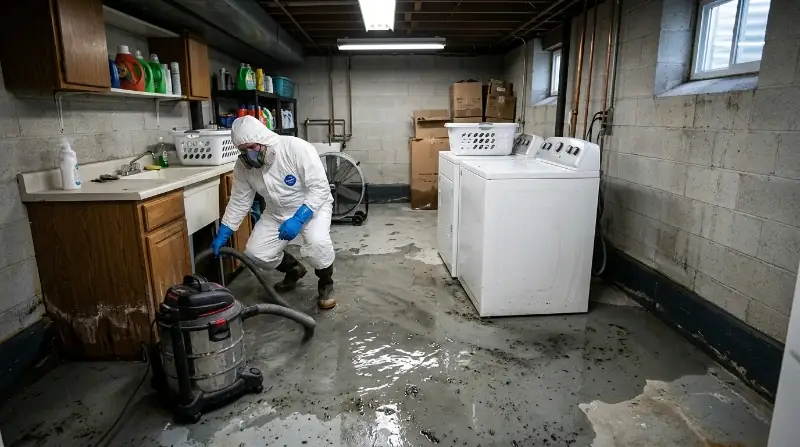
Our response to every American Fork sewer backup follows the published IICRC S500 and S520 framework: stop all plumbing use immediately and call (877) 394-0234. If it is spring and you suspect canyon snowmelt surcharge, check with immediate neighbors and tell us when you call — we report and document the event with American Fork City Public Works. Our IICRC crew arrives in 1–3 hours with truck-mounted extraction equipment. Full PPE and negative air pressure containment are established before extraction begins — American Fork Creek corridor properties may require additional dewatering steps for elevated groundwater conditions. Industrial sewage extraction follows, with biohazardous waste manifested per EPA standards. All porous material removal and documentation per IICRC S500. EPA-registered antimicrobials applied, HEPA air scrubbing, and written clearance testing before reconstruction. Full IICRC S500 process →
Our Certified Technicians Serving American Fork 84003
Marcus R. Webb, Lead Restoration Technician, holds IICRC Water Restoration Technician (WRT) and Applied Microbial Remediation Technician (AMRT) certifications. Marcus leads our Category 3 response across all American Fork neighborhoods — historic downtown, east bench, and canyon-mouth zones — and has specific experience with the plaster-lath removal requirements common in historic AF homes. His AMRT certification covers the microbial contamination assessment and remediation protocols required when the 24–48 hour mold window has passed before cleanup begins.
Dana L. Sorenson, Lead Field Technician, holds IICRC WRT certification and leads extraction and material removal in American Fork. Dana's field experience includes American Fork Creek corridor properties with elevated spring groundwater — conditions that require additional dewatering equipment and modified extraction protocols to achieve the dry standard required for clearance under IICRC S500.