
Pleasant Grove ZIP 84062 — Utah County's Historic Infrastructure Problem
Pleasant Grove is one of the oldest incorporated cities in Utah County — platted in 1851 — and its historic downtown on the State Street / Center Street grid still runs on clay sewer laterals from the 1920s and 1940s. When those 80–100-year-old pipes fail under a cottonwood-shaded lot, the backup is Category 3 black water: raw sewage in your basement, contaminating carpet, drywall, and framing in minutes. No extra charge for weekends or holidays.
Pleasant Grove, Utah (ZIP 84062) sits at the base of Mount Timpanogos's western foothills, roughly 35 miles south of Salt Lake City in north-central Utah County. With approximately 40,000 residents and an incorporated history dating to 1851 — making it one of the oldest continuously inhabited municipalities in the state — Pleasant Grove carries more genuine historical depth than most Utah County cities, and that history shows up most clearly in what runs underneath its streets. Pleasant Grove is covered by the same team that runs sewage backup cleanup in Provo, under the same written-estimate-first policy.
The downtown core — bounded roughly by State Street, Center Street, 200 North, and 400 East — contains some of the original residential development from the late pioneer era. While most of the actual pipe has been replaced over the decades, a significant portion of the historic district, particularly east of State Street and south of Center Street, still relies on clay sewer laterals installed between approximately 1920 and 1945. These are the oldest residential sewer laterals in Utah County outside of Provo's downtown core, and they are operating 80–100 years past their installation date.
Outside the historic core, Pleasant Grove's development pattern spans multiple eras: 1950s–1970s ranch homes in the central and southern sections, 1980s–1990s tract homes in the northeast quadrant, and 2000s infill throughout. Each era has its own pipe characteristic, but the historic district's clay infrastructure represents the city's most acute backup risk because it is the oldest, the most root-infiltrated, and the least likely to have been scoped or maintained in recent decades.
The Mount Timpanogos Drainage Effect — Why Spring Is Pleasant Grove's Most Dangerous Season
Pleasant Grove sits at the base of the western drainage zone of Mount Timpanogos, Utah's second-highest peak. The mountain's western face generates significant snowpack during normal Utah winters — measured in hundreds of inches of snow water equivalent in above-average years. When that snowpack begins melting in late February and continues through April, the drainage pattern funnels enormous volumes of water westward and downslope through the Pleasant Grove bench areas.
The practical effect on Pleasant Grove's sewer system is inflow and infiltration (I/I) at a scale that exceeds most other Utah County cities. The Timpanogos snowpack drainage, combined with the shallow groundwater table that forms under the bench neighborhoods in wet springs, creates conditions where even properly maintained laterals experience infiltration through minor joint imperfections. For the historic district's 1920s–1940s clay pipe — which has had eight or nine decades to crack, settle, and accumulate root intrusion — peak snowmelt months are when backups cluster. Neighboring Lindon sits on the same Timpanogos drainage and sees the same spring pattern.
The February through April window is the period when Pleasant Grove sees its highest concentration of sewer backup calls. Pleasant Grove City's sewer main in the historic district is typically running at elevated capacity during this period. When both the main and the lateral are stressed simultaneously — main running high, lateral partially blocked by roots — the overflow goes backward through the lateral and into the lowest fixture in the house. If you have a basement in a pre-1960 Pleasant Grove home and you have not experienced a spring backup in the last several years, it is statistically more likely that you have not had a backup yet than that your pipe is in good condition.
The Hill Neighborhood — Long Laterals, Elevation Changes, and Sediment Accumulation
Pleasant Grove's "The Hill" neighborhood — the residential area above 800 North, climbing the Timpanogos foothills east of the city core — presents a distinct failure pattern from the historic downtown. Properties here sit on steeper lots with longer lateral runs: 80–120 feet from the house to the city main is common, compared to 40–60 feet in flatter central Pleasant Grove. Longer laterals have more opportunities for grade inconsistency — a section of pipe that does not maintain a consistent downslope and instead levels out or dips slightly creates a low point where solids accumulate.
These low points, called "bellies" or "sags" in the pipe, collect every piece of solid material that passes through — coffee grounds, tissue paper fragments, grease, sediment — until the accumulation reduces the effective pipe diameter enough to cause a blockage. In flatter-grade pipe, a belly is detectable only by camera scope; it produces no warning signs until the blockage is near-complete. Homes in The Hill neighborhood with long, steep-then-flat lateral runs are particularly susceptible to this failure mode.
The elevation changes in The Hill neighborhood also affect excavation costs when repair is required. A lateral failure at 80 feet depth on a steep lot may require excavation through landscape rock, terracing material, or concrete retaining walls — all of which add to the repair cost beyond the pipe replacement itself. Our post-cleanup documentation includes a recommendation for lateral camera scope and flags the specific concerns that would affect excavation cost in your property's specific topographic situation.
Cottonwood and Silver Maple Root Intrusion — Pleasant Grove's Canopy Problem
Pleasant Grove has one of the most developed urban tree canopies in Utah County. The city's historic residential streets — particularly along Center Street, 100 East, 200 East, and the residential blocks in the State Street corridor — are lined with mature cottonwood trees and silver maples that were planted in the 1930s through 1960s to provide shade and community character. These trees are beautiful. Their roots are the single largest contributor to sewer lateral failures in Pleasant Grove's historic districts.
Cottonwood trees (Populus deltoides and related species) have aggressive, water-seeking root systems that can extend 30–40 feet from the trunk base in search of moisture. A cottonwood tree planted 10 feet from the property line in 1945 has root mass that extended to the street and beyond by the 1970s. Those roots found the moisture in the clay lateral joints — the oakum-sealed bell connections that wick water from inside the pipe — decades ago. By now, root systems that initially threaded through a 1/16-inch crack have expanded to fill significant pipe diameter and create chronic partial blockages that worsen each growing season.
Silver maples (Acer saccharinum) planted as street trees in Pleasant Grove's midcentury development have a similar problem: aggressive surface root systems that seek water along utility corridors. Any clay lateral within 25 feet of a mature silver maple in Pleasant Grove is a root intrusion candidate. Annual root cutting via hydro-jetting can extend a clay lateral's service life, but it does not solve the underlying joint integrity problem — it only clears the current root mass while new growth begins immediately.
The only permanent solution to root intrusion in a clay lateral is pipe relining (cured-in-place pipe / CIPP) or full replacement. A camera scope ($200–$400) is the first step to determine which intervention is appropriate for your specific pipe condition.
ADU Conversions Adding Load to Undersized Laterals
Pleasant Grove's 1950s–1970s residential stock has seen significant accessory dwelling unit (ADU) conversion activity over the past decade. Homeowners have converted garages, basements, and attached spaces into separate rentable units, adding kitchens, bathrooms, and laundry hookups without upgrading the service lateral. The original 4-inch clay or early PVC lateral designed for a family of four is now carrying waste from two separate households — potentially 8–10 occupants total — including the additional load from a second kitchen sink, laundry machine, and bathroom set.
The math is unfavorable. A standard 4-inch lateral carries a maximum design flow of approximately 200 gallons per day for a single-family home. An ADU conversion adds 80–120 gallons per day of additional flow, pushing the lateral to or beyond its design capacity during peak morning and evening usage hours. When a root intrusion point or sediment belly is already reducing effective pipe diameter, the additional ADU load is frequently what tips a slow drain into a full backup event.
Under Pleasant Grove's sewer rules, the property owner is responsible for the lateral from the city main to the foundation. If an ADU conversion's additional plumbing load contributes to a backup event, the property owner bears the cleanup cost. We document the source and contributing factors of every backup we respond to — this documentation is relevant both for insurance purposes and for the plumbing permit compliance history of the property.
Pleasant Grove Sewer Rules — Your Lateral, Your Responsibility
Pleasant Grove's sewer rules assign full maintenance and financial responsibility for the sewer service lateral to the property owner. This means from the city's main line — which runs under the public right-of-way — all the way to the foundation wall of your home is your pipe and your cost when it fails. Pleasant Grove City is not responsible for backup cleanup, lateral repair, or excavation costs unless a documented main line failure caused the backup.
If you suspect a city main event — multiple properties backing up simultaneously, or a backup that occurs immediately after heavy rain or snowmelt when no individual lateral failure pattern is present — we report it to Pleasant Grove City Public Works before cleanup begins. Their response team can scope the main and document whether the event originated in the city's infrastructure. This documentation is essential if you intend to pursue a claim against the city for damage to your property.
For the vast majority of Pleasant Grove backups, particularly those in the historic district and The Hill neighborhood, the failure is in the private lateral. Our IICRC crew identifies and documents the origin of every backup event as part of the initial scope and provides that documentation to the homeowner for insurance and repair planning purposes.
Insurance Reality for Pleasant Grove Homeowners — HO-3 Exclusions
Standard homeowner's insurance policies in Utah — the HO-3 policy form used by most carriers — exclude sewer and drain backup from their base coverage. This means a $7,000–$12,000 cleanup bill from a historic district basement backup is entirely out-of-pocket unless the homeowner added a sewer backup endorsement rider at policy inception or renewal.
A sewer backup endorsement costs $40–$250 per year depending on coverage limit and carrier. Coverage limits typically range from $5,000 to $25,000. For a Pleasant Grove homeowner with an older home in the historic district — where the probability of a lateral backup in any given 5-year period is meaningfully higher than average — a backup endorsement is one of the highest-value optional coverages available. We provide the full insurance documentation package required for any claim: moisture readings, contamination logs, material removal manifest, photos, and itemized cost breakdown — all formatted to match your insurer's claim requirements from the moment we arrive on site.
Pleasant Grove Sewer Backup Cleanup — Cost Ranges
| Pleasant Grove Scenario | Typical Range |
|---|---|
| Unfinished basement, 200 sq ft, clay lateral event | $1,500 – $3,500 |
| Finished basement, 300–400 sq ft, carpet and drywall | $4,500 – $8,500 |
| Finished basement, 500 sq ft (real documented case) | ~$7,300 |
| Historic district home with crawl space involvement | $5,000 – $11,000 |
| ADU conversion, dual-household backup, full demo | $8,000 – $16,000+ |
Estimates based on IICRC S500 scope requirements for the Pleasant Grove market. Use the free calculator for a specific estimate →
Neighboring American Fork shares Pleasant Grove's mix of historic downtown laterals and Timpanogos snowmelt, so the two cities tend to see backups in the same weeks each spring.
Frequently Asked Questions — Pleasant Grove, Utah Sewer Backup Cleanup
How fast can you respond to sewer backup in Pleasant Grove Utah?
We respond to Pleasant Grove sewer backup emergencies in 1–3 hours, 24/7 including weekends and holidays. We cover all of ZIP 84062, from historic downtown to The Hill neighborhood. Call (877) 394-0234.
Why does my Pleasant Grove home keep backing up?
Pleasant Grove's historic districts still have clay sewer laterals from the 1920s–1940s — the oldest in Utah County outside Provo. Cottonwood and silver maple root intrusion is severe in these neighborhoods. Converted ADU garages also add toilet/laundry loads that overwhelm 4-inch laterals built for single-family use. A camera scope ($200–$400) will identify whether you need root cutting, relining, or full replacement.
What should I remove after sewer backup in Pleasant Grove?
Per IICRC S500/S520 protocol: carpet and pad must always go (they cannot be decontaminated). Drywall up to at least 12–24 inches above the wet line must be cut and removed. Upholstered furniture is biohazard waste. Solid wood furniture, tile floors, and metal appliances can often be salvaged with proper antimicrobial treatment. Call (877) 394-0234 — our technician will walk you through it.
Does Pleasant Grove City cover sewer backup cleanup costs?
No. Pleasant Grove's sewer rules place the service lateral from the city main to your foundation fully within the homeowner's responsibility. The city only maintains the main sewer line. Your homeowner's insurance (HO-3) may cover backup with a rider, but standard policies exclude it. Call (877) 394-0234 for a free estimate and insurance documentation package.
IICRC S500/S520 Process — Pleasant Grove Response
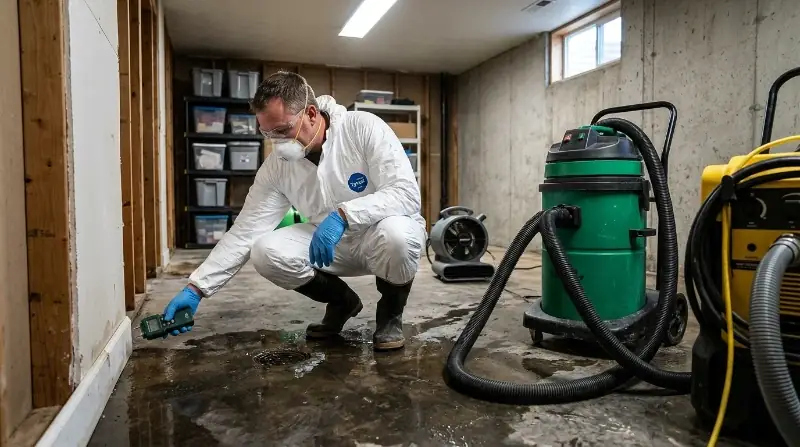
Every Pleasant Grove sewer backup call follows the IICRC S500 framework without exception. Our crew stops the source, establishes PPE and negative-air containment, extracts all sewage with truck-mounted industrial equipment, manifests biohazardous waste for EPA-compliant disposal, removes all porous materials per IICRC S500 contamination categorization with full written documentation, applies EPA-registered antimicrobials per IICRC S520, runs HEPA air scrubbers, and provides written clearance before reconstruction begins. There are no shortcuts for Category 3 water contamination — the IICRC standard is the floor, not the ceiling. Full IICRC S500 process details →