
The Short Answer: Days to Clean, Weeks to Rebuild
For a typical basement backup, cleanup through clearance usually runs about 4 to 7 days, and rebuilding takes anywhere from a few days to several weeks. No industry standard publishes fixed phase times, so the table below shows typical ranges rather than promises. Your timeline depends on square footage, materials, and how quickly the job starts.
| Stage | Typical time |
|---|---|
| Our arrival after your call | 1–3 hours, 24/7 |
| Inspection, moisture mapping, source and category | 1–2 hours, same day |
| Extraction of standing sewage | A few hours to 1 day |
| Removal of carpet, pad, drywall, insulation | About 1 day for a typical basement |
| Cleaning and antimicrobial treatment | Same day as tear-out or the next day |
| Structural drying | About 3–5 days, longer for dense materials |
| Clearance readings and sign-off | About 1 day |
| Reconstruction | Days to several weeks |
Day One: Extraction and Tear-Out
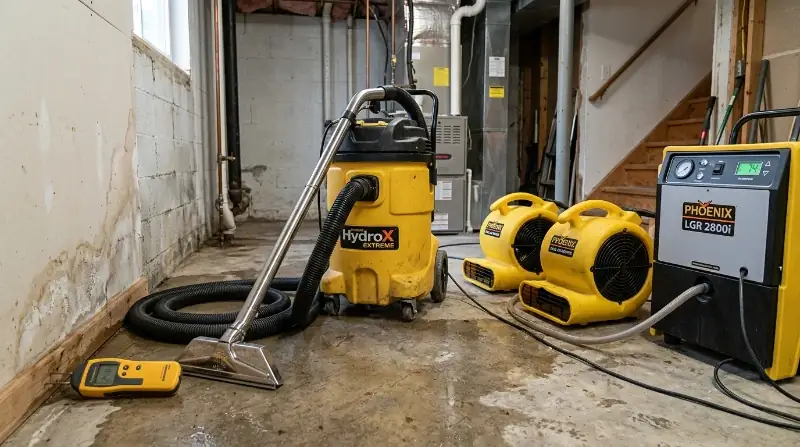
The first day does the most work. We contain the area, extract standing sewage with truck-mounted equipment, and remove porous materials the water reached: carpet and pad, drywall cut above the wet line, insulation, and particleboard. Under IICRC S500, these materials cannot be dried in place after Category 3 contact, so removal happens before drying starts, not after.
Speed on day one sets the rest of the timeline. The EPA advises drying water-damaged areas within 24–48 hours to prevent mold, and sewage that sits overnight wicks higher up walls, which means more demolition and more drying. A backup found Monday morning after starting Friday night almost always takes longer than one caught within the hour.
Why Structural Drying Takes Three to Five Days (and Sometimes More)
The "three-day drying" promise is a myth the industry itself argues against. As Canadian Underwriter put it in a myth-busting piece, quoting the S500, "three-day drying cannot be guaranteed." Drying time depends on how long materials were wet before drying began, air temperature and humidity, the temperature of the materials, and what the assembly is made of.
Wood framing is dried to a measured target, not by the calendar. The USDA Wood Handbook puts dry softwood framing around 15% moisture content and not above 19%. The S500 has restorers set the "dry standard" by comparing affected materials with unaffected materials in the same house, so a Provo basement and a Sandy basement each have their own finish line. Concrete block and plaster hold water longer than studs and need more time, sometimes with specialty equipment.
Utah Seasons and Drying: It Is Not Always Faster Here
Utah is a dry state, but that does not mean drying is always quick. NOAA normals for Salt Lake City show average relative humidity around 74% in January and 36% in July. Winter air reads humid because it is cold, and a cold basement slows evaporation. Summer and early fall are the easiest months to dry a structure.
| Season (SLC) | Average relative humidity | What it means for drying |
|---|---|---|
| Winter (Dec–Feb) | About 70–74% | Cold basements dry slowly; heat and desiccant units help |
| Spring (Mar–May) | About 49–60% | Snowmelt season; groundwater can complicate basements |
| Summer (Jun–Aug) | About 36–41% | Fastest drying; surfaces can feel dry before framing is |
| Fall (Sep–Nov) | About 46–66% | Good drying early, slowing as temperatures drop |
Equipment choice follows the season. Low-grain refrigerant (LGR) dehumidifiers handle most basement jobs, but Legend Brands notes they perform poorly below about 20% relative humidity and can freeze up in cold spaces. Desiccant dehumidifiers keep working near 0°F and are the better tool for unheated basements, crawl spaces, and dense materials. In summer the risk is the opposite: very dry outdoor air can make surfaces feel finished while subfloor and framing are still wet, which is why we go by meter readings, not touch.
Clearance: How We Decide the Job Is Done
Drying ends when moisture readings in affected materials match the dry standard taken from unaffected areas. Many restorers also use ATP surface testing to show that cleaning reduced organic residue, comparing readings before and after. ATP measures organic material, not specific pathogens, and there is no industry-wide pass number, so we report it as a before-and-after comparison rather than a single score. Only after sign-off do we close walls, because sealing damp framing is how a fixed basement turns into a mold problem a year later.
Reconstruction and Insurance: The Part That Takes Weeks
Rebuild time depends on scope and on decisions: drywall and paint in a few rooms can take days, while flooring on special order, custom cabinetry, or a permitted lateral replacement can stretch it to several weeks. Insurance can also set the pace. Under Utah Admin. Code R590-190, insurers must acknowledge a claim within 15 days and, once they have a complete proof of loss, accept or deny within 30 days or explain the delay in writing, with status letters every 45 days.
You can shorten things by calling your insurer the same day, choosing replacement flooring early, and keeping receipts for any hotel or meal costs if your policy covers loss of use. If the city main caused the backup, a written notice of claim must be filed within one year under Utah Code 63G-7-402. Our sewer backup restoration service runs cleanup and rebuild as one project, which removes the gap between two contractors.
Can You Stay in the House During Cleanup?
Often, yes, if the backup is confined to a basement you can close off and the rest of the home has working plumbing once the line is cleared. The affected area is sealed with containment and kept under negative air pressure during tear-out. It is a different call for households with infants, elderly family members, or anyone with a weakened immune system, or when the only bathroom is in the affected area. We will tell you plainly on the first visit.
What Slows a Utah Sewer Backup Cleanup Down
Most delays happen before drying starts. The line has to be cleared first, because cleaning a basement while the sewer is still blocked just invites a second backup; a plumber with access to an outdoor cleanout can usually do that within hours, but a home without one may need a toilet pulled. If the blockage is in a city main or manhole, the city has to clear it, which can add a day. Septic homes wait on a pump truck.
Paperwork is the next delay. Insurers often want an adjuster to see the damage before tear-out, though you may be expected to take reasonable steps to prevent further damage. In rentals, the landlord has to approve the work. And DIY attempts with bleach or a shop vac add time, because the crew must redo the work and treat surfaces that were spread with contamination.
Weather matters too: in a runoff year, high groundwater can slow drying in basements below the water table. For cost, see the Utah County sewer backup cost guide; for local rules, see the Utah County page. Our sewer backup cleanup team in Provo starts the clock within 1–3 hours of your call.
Sewer Backup Cleanup Time: Common Questions
How long does sewer backup cleanup take?
For a typical basement, cleanup through clearance usually takes about 4–7 days: extraction and tear-out on day one, then roughly 3–5 days of drying. Rebuild is separate and can take days to weeks.
Why can drying not be guaranteed in three days?
Drying depends on how long materials were wet, temperature, humidity, and material type. Dense materials like concrete block and plaster take longer, and the S500 itself says three-day drying cannot be guaranteed.
Is drying faster in Utah because the air is dry?
In summer, often yes. In winter, Salt Lake City averages about 74% relative humidity and basements are cold, so drying can be slower without heat or desiccant equipment.
How long does a Utah insurer have to respond to my claim?
Under Utah Admin. Code R590-190, an insurer must acknowledge a claim within 15 days and decide within 30 days of a complete proof of loss, or explain in writing why it needs more time.
How long can sewage sit before mold starts?
The EPA and CDC advise drying within 24–48 hours to prevent mold. Sewage is a health hazard from the first minute, regardless of mold.
Start the Clock Early
The fastest cleanup is the one that starts first. Call (877) 394-0234 and our crew arrives in 1–3 hours, day or night, across Utah County and Salt Lake County. For what it will cost, see the Utah County sewer backup cost guide.
- Canadian Underwriter — Restoration myth busting: three-day drying
- AccuServe — Setting drying targets under the new S500
- Legend Brands — Why Use a Desiccant?
- R&R Magazine — Verification: measuring what remains (ATP)
- Climate of Salt Lake City (NOAA humidity normals)
- Utah Admin. Code R590-190-6
- Utah Admin. Code R590-190-10
- EPA — A Brief Guide to Mold, Moisture and Your Home