
In Salt Lake City, the Sewer Pipe Is Yours Up to the Main
Salt Lake City Public Utilities collects and treats wastewater for the city, but the pipe that carries it out of your house is your responsibility. Salt Lake City Code §17.48.190 says it plainly: "All building sewers, including the connection to the POTW sewer, shall be maintained by the property owner." That includes the tap where your line meets the public main, which is further than many homeowners assume.
The code also requires a cleanout "immediately at the property line" (§17.48.110), and homes too low to drain by gravity must lift their sewage with an approved pump that the owner maintains (§17.48.060). In practice, that means three things after a backup: the cleanout is the first place to look, the cost of clearing or replacing the line usually falls on the owner, and the city is responsible only when the public main itself is blocked or broken.
Salt Lake City also runs a separate stormwater utility (Code ch. 17.81), so a flooded street and a backed-up floor drain are usually two different systems. That difference decides which insurance applies, so we document it on the first visit.
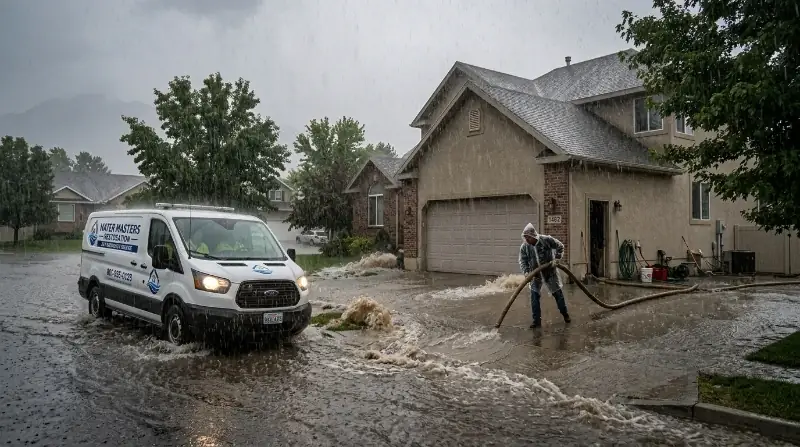
Old Homes, Old Pipe: Why Salt Lake City Basements Back Up
Census figures compiled from the American Community Survey put the median Salt Lake City home at 1965, with about 25% built before 1940 and roughly 45% before 1960. Those decades used vitrified clay and other legacy sewer pipe that is now 60 to more than 100 years old. Joints loosen, tree roots find the gaps, and a partial blockage holds until a heavy day of laundry and showers pushes sewage up the lowest drain.
- The Avenues were built mostly between 1880 and 1920; the Avenues Historic District was listed on the National Register in 1980. Mature street trees and century-old building sewers are a common combination here.
- Rose Park was built in the 1940s and 1950s as affordable brick homes for World War II veterans, reaching west to the Jordan River.
- Glendale saw most of its residential building between 1937 and 1958.
- Sugar House, established in 1853, mixes pre-war bungalows with newer infill, so two neighbors can have pipe generations apart.
Broken lines do not always announce themselves with a flood. In November 2025 the Salt Lake Tribune reported that a fractured sewer line under the Open Classroom school building in the Avenues had caused months of intermittent odor before it was found, forcing about 260 students to move to another building. A persistent sewer smell in a basement is worth a camera inspection before it becomes a backup; our sewer odor removal page explains why.
Sewage Cleanup in Salt Lake City: Sewage or Groundwater?
Salt Lake City sits on the bed of ancient Lake Bonneville, and parts of the northwest side have a high water table. When the city built its new water reclamation facility there, crews surcharged the site with 1.6 million tons of soil for about eight months because of it. West-side basements can take on water from below during wet springs, and that water is a different problem from sewage.
Water coming up evenly through a slab is usually seepage, which the IICRC S500 standard treats as Category 2. Water coming out of a floor drain, toilet, or tub, especially with debris or odor, is sewage and is Category 3, which means carpet, pad, and wet drywall are removed rather than dried. Sometimes it is both: groundwater enters a cracked pipe, the line fills, and a mix comes up the drain. We identify the source before deciding the scope, and our guide to Category 3 water damage explains how the categories work.
Spring Runoff and the 2023 Flood Emergency
On April 13, 2023, the Salt Lake County Mayor declared a flooding state of emergency, citing a "historic, record-breaking" snowpack and naming Red Butte, Emigration, City Creek, and other canyon creeks as the highest risks. A day earlier, Emigration Creek overflowed through Wasatch Hollow Park and down 1700 South and 1500 East after a steel plate blocked a culvert, and hundreds of volunteers filled sandbags. The city has been here before: in 1983, City Creek left its banks and turned downtown streets into waterways.
Runoff years matter for sewer backups in two ways. Surface water can enter basements directly, and high groundwater can infiltrate older pipe and fill it. For insurance, creek floodwater falls under flood coverage, while a backup from a clogged or failed sewer line needs a water backup endorsement. Mixing them up on a claim is one of the most common reasons we see payments delayed.
Salt Lake City's New Water Reclamation Facility
The city is replacing its 1965 treatment plant with a new water reclamation facility, a roughly $800 million project built by a Sundt and PCL joint venture and supported by a $348.6 million EPA WIFIA loan. It was driven by a state limit of 1 mg/L on phosphorus and adds nutrient removal, UV disinfection, and seismic resilience, with completion scheduled for late summer 2026.
It is a major investment, but it treats sewage after it leaves your neighborhood. It does not change the condition of the pipe between your basement and the main. A homeowner in a 1920s Avenues bungalow still has a century-old building sewer, and that is where most backups we clean start.
Sewer Backup Insurance and Warranties in Salt Lake City
A standard homeowners policy excludes sewer backup; coverage comes from a water backup endorsement, which typically adds $40–$250 a year. A 2024 KSL investigation into a Salt Lake City homeowner's denied sewer line warranty claim made a useful point: standard policies generally exclude the sewer line itself, and an insurance rider is often cheaper than a separate warranty plan. Salt Lake City Public Utilities also began offering optional sewer and water line protection plans through HomeServe in 2014; check current terms directly before relying on one.
Cleanup itself usually runs about $7–$15 per square foot. Our sewer backup cost guide breaks down the separate costs for cleanup, the plumbing repair, and the rebuild.
Sewer Backup Cleanup Salt Lake City Calls: How We Respond
We dispatch from our Provo base, about 45 miles south via I-15, and arrive within 1–3 hours, day or night, with no extra charge for nights or weekends. We serve every Salt Lake City ZIP from the Avenues (84103) and Capitol Hill to Sugar House (84106), Rose Park and Fairpark (84116), Glendale and Poplar Grove (84104), and the East Bench (84108, 84109).
On arrival we stop the source, contain the area, extract with truck-mounted equipment, remove contaminated porous materials, disinfect, and dry to a measured standard before clearance. If neighbors are backing up at the same time, tell us when you call; we report it to Salt Lake City Public Utilities and document the timing for any claim.
South of the city we cover West Valley City, Midvale, and Sandy, each on a different sewer provider, and our home base serves all of Utah County.
Repairing an Old Salt Lake City Sewer Lateral
With a median build year of 1965, many Salt Lake City homes still drain through clay or cast iron laterals. Under the city's rules the lateral, from the house to the main, belongs to the owner, so after the cleanup the repair is yours too. A camera inspection decides the method: root cutting for a sound pipe, a cured-in-place liner for cracks and offset joints, pipe bursting to pull a new pipe through a failed one, or excavation where the line has collapsed. Work in the street needs city permits and sometimes traffic control.
Salt Lake City runs its sanitary sewer separately from its storm drains, so roof drains and sump pumps must not discharge into the sewer. When a main surcharges, pressure pushes sewage into the lowest fixture, and a backwater valve on the basement line is the standard protection. Manholes let city crews reach the mains; the lateral is reached from your cleanout.
Sewage carries pathogens, so do not clean it up with a shop vac or bleach. Many Salt Lake City residents rent; tenants should report a backup to the landlord in writing. Our sewer backup cleanup company serves the city from our Provo base.
Salt Lake City Sewer Backup Cleanup: Common Questions
Who is responsible for a sewer backup in Salt Lake City?
Under Salt Lake City Code §17.48.190, the property owner maintains the building sewer, including the connection to the city main. The city is responsible for the public main itself.
How fast can you reach a Salt Lake City home?
Our crew arrives within 1–3 hours, 24/7, across all Salt Lake City ZIP codes, with no extra charge for nights or weekends. Call (877) 394-0234.
Is water coming up through my Salt Lake City basement floor sewage?
Not always. Seepage through a slab from a high water table is usually Category 2; water from a floor drain or toilet is sewage and Category 3. We confirm the source before deciding what must be removed.
Does homeowners insurance cover sewer backup in Salt Lake City?
Only with a water backup endorsement. Standard policies exclude sewer backup, and creek or river flooding falls under separate flood coverage.
Why does my older Salt Lake City home smell like sewer?
A cracked or loose building sewer can leak gas long before it backs up. A camera inspection from the cleanout usually finds the cause.
- Salt Lake City Code §17.48.190 Maintenance Responsibility
- Salt Lake City Code §17.48.110 Cleanout Requirements
- U.S. Census QuickFacts — Salt Lake City
- Salt Lake Tribune — Sewage line break at Open Classroom (Nov 2025)
- Salt Lake County — 2023 flooding state of emergency
- Salt Lake City — 2023 flooding events
- Sundt — Modernizing a 60-year-old treatment plant (2026)
- EPA — Salt Lake City WIFIA loan fact sheet
- KSL — Insurance claim denied for sewer line (2024)