
Two Sewer Districts Serve Sandy
Sandy City is not the main sewer provider. Most of the city is served by the Sandy Suburban Improvement District, created in 1958, which maintains about 160 miles of collection lines for roughly 45,000 residents and sends wastewater to the South Valley Water Reclamation Facility in West Jordan. Southern Sandy is served by the Jordan Basin Improvement District, formerly South Valley Sewer District. The boundary does not follow ZIP codes neatly, so check your sewer bill to see which district serves your address.
Both districts place the private lateral, the pipe from your house to the main, on the owner. That means the plumbing repair after a backup is almost always yours, and cleanup is covered only if your homeowners policy has a water backup endorsement.
Sandy Suburban's Lateral Insurance Program
Sandy Suburban tried something few districts have. In October 2014 it launched a Sewer and Water Insurance Program with Prime Insurance Co., covering residential laterals up to $15,000 with no deductible. According to Underground Construction magazine, the first ten months produced 115 claims and 65 repairs averaging about $4,200, and about 99% were fixed with cured-in-place lining rather than excavation.
Two takeaways for homeowners. First, ask the district whether the program is still offered and whether your address is enrolled; we have not confirmed its current status. Second, the numbers show what a typical Sandy lateral repair looks like: a few thousand dollars and usually trenchless. That is separate from the cost of cleaning up the basement, which is what we do.
The 1970s Housing Boom and Aging Laterals
Sandy was founded in 1871 as a supply stop for Little Cottonwood Canyon silver mining and incorporated in 1893, but most of today's city came later. Census data compiled from the ACS shows about 32% of Sandy homes were built in the 1970s, the largest single decade, and about 42% before 1980, the oldest housing of any city in the south valley. The Sandy Historic District, listed on the National Register in 2007, notes the area "remained largely undeveloped until suburbanization reached it in the 1970s."
Laterals from that era are now about 50 years old. Root intrusion through joints, offset sections, and early plastic pipe that has deformed are the usual causes, and mature trees planted when the subdivisions were new are now big enough to find every gap. A camera inspection before a backup, especially if drains are slowing or a basement smells of sewer, is far cheaper than the cleanup after one.
When a Water Main Breaks the Sewer: Silver Sage, 2024
Backups do not always start in the sewer. In February 2024, KUTV reported that a water main break in Sandy's Silver Sage neighborhood led to a sewer line break and a sinkhole that grew to about 20 feet, cutting water to about 35 homes; one home had minor flood damage. Pressurized water undermining the ground around a sewer line is a reminder that clean water and sewage problems can arrive together.
When they do, we sort out which water is which. Clean water from a supply break starts as Category 1; once it mixes with sewage it is treated as Category 3, and the cleanup and removal follow the stricter standard. Our Category 3 guide explains how that works.
Creek Flooding and Sewage Cleanup in Sandy
On May 31, 2023, Sandy declared a flood emergency as record snowmelt swelled Little Cottonwood Creek, after more than a month of mitigation work. Creek water entering a basement is floodwater, generally covered by flood insurance rather than a sewer backup endorsement, while high runoff can also surcharge older sewer pipe. We record the source and category on the first visit so the claim is filed correctly.
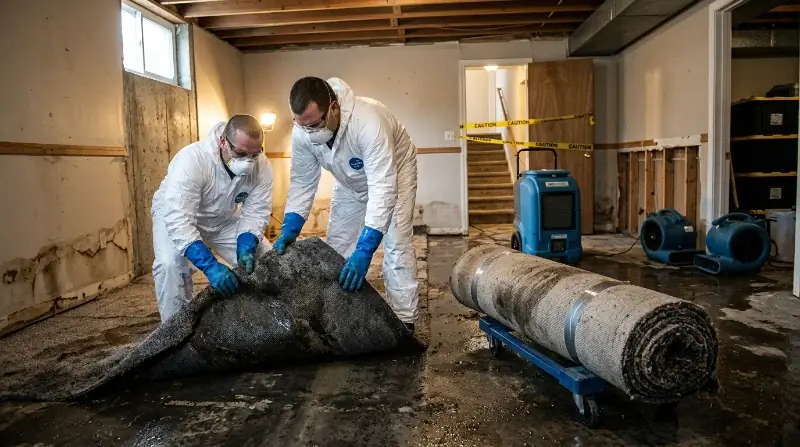
On a sewage job we contain the area, extract with truck-mounted equipment, remove carpet, pad, wet drywall, and insulation, disinfect with EPA-registered antimicrobials, and dry to a measured standard before clearance.
Inside a 1970s Sandy Sewer Line
A Sandy home built in the 1970s may have a clay, cast iron, or early plastic lateral. All three age differently: clay joints let roots in, cast iron corrodes from the inside, and early plastic can crack. Groundwater infiltrates through the same gaps, adding flow to the gravity sanitary sewer during wet springs. Many homes of this age also lack an outdoor cleanout; adding one makes every future clearing and inspection cheaper.
Who pays depends on location. The owner is responsible for the lateral; the district maintains the mains and manholes. If several neighbors back up at once, the main is the likely cause, so report it to your district right away. Sandy's storm drains are separate from the sanitary sewer, so sump and roof water belong outside. A backwater valve on the lowest drain stops a surcharged main from pushing sewage into the basement.
Sewage carries health hazards, so stop water use, keep the room closed, and avoid DIY cleanup with bleach. Renters should notify the owner in writing. Our sewer backup cleanup crew handles Sandy calls 24/7.
Our Sandy Response
Sandy is about 31 miles north of our Provo base, and our crew arrives in 1–3 hours, 24/7, across 84070, 84092, 84093, and 84094, from the historic district along State Street to the east bench neighborhoods near the Wasatch foothills. No extra charge for nights or weekends. For what to expect on cost, see the sewer backup cost guide.
Sandy sits between Midvale and Draper, and we serve both, along with the rest of the south valley.
Sandy Sewer Backup Cleanup: Common Questions
Who is my sewer provider in Sandy?
Most of Sandy is served by Sandy Suburban Improvement District; southern Sandy is served by Jordan Basin Improvement District. Your sewer bill shows which.
How much does a Sandy sewer lateral repair cost?
Under Sandy Suburban's 2014 insurance program, early repairs averaged about $4,200, and most used trenchless lining. Cleanup of the basement is a separate cost.
Why do older Sandy homes get sewer backups?
About a third of Sandy homes date to the 1970s. Their laterals are about 50 years old, and tree roots, offsets and deformed pipe are common causes.
Does insurance cover a Sandy sewer backup?
Only with a water backup endorsement. Creek or surface flooding falls under flood insurance instead.
How fast can you reach Sandy?
Our crew arrives within 1–3 hours, 24/7, in all Sandy ZIP codes. Call (877) 394-0234.
- UASD — Sandy Suburban Improvement District
- Jordan Basin Improvement District — History
- Underground Construction — Community funding for lateral repair (2015)
- U.S. Census QuickFacts — Sandy
- Sandy Historic District
- KUTV — Sinkhole in Sandy after sewer line burst (2024)
- Salt Lake Tribune — Sandy declares state of emergency (2023)