
Why Joaquin Has Unique Sewer Backup Risk
Joaquin is one of the higher-risk sewer backup neighborhoods in Provo, based on its housing age and concentration of original clay laterals. Pre-1980 clay and cast iron laterals dominate this area — joints sealed with oakum and lead, both of which deteriorate after 50+ years. Dense BYU rental housing means any main line event affects 8–12 units simultaneously. March snowmelt surge hits Joaquin floor drains first due to proximity to the city main corridor along Center Street. Joaquin is one of the highest-frequency sewer backup neighborhoods in Provo based on housing age and pipe material concentration. Our office on 100 West is a short drive from Joaquin, so this is home ground for our Provo sewer backup cleanup crew.
Pipe Age and Infrastructure in Joaquin
Most Joaquin homes were built between 1940 and 1975. Laterals from this era are vitrified clay — brittle, root-susceptible, and joint-degraded after five decades of Lake Bonneville soil expansion. Tree root intrusion through cracked clay joints is the single leading cause of backup in Joaquin. Any Joaquin home built before 1980 that has not had a sewer camera inspection is operating on borrowed time.
Frequently Asked Questions
How fast can you respond to a sewer backup in Joaquin, Provo?
Joaquin is one of the closest neighborhoods to our 100 West office, so our crew is typically there well inside the 1–3 hour window, any hour of the day or night. No extra charge for nights, weekends, or holidays. Call (877) 394-0234 for immediate dispatch.
What causes sewer backups in Joaquin?
Joaquin is one of the higher-risk sewer backup neighborhoods in Provo because of its housing age and original clay laterals. Pre-1980 clay and cast iron laterals dominate — joints degrade after 50+ years. Dense BYU rental housing means any main line event affects multiple units simultaneously. March snowmelt surge hits Joaquin floor drains first due to proximity to the Center Street main corridor. Call (877) 394-0234 immediately — every hour of delay increases cost and health risk.
Does homeowners insurance cover sewer backup cleanup in Joaquin?
Usually not under a standard Utah HO-3 policy — sewer backup needs its own endorsement, typically $40–$250 a year for $5,000–$25,000 of coverage. Many Joaquin homes are rentals, so check whether the owner's landlord policy or your renters policy carries that endorsement. We document everything from hour one for whichever claim applies.
What is IICRC Category 3 sewage cleanup?
Category 3 is the IICRC S500 name for grossly contaminated water — raw sewage carrying E. coli, Norovirus, Hepatitis A, and Giardia (CDC). In an older Joaquin basement that usually means carpet, pad, and the lower drywall come out; nothing porous that touched it can be dried in place.
An Illustrative Joaquin Backup Scenario
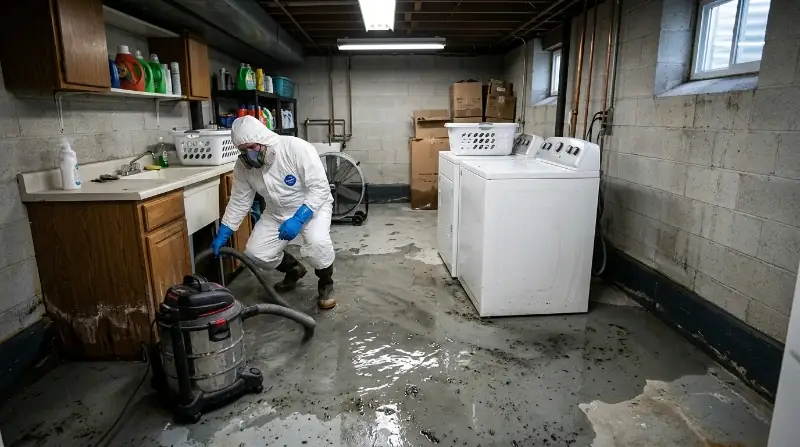
11 PM on a Tuesday in March. A homeowner on 500 North — a 1962 duplex converted to student housing — calls because sewage is backing up through both first-floor toilets. The main line serving that block has backed up before. The clay lateral is the original 1962 installation. By arrival: 2 inches of Category 3 sewage across 340 square feet of finished basement. Root blockage in the lateral at the 28-foot mark. City main is clear. Cleanup cost: in the $4,500–$8,000 range for extraction, demo, decontamination, and drying — typical for a finished basement lateral event of this scope. Lateral repair: separate plumber contract, same week. Actual costs vary with square footage, materials affected, and contamination level — this example is illustrative, not a quote.
Highest-Risk Streets in Joaquin
400–600 North between University Avenue and 300 East concentrates 1940s–1960s housing with original clay laterals and high rental conversion rates. The 200–400 East corridor between Center Street and 500 North has some of the oldest housing in the neighborhood, where original laterals are less likely to have been camera-inspected or replaced. Homes on Center Street between 100 and 400 East sit low in the neighborhood's gravity-flow system — lower-elevation connections are typically the first to see backflow when a main surges.
Seasonal Backup Risk in Joaquin
Peak risk: March–April — Wasatch snowmelt drives the Provo City main line over capacity, pushing sewage back through the weakest laterals in the system. Joaquin's pre-1980 clay pipes are first to back up when system pressure spikes. August is Joaquin's second peak — BYU fall semester return adds 33,000 people to the corridor in 2–3 weeks, spiking sewage load beyond design capacity.
Provo City Code §10.03.060 and Joaquin Homeowners
The Provo City main line runs through the Center Street corridor — directly through Joaquin's core. Under Provo City Code §10.03.060, once sewage enters your lateral from that main, cleanup is your responsibility. If multiple homes on your block are backing up at once, tell us when you call — we report it to Provo City 311 immediately, which documents main line involvement for insurance purposes.
Our IICRC S500 Cleanup Process
In Joaquin the lateral is usually already compromised by roots or a cracked clay joint, so we contain the area first, then run industrial extraction, pull out every porous material the sewage reached, decontaminate to AMRT standard, dry to a measured target, and test before we sign off. How sewage cleanup in Provo works, step by step →
Cleanup Cost in Joaquin
Joaquin basements are often older and partly finished, which keeps most jobs inside the usual Provo range of $2,000–$10,000 ($7–$15 per square foot). Rental duplexes can run higher when two units share one failed lateral. Speed matters most: a call within 6 hours can cost half what a 24-hour-old backup does. Use the free cost calculator for a specific estimate →