
Lehi Utah ZIP 84043: A Dual-Infrastructure City with Two Distinct Sewer Failure Patterns
Lehi is one of Utah's fastest-growing cities and home to Silicon Slopes, yet its sewer infrastructure spans two completely different eras. Old Town Lehi runs on 1940s clay laterals with oakum-lead joints past their service life, while the tech corridor has rapid-development PVC with trench compaction issues.
Lehi (population approximately 90,000 as of 2025) is simultaneously one of the state's oldest settled communities and its fastest-growing tech hub. The city contains two infrastructure realities that rarely appear together — and each carries its own sewer backup risk profile. Understanding which zone your property sits in is the first step toward preventing or responding to a backup event. Lehi calls run out of our Provo office, staffed by the same technicians who handle sewer backups in Provo.
Old Town Lehi centers on the Main Street grid and the 300–500 North corridor. These neighborhoods date to the 1940s and 1950s, when Lehi was an agricultural community. The sewer laterals installed here were vitrified clay pipe with oakum-packed lead joints — the same material found in aging sections of downtown Provo and Salt Lake City. The Silicon Slopes zone — roughly the area from 2000 West out to the I-15 tech corridor — is entirely new construction from 2010 to 2025. The Adobe, Microsoft, and Ancestry campuses anchor this zone, and the surrounding residential development grew rapidly to house the workforce. New PVC pipe runs everywhere here. Different pipes, different failure modes, same result when things go wrong.
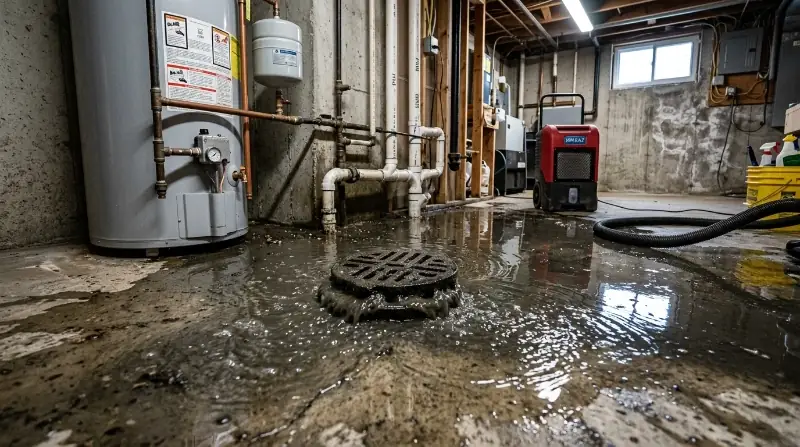
Old Town Lehi: 1940s Clay Pipe and the Jordan River Groundwater Factor
The Main Street corridor and surrounding grid in Old Town Lehi are among the most interesting failure environments in Utah County. The sewer laterals here were installed during the same era as the oldest Provo infrastructure — vitrified clay pipe with lead-oakum bell-and-spigot joints. A properly maintained clay lateral in stable soil can last 80–100 years. But two conditions in Old Town Lehi accelerate failure: root intrusion from mature landscaping, and Jordan River corridor groundwater.
Lehi sits at the north end of Utah Valley, where the Jordan River originates from Utah Lake at its outlet at the north end of the valley. Spring snowmelt raises the groundwater table throughout west Lehi — particularly within the Jordan River floodplain and the lower elevation portions of Old Town. When groundwater rises to within a few feet of the sewer lateral elevation, two things happen. First, inflow and infiltration (I/I) enters the pipe through joint cracks and adds volume to the city main. Second, reverse hydrostatic pressure can push water backward through a partially blocked lateral.
City main upgrades address the public pipe — not the individual service laterals branching off from it to each property. Properties on the side streets running off Main Street between 100 South and 500 North remain on original 1940s clay laterals. These are the properties most vulnerable to root intrusion, joint offset, and spring I/I surcharging.
Silicon Slopes: New Pipe, New Problems — The Trench Compaction Issue
The Silicon Slopes residential developments — the subdivisions and mixed-use zones that grew alongside the tech campuses — present a different but equally real risk. The pipes here are modern Schedule 40 PVC, installed correctly per spec in most cases. The problem is in what happens after the pipe goes in the ground.
High-density development in Silicon Slopes introduced a condition not commonly seen in residential neighborhoods: heavy foundation loads from large office and commercial buildings installed adjacent to residential sewer lines. When a tech campus excavates and pours a foundation within 20–30 feet of a residential sewer trench, the surcharge load on the surrounding soil can compact trench backfill unevenly — even if the original compaction was done correctly. The result is differential settlement: the pipe settles faster in one section than another, creating joint deflection and the beginnings of a belly or sag in the line.
Additionally, the sheer pace of Silicon Slopes residential development created production pressure on utility contractors. Fast construction schedules mean trench backfill sometimes went in without the required 6-inch lift compaction. Homeowners who purchased Silicon Slopes homes built between 2012 and 2022 should note that pipe deflection from trench settlement typically takes 3–7 years to develop into a backup event. If your home was built in 2016 and you are now experiencing slow drains, the timeline is consistent with early deflection failure. A camera scope ($200–$400) will confirm it before the backup occurs.
Lehi Sewer Rules — What Every Lehi Homeowner Must Know
Under Lehi's sewer rules, the service lateral connecting your home to the city's public sewer main is your property and your financial responsibility — for both maintenance and repair. The city maintains the public main under the street; you maintain everything from the main connection to your foundation. This distinction matters enormously when a backup occurs.
If the backup was caused by a city main blockage or surcharge — something that can be documented through Lehi City Public Works — you may have a claim against the city for property damage. However, the cleanup of sewage inside your home remains your immediate responsibility regardless of cause. We coordinate with Lehi City on your behalf when a main event appears to have contributed, providing documentation of your call times, arrival times, and remediation scope for any city claim process. If your lateral caused the backup (root intrusion, deflection, offset), the repair and cleanup are entirely your expense under Lehi's sewer rules.
What IICRC S500 Protocol Requires in Lehi Homes
Raw sewage is IICRC Category 3 water — grossly contaminated with E. coli, Norovirus, Hepatitis A, and Giardia per CDC data. The S500 Standard for Professional Water Damage Restoration has a clear position: Category 3 material cannot be dried in place. All porous materials that contacted sewage must be removed, documented, and disposed of as biohazardous waste. This is not a judgment call made on site — it is the written standard that certified professionals are required to follow.
For Lehi homeowners, this means: carpet and pad are removed entirely from any affected area. Drywall up to at least 12–24 inches above the wet line is removed. Fiberglass insulation in any cavity that was wetted is removed. Particleboard or OSB subfloor that absorbed sewage is removed. What typically can be retained and cleaned: concrete slabs, ceramic tile set in thinset, painted masonry block, metal fixtures, and LVP flooring (the vinyl itself is non-porous, though the foam underlayment beneath it must go if wetted).
Lehi's average home size is approximately 3,200 square feet with full basement — larger than the Utah County average. In Old Town, basements tend to be lower-ceiling, partially finished utility spaces. In Silicon Slopes, basements are full 9-foot finished spaces with egress windows, home theater setups, and full baths. A Category 3 backup in a Silicon Slopes finished basement involves more material volume and higher cleanup costs than Old Town equivalents.
Lehi Utah Sewer Backup Cleanup — Cost Ranges
Lehi's larger homes and Silicon Slopes finished basements typically push costs toward the upper end of the range for fully finished spaces. Old Town basements — often lower ceiling, concrete floor, utility use — run considerably less.
| Scenario | Typical Range |
|---|---|
| Old Town basement, unfinished, clay lateral event | $1,500 – $3,200 |
| Old Town basement, partially finished, drywall affected | $3,500 – $6,500 |
| Silicon Slopes finished basement, 400–600 sq ft | $7,000 – $12,000 |
| Silicon Slopes large finished basement, 700+ sq ft, 9-ft ceiling | $10,000 – $16,000 |
Based on IICRC S500 scope requirements and the $7–$15/sq ft restoration benchmark for the Lehi 84043 market. Use the free calculator →
Tech-Sector Expectations — Professional Response, Not a Restoration Crew
Lehi's Silicon Slopes demographic includes Adobe, Microsoft, and Ancestry employees who approach home maintenance with the same process-orientation they bring to work. When a sewer backup occurs in a $700,000–$1,200,000 Silicon Slopes home, the homeowner's expectation is clear documentation, professional PPE, written scope, and a crew that knows what they are doing. They are not calling whoever picks up first — they are calling whoever can demonstrate IICRC certification and provide a documented process before work begins.
We meet that expectation. Marcus R. Webb (IICRC WRT and AMRT) leads our Category 3 response and can walk through the S500 protocol, the contamination classification rationale, and the material removal requirements before extraction begins. Dana L. Sorenson (IICRC WRT) leads field extraction and documents each step for the insurance and city records package we provide at job completion.
Next door, American Fork sees the same spring pattern from American Fork Canyon snowmelt, while its historic downtown still runs on older clay laterals. Our crew covers both cities from the same dispatch.
Frequently Asked Questions — Sewer Backup Cleanup Lehi Utah
Do you serve historic Old Town Lehi and Silicon Slopes?
Yes. We cover all of Lehi Utah (ZIP 84043), from the 1940s clay-pipe neighborhoods of Old Town to the 2010s–2020s Silicon Slopes tech corridor developments. Both zones have different pipe failure modes — our IICRC crew identifies the cause and begins extraction within 1–3 hours. Call (877) 394-0234.
Why do sewer backups happen in Lehi's newer Silicon Slopes homes?
Rapid development in Silicon Slopes means trench backfill is sometimes compacted too quickly, allowing PVC pipe to deflect and joints to gap within 3–7 years of installation. High-density office and residential foundations adjacent to sewer trenches add load stress. If you see slow drains in a home built 2012–2022, schedule a camera scope before the backup happens. Call (877) 394-0234.
What does sewer backup cleanup cost in Lehi Utah?
Lehi's average home (3,200 sq ft, finished basement) runs $8,000–$14,000 for a Category 3 sewer backup. Smaller areas or unfinished basements may be $1,500–$4,500. IICRC protocol determines what must be removed. Call (877) 394-0234 for a free on-site estimate.
Is Lehi City responsible for sewer backup on my property?
No. Under Lehi's sewer rules, the homeowner is responsible for the entire service lateral from the city main to the structure. The city maintains only the public main. File a scope report if you suspect main surcharge, but your lateral repair and cleanup is your expense. Call (877) 394-0234 — we provide the documentation you need for insurance and city inspection requests.
IICRC S500 Cleanup Process — Lehi Utah
Our response to every Lehi sewer backup follows the published IICRC S500 and S520 framework: stop all plumbing use immediately — in Old Town, check whether Main Street neighbors are also affected; if so, tell us when you call and we document a potential main event with Lehi City Public Works before cleanup begins. Call (877) 394-0234 for immediate dispatch. Our crew arrives in 1–3 hours with full PPE and truck-mounted extraction equipment. Negative air pressure containment is established before extraction. Industrial sewage extraction with biohazardous waste manifesting follows. Porous material removal and documentation per IICRC S500. EPA-registered antimicrobials applied, HEPA air scrubbing, written clearance testing before reconstruction. Full IICRC S500 process →